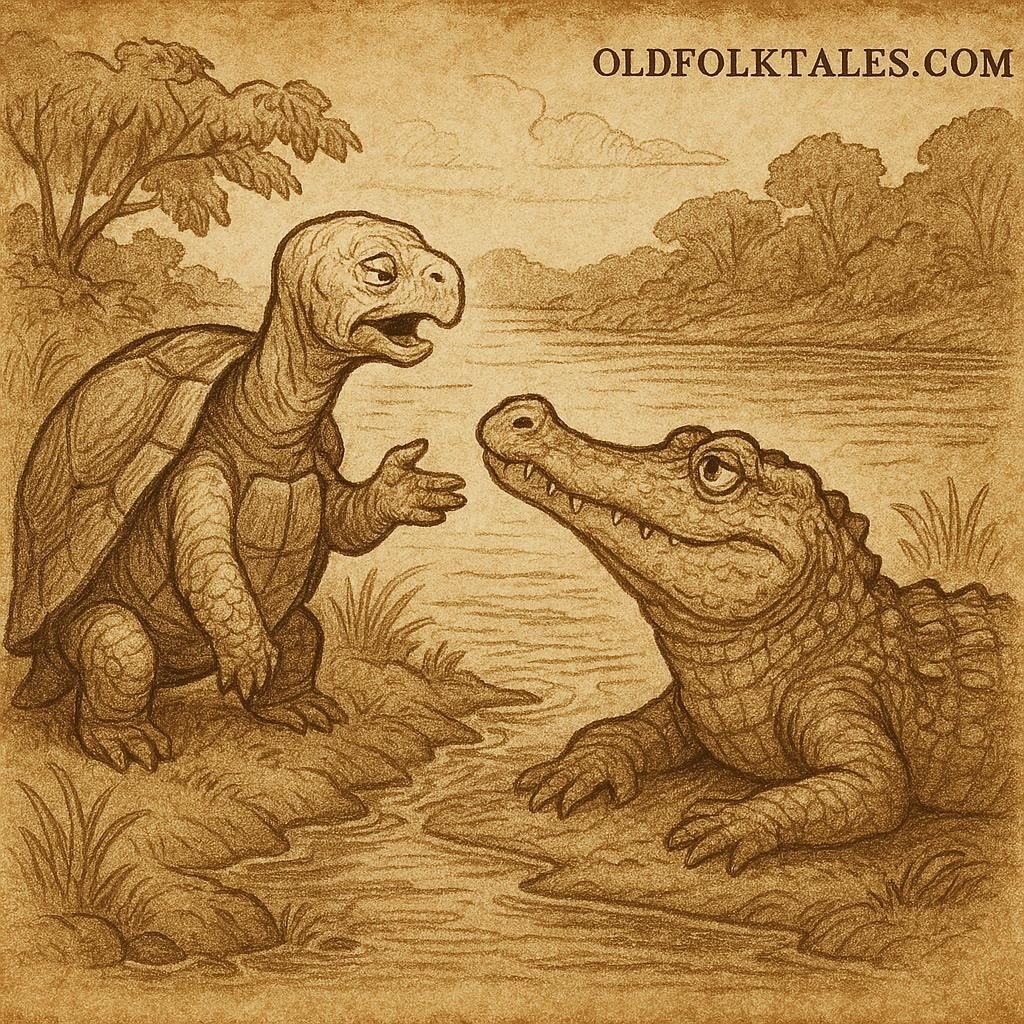
Long ago, when the great rivers of Gabon flowed quietly under the sun and the forest animals gathered at the water’s edge, the Crocodile ruled the streams. He was feared by all creatures who came to drink, for his sharp teeth and powerful tail made him the master of the waters. Yet among all the animals, there was one he had not conquered. That was the Tortoise, small and slow, but clever beyond measure.
One hot afternoon, Crocodile rested at the riverbank with his jaws wide open. Tortoise came walking slowly along the shore. The sight of the little creature stirred Crocodile’s hunger. He thought, “At last I will make a meal of this slow one, for today he cannot escape.”
When Tortoise saw Crocodile watching him with greedy eyes, he stopped at once. He knew the danger that lay before him, yet he did not tremble. Instead, he greeted Crocodile politely. “Good day, friend. How strong and mighty you look as you rest in the sun.”
READ THIS: The Crocodile’s Judgment
Crocodile laughed. “Your words are sweet, but they cannot save you. I have waited too long to taste your flesh. Today, Tortoise, you shall not escape.”
Tortoise remained calm. He slowly raised his head and said, “Friend Crocodile, do you not remember the time I saved your life? When you were caught in the fisherman’s net, who was it that bit through the ropes with patient care? Was it not I, the small one whom you now call prey?”
Crocodile frowned, for indeed he remembered. Once, when he had been trapped and sure to die, it was Tortoise who freed him. But hunger clouded his memory, and pride hardened his heart. “That may be true,” he replied, “but the river does not wait, and my belly is empty.”
Tortoise did not give up. He spoke again with wisdom. “If you eat me today, the animals of the forest will say that Crocodile forgets kindness. They will whisper that you repay good with evil. Tell me, is that the name you wish to carry along the riverbanks? Will you be feared only for your teeth, or respected also for your heart?”
The river grew quiet as Crocodile pondered these words. He was feared already, but respect was something he had never truly gained. At last he lowered his great head and sighed. “You are right, Tortoise. Strength may command fear, but wisdom wins lasting honor. From this day, I will not eat you.”
Tortoise bowed politely. “Then let peace remain between us, and may the river remember that even the smallest creature can earn respect through wisdom.”
And so it was. From that day to this, Crocodile does not eat Tortoise. The river animals tell the story to remind one another that cleverness and gratitude can overcome even the sharpest teeth.
Moral Lesson :
This tale teaches that true power is not only in strength but also in wisdom and gratitude. Tortoise was small and weak compared to Crocodile, yet he survived because he spoke with wisdom and reminded Crocodile of kindness repaid. The story reminds us that respect is earned through good deeds and fair words, and that even the strongest should never forget those who once helped them.
Knowledge Check
What is the main lesson in Why the Crocodile Does Not Eat the Tortoise?
The story teaches that wisdom, gratitude, and respect are stronger than physical power alone.How did Tortoise save Crocodile in the past?
Tortoise freed Crocodile from a fisherman’s net by patiently biting through the ropes.Why did Crocodile decide not to eat Tortoise?
Because Tortoise reminded him of past kindness and showed that respect is greater than fear.What does this folktale from Gabon suggest about leadership and power?
It suggests that true leadership is not just about strength but about fairness, memory, and gratitude.How does the story of Tortoise and Crocodile inspire community respect?
It shows that communities honor those who repay good deeds with kindness, not betrayal.What makes Why the Crocodile Does Not Eat the Tortoise an important Gabonese folktale?
It reflects the Mpongwe tribe’s belief that wisdom and gratitude are essential values for survival and respect.
Cultural Origin: Gabonese folktale (Mpongwe Tribe), recorded by Robert H. Nassau in Where Animals Talk: West African Folklore Tales (1914).