
Long ago, in the time when the world was young, famine struck the land. Food was scarce, and families struggled to survive. Among those suffering from hunger were Father Anansi, the clever yet selfish spider trickster, and his son, the dutiful Kweku Tsin.
One morning, their hunger drove them into the forest in search of something to eat. The air was heavy with silence, and every rustle of leaves seemed to carry both hope and danger. After much searching, fortune favored Kweku Tsin. With great skill and determination, he killed a fine deer. His heart swelled with relief, for this catch meant life for him and his father. Proudly, he carried the animal back to their resting place where Anansi awaited.
When Anansi saw the deer, his many eyes glistened with greedy delight. “Ah, my son,” he said slyly, “this is a great treasure indeed. Stay here and guard it well while I fetch a basket to carry it home.”
Kweku Tsin nodded dutifully, though something in his father’s tone made him uneasy. Hours passed, and still Anansi did not return. The boy grew restless, fearing that his father had lost his way. Finally, he called out into the trees, “Father! Father! Where are you?”
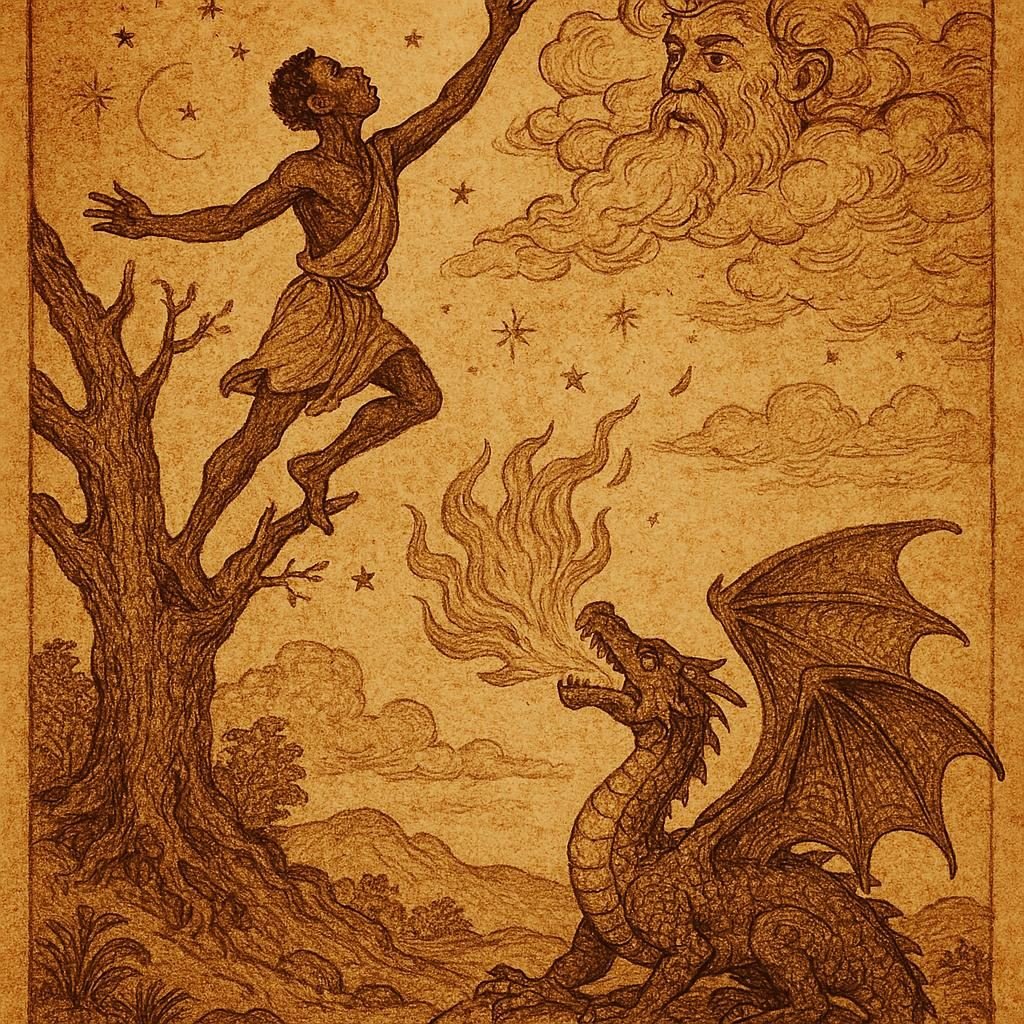
To his surprise, a voice answered, “Yes, my son.” Relieved, Kweku Tsin called again. But from behind the trees came not his father, but a terrible dragon. The creature’s eyes glowed like burning coals, and fire poured from its nostrils with each breath.
The dragon lunged toward the boy. Thinking quickly, Kweku Tsin prayed to the Sky-God for deliverance. At once, he began to rise upward, lifted toward the heavens by unseen hands. The dragon roared and pursued, its flaming breath scorching the air. Higher and higher the boy ascended, but when his hunger became unbearable, he was forced to descend to the earth for food.
Each time he returned to the ground, the dragon was waiting. Each time, the monster tried to seize him. But again and again, Kweku Tsin called upon the Sky-God, who raised him back to safety in the skies. This continued until finally, the boy could no longer risk the descent. He resolved to remain in the heavens forever.
The Sky-God, moved by Kweku Tsin’s courage and his suffering, transformed him into the Moon, placing him high above the earth to watch over it. But the boy’s face still bore the memory of hunger, giving the Moon its pale and sorrowful glow.
Yet the heavens were vast and empty, and the Moon felt lonely. To comfort him, the Sky-God called upon the stars, scattering them across the night sky to keep him company. They shone faintly, but their light was weak, for they had little strength of their own.
Meanwhile, Anansi, who had abandoned his son to danger, continued his selfish ways on earth. When he looked up at the night sky and saw the Moon and stars shining down, he realized his son had found a greater place than he ever could have given him.
But the Moon and stars remained dim, unable to shine brightly. The Sky-God therefore commanded the Sun, the giver of life and strength, to share its light with them. Each night, after the Sun set, it passed its radiance to the Moon and scattered sparks to the stars. That is why the Moon glows gently in the darkness and the stars twinkle faintly beside it, reflections of the Sun’s power.
And so, the balance of day and night was established. The Sun ruled the daytime with fiery brilliance, while the Moon and stars guarded the night with borrowed light, forever reminding mankind of Kweku Tsin’s courage and sacrifice.
Moral Lesson
This folktale teaches that courage, endurance, and faith can turn suffering into greatness. Even when abandoned, Kweku Tsin’s bravery won him a place among the eternal lights of the heavens. At the same time, it reminds us that selfishness, like Anansi’s, leads only to shame and regret.
Knowledge Check
Q1: Who are the main characters in the folktale?
The story centers on Anansi the spider, his son Kweku Tsin, a terrible dragon, and the Sky-God.
Q2: What cultural origin does this story come from?
This tale is an Ashanti folktale from Ghana, rooted in West African storytelling traditions.
Q3: Why does Kweku Tsin become the Moon?
After escaping the dragon through the Sky-God’s help, he chose to remain in the heavens, where he was transformed into the Moon.
Q4: Why do the stars shine with faint light?
The stars were placed in the sky to keep the Moon company, but their light is weak because they rely on the Sun.
Q5: What role does the Sun play in the folktale?
The Sun generously shares its light with the Moon and stars, enabling them to shine in the night sky.
Q6: What is the moral lesson of the story?
The folktale highlights courage, sacrifice, and endurance, while warning against selfishness and abandonment of loved ones.
Source: Ghanaian Folktale

