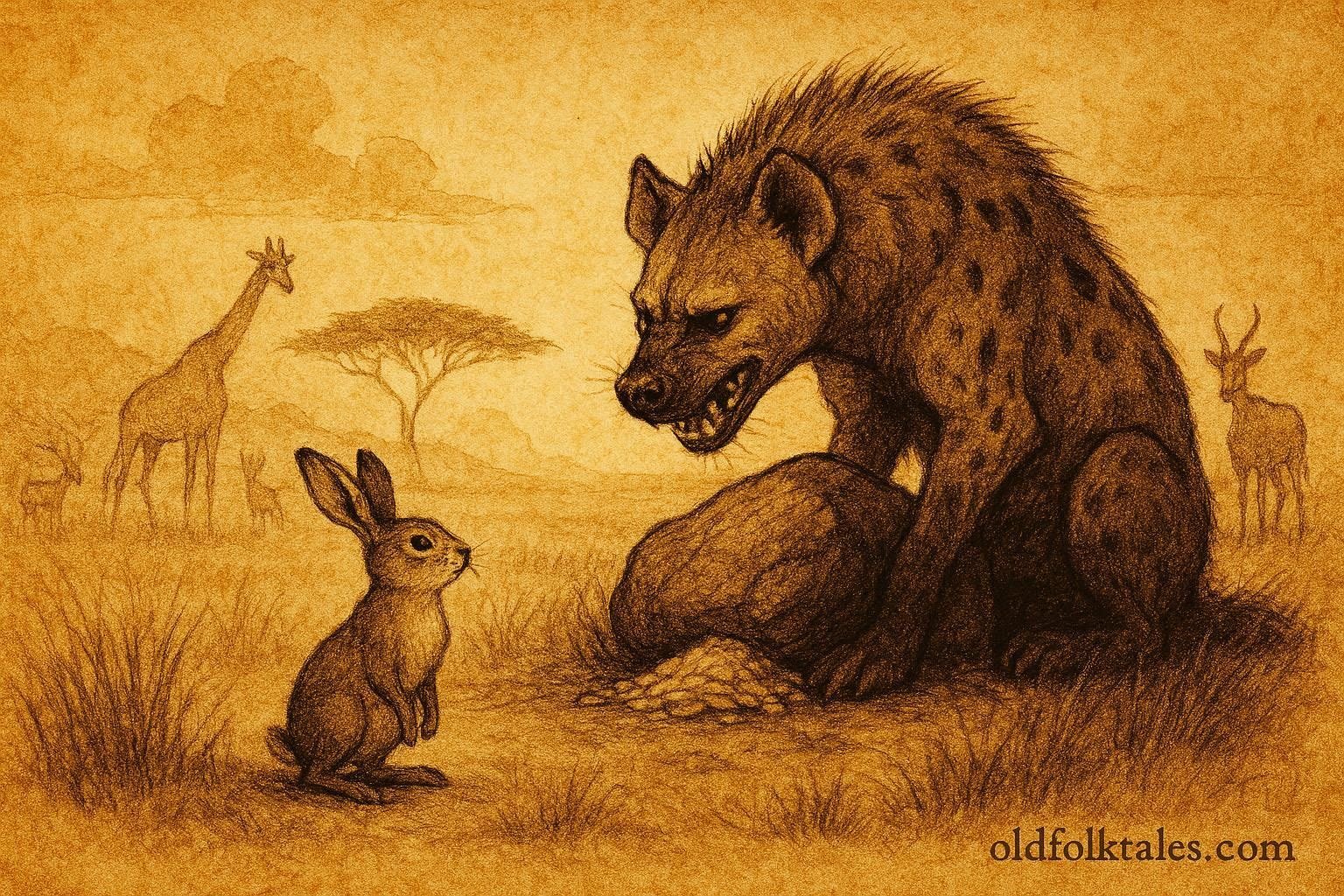
In the rolling hills and open grasslands of the Great Lakes region, where Burundi’s landscapes stretch between forests and savannah, there came a season when the earth grew thin and unkind.
The rains had failed.
If you enjoyed this story, explore our full West African folktales collection
The grasses dried out.
Food became scarce.
Animals who once roamed freely now wandered in hunger, searching longer distances for even the smallest scraps of nourishment. The forest grew quieter, not because it was empty, but because survival had tightened every voice into caution.
It was in this difficult time that two very different creatures stood out.
One was a hyena.
The other, a hare.
The hyena was strong, large, and known for its hunger that never seemed satisfied. When food was found, it was not shared. It was stored, guarded, and taken in excess whenever possible. The hyena believed that survival belonged to those who took first and asked questions later.
Greed, to the hyena, was not a flaw.
It was a strategy.
And in famine, strategy became everything.
The hare, however, was small.
Easily overlooked.
But what it lacked in strength, it made up for in thought.
The hare moved through the land quietly, observing more than it consumed. It noticed what others ignored: patterns of movement, changes in behavior, and the growing imbalance between those who had and those who had none.
Where others saw only hunger, the hare saw opportunity for balance.
And imbalance, the hare believed, could be corrected, not by force, but by wisdom.
One day, the hare discovered something important.
The hyena had found a hidden supply of food deep within the dry grasslands. Instead of sharing it or preserving it fairly, the hyena kept it alone, consuming far more than necessary while others suffered nearby.
The news of this spread quickly among the starving animals.
But none dared to confront the hyena directly.
Except the hare.
The hare did not rush in anger.
It did not challenge the hyena openly.
Instead, it waited.
Because the hare understood something the hyena did not.
Greed often exposes itself over time.
The first encounter between them was simple.
The hare approached the hyena calmly, pretending not to know anything about the hidden food.
“Brother Hyena,” the hare said politely, “you seem well-fed in a time when others struggle. How do you manage such fortune?”
The hyena lifted its head with pride.
“I am careful,” it replied. “I take what I find before others do.”
The hare nodded slowly, as if impressed.
“Ah,” it said. “Then you must be the wisest survivor among us.”
The hyena smiled at this.
It liked praise.
It mistook flattery for respect.
But the hare was not finished.
Over the following days, it continued speaking with the hyena, always carefully, always gently, planting small thoughts rather than direct accusations.
“If food is hidden too long,” the hare once said, “it spoils without benefit.”
The hyena only laughed.
“Not mine,” it replied. “I know how to keep what I have.”
Still, the idea had been planted.
Meanwhile, the other animals grew weaker.
Some began to leave the area entirely.
Others simply waited in silence, hoping for change.
The hare watched this carefully.
And then it made its move.
The hare approached the hyena again, this time with urgency in its voice.
“Brother Hyena,” it said, “there is news. A stronger predator has been seen nearby. It is searching for food, and it does not distinguish between what is yours or what is found.”
The hyena stiffened.
“Where?” it demanded.
The hare pointed vaguely toward the opposite direction.
“In the low valley. But it moves quickly.”
The hyena growled.
It became restless.
And in that moment, fear entered where greed had once lived alone.
That night, the hyena made a decision.
It would move its hidden food.
To protect it.
To secure it further.
It gathered everything and carried it to a new location deeper in the grasslands, far from its original hiding place.
What the hyena did not realize was that the hare had anticipated this.
The hare had already spoken to the starving animals.
Not to encourage theft.
But to encourage cooperation.
“We cannot survive separately,” it told them. “But we can survive together.”
It guided them toward a shared effort, small, careful gathering, mutual protection, and patient waiting.
Unlike the hyena, the hare did not hoard knowledge.
It distributed it.
When the hyena arrived at its new hiding place, exhausted from the move, it found something unexpected.
The food was still there.
But not untouched.
Signs of disturbance were visible.
And more importantly, the hare was waiting.
Not alone.
But with others behind it.
Not to attack.
But to witness.
“You have been followed,” the hare said calmly.
The hyena snarled.
“This is mine,” it declared.
The hare tilted its head.
“Is it yours because you found it,” it asked, “or because others agreed you should keep it alone?”
The hyena had no answer.
For the first time, the hyena noticed something it had ignored before.
The hunger around it was no longer just absence of food.
It was absence of trust.
The hare stepped forward slightly.
“You cannot eat what a starving land refuses to support,” it said.
The hyena growled again, but weaker this time.
Because even strength begins to lose meaning when isolation becomes complete.
The animals behind the hare did not rush forward.
They did not fight.
They simply stood.
Waiting.
Watching.
Understanding that survival did not require destruction, but correction.
The hyena looked at the food.
Then at the animals.
Then at the hare.
And for the first time, it hesitated.
Not because it was defeated by force.
But because it was confronted by consequence.
Days passed.
The hyena’s behavior changed slowly.
It did not become generous overnight.
But it began to notice something it had ignored for too long:
Food shared returned in unexpected ways.
Food hoarded disappeared in isolation.
The hare continued guiding others quietly.
Helping animals find ways to survive without conflict.
Teaching that patience and cooperation often achieved what strength alone could not.
Eventually, the hyena spoke again to the hare.
“This way of yours,” it said reluctantly, “it does not feel strong.”
The hare replied calmly.
“It does not need to feel strong,” it said. “It only needs to work.”
And in time, the land changed again.
Not through abundance.
But through balance.
Animals shared more.
Took less.
Watched each other not with suspicion, but awareness.
And the hyena, still strong, still wild, learned to survive not by taking everything, but by understanding limits.
The hare remained small.
But its influence grew quietly across the land.
Not as a ruler.
But as a reminder.
That intelligence does not always roar.
Sometimes, it listens first.
Looking for more? Explore the magic of East African folktales here
Moral Lesson
Greed isolates, but wisdom connects. True survival is not achieved through hoarding, but through balance, patience, and shared responsibility within a community.
Knowledge Check
- What is the main lesson of “The Clever Hare and the Greedy Hyena”?
The story teaches that wisdom and sharing lead to survival, while greed leads to isolation and loss. - How did the hyena behave during the famine?
The hyena hoarded food and refused to share it with others. - What strategy did the hare use against the hyena?
The hare used intelligence, patience, and persuasion rather than force. - How did the hare help the other animals?
It encouraged cooperation and shared survival strategies among the starving animals. - What caused the hyena to change its behavior?
The realization that greed led to isolation and that shared survival was more sustainable. - What cultural themes are reflected in this Great Lakes folktale?
Themes include trickster wisdom, survival, greed versus generosity, and community balance in East African oral traditions.
Source: Part of East and Central African trickster tradition, documented in East African Folktales (1972)
Cultural Origin: Burundi and neighboring Great Lakes cultures, where hare (Akanyamuneza) figures as a clever trickster