In the lush regions of Burundi near the great Lake Tanganyika, where rivers wind through valleys like living veins of the land, there once flowed a river known for its calmness.
It was not a violent river.
Want more? Read more West African folktales now
It did not rush aggressively through the earth.
Instead, it moved steadily, quiet, reliable, and generous. It watered crops, nourished soil, and carried life gently from one place to another. The people who lived along its banks trusted it deeply.
They called it a friend.
For generations, the river was respected.
Villagers performed small rituals before drawing water. They spoke blessings before washing in its flow. Elders told stories of the river spirit, an unseen presence believed to guard the balance between water and land.
The river, they believed, was not just water.
It was alive.
And it was listening.
But over time, things began to change.
New generations grew distant from old customs. The rituals became less frequent. Some stopped entirely. People began treating the river as only a resource—something to use without acknowledgment.
Waste increased along its banks.
Words of respect disappeared.
The river was still used daily, but no longer honored.
And slowly, something shifted beneath its surface.
At first, it was subtle.
The water rose slightly at night, then receded by morning.
Villagers dismissed it as seasonal change.
But then it happened again.
And again.
Each night, the river grew restless.
Its flow became stronger.
Its banks less predictable.
Until one night, it overflowed entirely.
Water rushed into homes.
Fields were submerged.
Paths disappeared beneath rising currents.
By morning, the river would calm again, but the damage remained.
This pattern continued.
Night after night.
Calm by day.
Flood by night.
The village lived in fear of sleep.
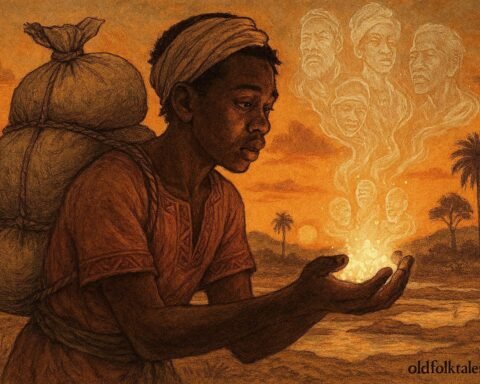
Among the villagers was a young girl known for her attentiveness.
She was not the loudest, nor the most powerful, but she noticed things others overlooked, the way elders avoided certain topics, the way older villagers looked toward the river with concern, the way the water seemed different when night fell.
She listened carefully to stories her grandmother once told about the river spirit.
And she remembered them when others did not.
One evening, after another flood had swept through the village, the girl sat quietly near the riverbank.
The water flowed normally now, as if nothing had happened.
But she did not trust its calmness.
She spoke softly into the air.
“Why do you rise when we sleep?” she asked.
At first, there was only silence.
Then, the water shifted.
Not violently.
But deliberately.
And she heard it.
A voice.
“We are not sleeping,” the river said.
The girl froze.
She looked around quickly, but there was no one else.
Only water.
Only wind.
“Who speaks?” she whispered.
“I am the river you forgot,” came the reply.
The girl did not run.
She did not deny what she heard.
Instead, she sat closer to the bank.
“What do you want?” she asked gently.
The water rippled.
“Respect,” the river answered. “You take from me without remembering me.”
The girl’s chest tightened.
She understood then that the stories were not just stories.
The river spirit was real.
And it was angry.
That night, she went to the elders.
She told them what she had heard.
At first, they were silent.
Then some shook their heads.
“Rivers do not speak,” one said.
But another elder, older and more thoughtful, looked troubled.
“There are things we forget,” he said quietly. “And things that remember us even when we do not remember them.”
Still, many villagers refused to believe her.
The floods continued.
Each night stronger than before.
The village became divided, some calling for practical solutions like barriers and diversions, others quietly remembering old rituals but unsure how to begin again.
The girl knew that neither approach alone would be enough.
Something deeper had been broken.
One night, she returned to the river alone.
The moon reflected softly on the surface, but beneath it she felt tension, like breath held too long.
“I believe you,” she said.
The water stilled slightly.
“I am listening,” the river replied.
“What must we do?” she asked.
The river’s voice was quieter now.
“Remember me,” it said. “Not as water alone. But as life that must be honored.”
The girl closed her eyes.
She thought of the old rituals her grandmother once described, offerings, words of respect, moments of pause before taking water.
Things the village had abandoned without realizing their meaning.
The next morning, she gathered the villagers again.
This time, she did not only speak.
She asked.
“What did our elders do before drawing water?”
Some were unsure.
Others remembered fragments.
Slowly, memory returned.
Small practices.
Old words.
Forgotten respect.
The girl encouraged them to begin again.
Not as punishment.
But as restoration.
At first, only a few participated.
Then more joined.
People began speaking to the river again, not as superstition, but as acknowledgment.
They stopped dumping waste into its flow.
They stood still before collecting water.
They remembered.
That night, they waited.
The river rose again.
But differently.
Not as violently as before.
Not as if it were attacking.
But as if it were listening.
The villagers stood by its banks, repeating the old words together.
Not perfectly.
But sincerely.
And then something changed.
The water slowed.
Not instantly.
But gradually.
The force that had filled the nights began to soften.
The river was still powerful.
But no longer restless.
The girl remained by the river until dawn.
When the sun rose, the water was calm.
Not empty of strength.
But balanced.
As it once had been.
The villagers understood then that the river had never been their enemy.
It had been responding.
To neglect.
To forgetting.
To imbalance.
And now, it had been heard.
From that time forward, the river was treated differently again.
Not with fear.
Not with control.
But with respect.
And the floods never returned in the same way.
The girl continued to live by the river.
And sometimes, when she stood near its edge, she would hear it softly, not in anger, but in quiet recognition.
“You remembered,” it would say.
And she would reply:
“We are learning to remember better.”
Continue your journey: Read more East African folktales
Moral Lesson
Nature responds to how it is treated. When traditions of respect are forgotten, imbalance follows, but restoration is possible through collective responsibility and renewed understanding.
Knowledge Check
- What is the main lesson of “The River That Refused to Sleep”?
The story teaches that disrespecting nature leads to consequences, but balance can be restored through collective action. - Why did the river begin flooding the village?
The river spirit was angered because people stopped performing traditional rituals and respecting the water. - How did the girl communicate with the river?
She spoke to it directly and heard its response as a spiritual voice. - What did the river demand from the villagers?
It demanded respect, remembrance of old rituals, and acknowledgment of its sacred role. - How did the village restore balance with the river?
They revived traditional water rituals and began treating the river with renewed respect. - What cultural themes are reflected in this Burundian folktale?
Themes include environmental respect, water spirit beliefs, tradition, and communal responsibility in Great Lakes cultures.
Source: Documented in Central African oral ecology narratives and river-spirit folklore compilations (1968)
Cultural Origin: Burundian communities near Lake Tanganyika and river systems, where water spirits are part of traditional belief systems