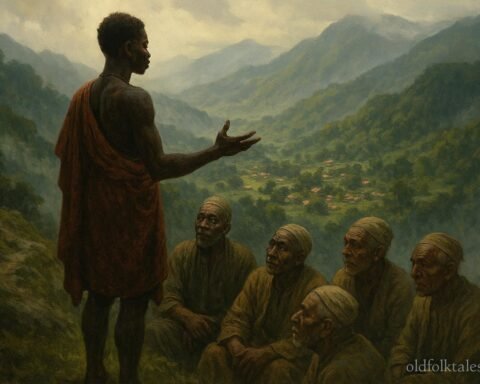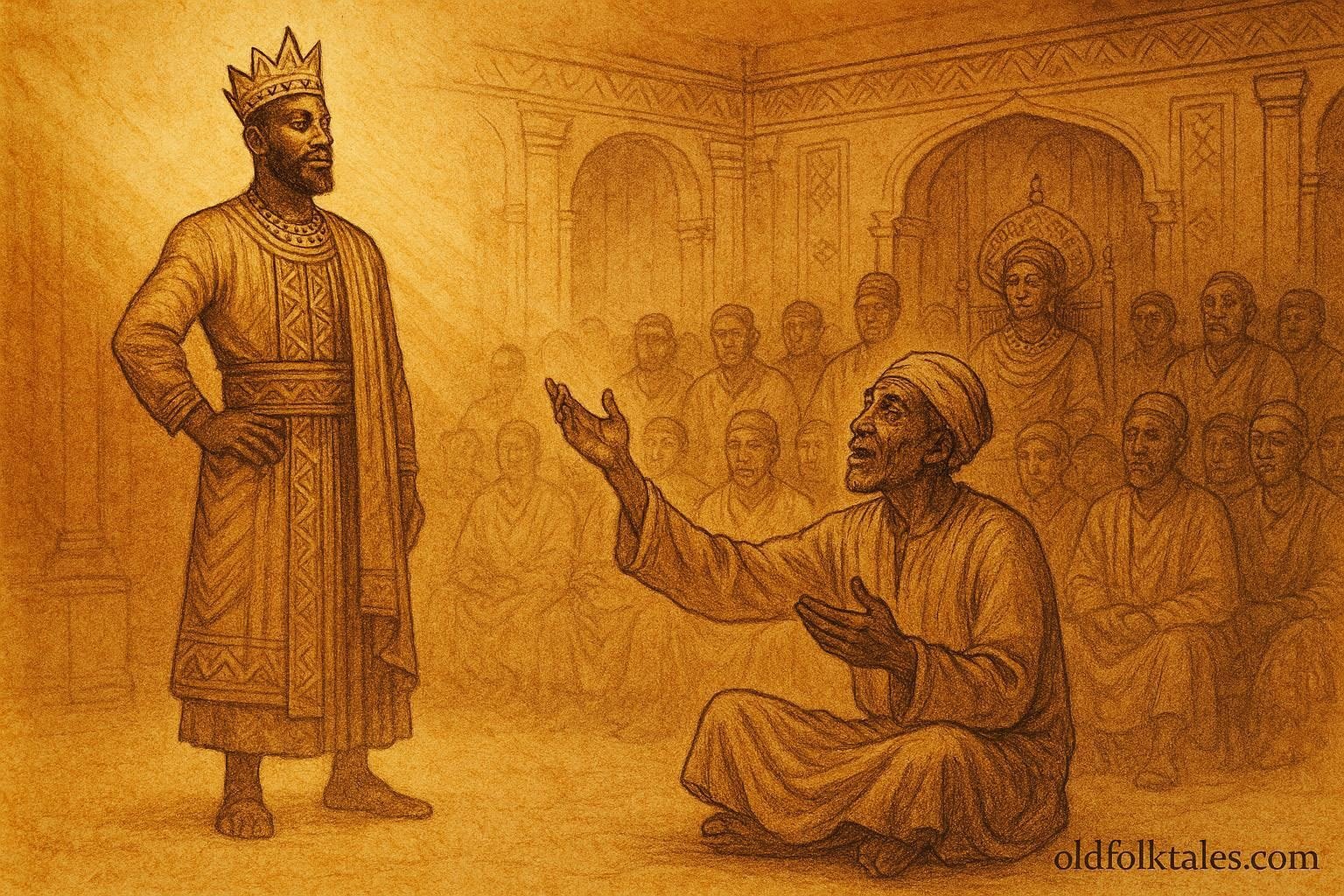
In the ancient hills of Burundi, where royal courts once stood as centers of authority and tradition, there ruled a king known for his power and presence.
His word carried weight.
Fascinated by this tale? Discover more North African folktales
His decisions shaped lives.
His throne was respected across the kingdom.
But over time, admiration slowly turned into fear.
And fear, when left unchecked, can harden into pride.
The king began to believe that his authority placed him above questioning.
He no longer listened as closely as he once did.
He no longer walked among his people as before.
His judgments became swift, and his distance from the concerns of ordinary lives grew wider.
Yet the kingdom remained silent.
For who could question a king?
One morning, something strange happened.
As the king rose from his bed and stepped into the morning light, he noticed something unusual.
He looked down.
And froze.
His shadow was gone.
At first, he thought it was the angle of the light.
He moved.
The shadow did not return.
He turned.
Still nothing.
Wherever he stood, there was only light, and absence.
Panic spread quickly through the palace.
Servants whispered.
Guardians observed carefully.
The royal advisors debated in confusion.
A king without a shadow had never been seen before.
Some said it was an omen.
Others said it was a curse.
But none could explain it.
Outside the palace, the kingdom began to feel uneasy.
People noticed changes they could not name.
The atmosphere felt unsettled.
As if something essential had shifted in the balance of leadership.
The king, once seen as complete, now felt incomplete.
And that incompleteness disturbed everything around him.
The king ordered scholars, healers, and spiritual advisors to be summoned.
They examined him.
They performed rituals.
They studied ancient texts.
But nothing restored the shadow.
And the more they searched, the more frustrated the king became.
Because for the first time in his life, something was beyond his control.
Days passed.
The king grew increasingly unsettled.
Without his shadow, he felt exposed, not to others, but to himself.
Every step reminded him of absence.
Every reflection reminded him of imbalance.
And slowly, something unfamiliar began to grow within him.
Doubt.
One evening, as he sat alone in the courtyard, a soft voice interrupted his thoughts.
“Great King,” it said.
He turned.
A humble storyteller stood at a distance.
He was not dressed in wealth or authority.
He carried only a simple walking staff and the calm presence of someone accustomed to being overlooked.
The king frowned.
“How did you enter without permission?” he demanded.
The storyteller bowed slightly.
“I was already here,” he replied gently. “You only just noticed.”
Something in the answer unsettled the king more than he expected.
“You claim to understand my problem?” the king asked sharply.
The storyteller nodded.
“I do.”
The king leaned forward.
“Then speak,” he said. “Where is my shadow?”
The storyteller looked at him quietly for a moment.
Then he answered.
“Your shadow left because you stopped standing in its place.”
The king frowned deeply.
“I do not understand riddles,” he said.
The storyteller stepped closer.
“Then I will speak plainly,” he said. “A shadow follows light. But it also follows character.”
The king’s expression tightened.
The storyteller continued.
“You have ruled with strength, but not with balance. You have spoken, but not always listened. You have judged, but not always understood.”
A silence fell between them.
The king stood abruptly.
“Are you accusing me?” he demanded.
The storyteller did not flinch.
“I am explaining what your shadow already knows,” he said.
The king’s voice rose.
“Then bring it back!”
The storyteller shook his head slowly.
“It does not return because it was taken,” he said. “It left because it was no longer aligned with you.”
For the first time, the king had no immediate response.
The courtyard felt still.
Even the air seemed to pause.
“What must I do?” the king asked more quietly.
The storyteller did not answer immediately.
Instead, he looked toward the kingdom beyond the palace walls.
“I have walked through your land,” he said. “I have heard your people speak.”
The king remained silent.
“They speak of fear,” the storyteller continued. “Not of enemies, but of judgment without understanding.”
The words landed heavily.
The king lowered his gaze.
For the first time in a long time, he did not interrupt.
He listened.
“The shadow will return,” the storyteller said at last, “when you return to the place where it once followed you naturally.”
“And where is that?” the king asked.
The storyteller met his eyes.
“Humility.”
That night, the king did not sleep.
He sat alone, thinking, not of power, but of distance.
Of how far he had moved from the people he once walked among.
Of how silence had replaced dialogue.
Of how certainty had replaced reflection.
And for the first time, he questioned not his authority, but his direction.
The next morning, something changed.
The king left the palace.
Without ceremony.
Without announcement.
He walked through the kingdom, not as a ruler on display, but as someone observing what he had long stopped seeing.
He listened.
He asked questions.
He allowed silence where he once filled space with command.
People noticed.
Slowly.
Carefully.
The king was different.
Not weaker.
But more present.
More aware.
More open.
And then, one afternoon, as he stood among his people in an open field, something shifted.
The sunlight touched the ground beside him.
And there it was.
His shadow.
Returning.
Quietly.
Naturally.
The king looked down.
He did not speak immediately.
He simply stood still.
And for the first time in a long time, he felt whole, not because of authority, but because of alignment.
The storyteller, who had been watching from a distance, smiled faintly.
The king turned toward him.
“You were right,” he said.
The storyteller bowed slightly.
“No,” he replied. “You were willing to listen.”
From that day onward, the king ruled differently.
Not without authority.
But with awareness.
Not without strength.
But with humility.
And the shadow never left him again.
Don’t stop yet! See our complete East African folktales collection
Moral Lesson
True leadership is not defined by power, but by humility and self-awareness. When pride distances a leader from their people, even what follows them most faithfully—like a shadow, can be lost.
Knowledge Check
- What is the main lesson of “The King’s Lost Shadow”?
The story teaches that humility and self-awareness are essential for true leadership. - Why did the king lose his shadow?
He lost it because his pride and lack of humility caused imbalance in his character. - Who helped the king understand his problem?
A humble storyteller explained the meaning behind the lost shadow. - What did the shadow symbolize in the story?
The shadow symbolized the king’s connection to humility and moral balance. - How did the king regain his shadow?
He regained it by returning to humility and reconnecting with his people. - What cultural themes are reflected in this Burundian royal folktale?
Themes include leadership ethics, moral justice, humility, and traditional court storytelling as moral instruction.
Source: Adapted from Great Lakes region royal court storytelling traditions documented by cultural historians
Cultural Origin: Burundian royal court oral traditions, where storytelling was used to teach rulers moral lessons (1963)