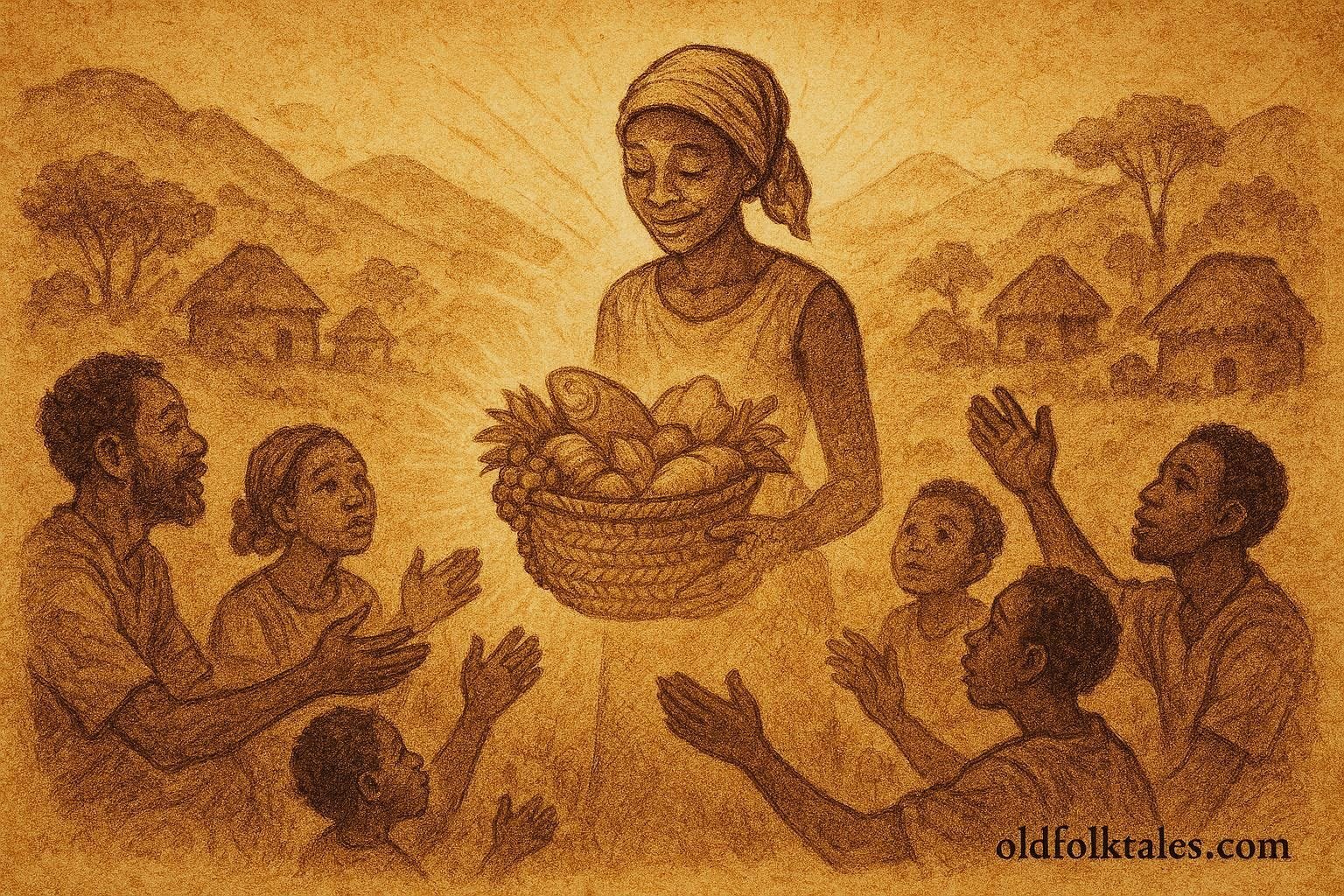
In the rural heartlands of Burundi, where rolling hills cradle small villages and every household depends closely on the land, there was once a woman known for her resilience.
Life in her village was not easy.
Explore the wisdom and wonder of North African folktales
The soil demanded patience.
The seasons demanded trust.
And food, though grown with care, was never something taken for granted.
In such a place, sharing was not just kindness, it was survival.
The woman lived simply.
She worked hard in her fields, tended her home, and helped her neighbors whenever she could. Though she was not wealthy, she was respected for her willingness to give even when she had little.
One day, while returning from a distant path through the hills, she encountered an old traveler sitting quietly beneath a tree.
The traveler looked tired, as though he had walked far without rest.
Without hesitation, the woman offered him water and a small portion of food she had carried with her.
The traveler accepted gratefully.
He ate slowly, as if each bite carried meaning.
When he finished, he looked at her with calm eyes.
“You have given without expecting return,” he said.
The woman only nodded.
“That is how we live,” she replied.
The traveler smiled faintly.
From beneath his cloth, he produced a small woven basket.
It was simple in appearance, no decoration, no markings, but it carried a quiet presence, as though it held something unseen within it.
“Take this,” he said.
The woman hesitated.
“I cannot take what is not mine,” she said.
The traveler shook his head.
“It is yours now,” he replied. “But only under one condition.”
She listened carefully.
“It will always fill with food,” he said. “But only if you share what is inside.”
The woman looked at the basket uncertainly.
“That is all?” she asked.
The traveler nodded.
“Abundance lives where generosity remains alive.”
And with that, he was gone.
The woman returned to her village carrying the basket.
At first, she did not believe anything unusual would happen.
But when she placed it inside her home and opened it later that evening, she gasped.
It was full.
Food filled it completely, fresh and abundant, as though it had been prepared by unseen hands.
Word of the miracle did not take long to spread.
Neighbors came to see.
At first, the woman shared freely, just as the traveler had instructed.
She fed her family.
She fed her neighbors.
She even set aside portions for those who had nothing.
And each time the basket was emptied, it filled again by morning.
The village rejoiced.
Hunger began to ease.
Smiles returned.
The woman became known not for wealth, but for generosity.
But over time, something changed.
Whispers began to grow in her mind.
“What if there is not enough tomorrow?”
“What if others take more than you receive?”
“Why should so many depend on one basket?”
At first, she ignored these thoughts.
But slowly, they grew louder.
And fear, once planted, often leads to hesitation.
One evening, she made a decision.
Instead of sharing the contents of the basket, she kept it hidden.
She fed only her closest family.
No neighbors.
No visitors.
Just silence and secrecy.
She told herself it was for safety.
For preparation.
For control.
That night, she opened the basket.
It was empty.
She frowned.
She waited.
Nothing changed.
She closed it and reopened it again.
Still empty.
Confused, she placed it aside and tried to sleep.
But sleep did not come easily.
The next morning, she checked again.
The basket remained empty.
Panic began to rise.
She had done nothing different, at least, nothing she thought mattered.
Yet something had changed.
Days passed.
The basket no longer produced food.
Hunger returned to her home.
And soon, to the village.
The woman felt shame, though she did not yet fully understand why.
She had not broken it, she told herself.
She had only protected it.
But as she sat alone one evening, she remembered the traveler’s words.
It will only fill if you share what is inside.
She lowered her head.
And for the first time, she admitted the truth to herself.
She had stopped sharing.
The following day, she went to her neighbors.
Hesitantly, she brought out what little food remained from her own storage, not from the basket.
She shared it.
Then she went to others and did the same.
It was not easy.
But she did it anyway.
That night, she placed the basket in the center of her home.
She opened it.
And waited.
Nothing happened at first.
She sat in silence, unsure whether anything would change.
But as she reflected on her actions, she felt something shift within her, not in the basket, but in herself.
She understood now that the basket had never been about magic alone.
It had been about behavior.
About choice.
About trust.
By morning, she opened it again.
It was full.
Food had returned.
Abundance had returned.
But more importantly, understanding had returned.
From that day onward, she never hid the basket again.
She shared freely, not out of obligation, but out of clarity.
And the village learned something alongside her.
That generosity does not reduce what we have, it multiplies what is possible.
The woman remained a respected figure in her community, not because she owned something magical, but because she understood something essential.
That blessings are not meant to be held alone.
They are meant to move.
Looking for more? Explore the magic of East African folktales here
Moral Lesson
Generosity sustains abundance, while greed creates emptiness. What is shared strengthens communities, but what is withheld eventually weakens even the blessings we depend on.
Knowledge Check
- What is the main lesson of “The Basket That Never Stayed Full”?
The story teaches that generosity sustains abundance, while greed leads to loss. - What condition was attached to the magical basket?
The basket would only stay full if its contents were shared with others. - Why did the basket become empty?
It became empty when the woman stopped sharing and began hiding the food. - How did the woman restore the basket’s magic?
She restored it by returning to generosity and sharing with her community. - What does the basket symbolize in the story?
It symbolizes abundance, trust, and the importance of communal sharing. - What cultural themes are reflected in this Burundian folktale?
Themes include communal living, generosity, moral teaching, and the importance of sharing in rural Burundian society.
Source: Found in Central African folktale collections focusing on moral teaching stories (1971)
Cultural Origin: Rural Burundi, where communal living and food sharing are central cultural values