Across the vast southern caravan routes of Libya, where golden dunes roll endlessly beneath a sky that burns by day and shivers by night, merchants once traveled in long, patient lines. Their camels carried salt, spices, fabrics, and stories, always stories. Among these travelers, there lived a merchant whose name has been lost to time, though his character has not.
He was known simply as the Honest Trader.
Want more? Read more West African folktales now
He was not the richest among them, nor the most powerful. His robes were clean but worn, his goods modest but carefully chosen. What set him apart was not what he carried, but how he carried himself. In every market he entered, whether crowded or quiet, he weighed his goods fairly. He did not stretch measures, nor hide flaws, nor take advantage of a distracted buyer. If anything, he often gave more than expected.
Some merchants admired him quietly. Others laughed.
“Honesty is a slow camel,” they would say. “It never wins the race.”
But the Honest Trader never argued. He would simply smile, secure his goods, and continue on his way.
The Journey into the Deep Desert
One season, when trade routes grew thin and profits thinner, a caravan set out deeper into the desert than usual. Rumors had spread of distant settlements, hidden markets, and rare goods that could bring great wealth.
The Honest Trader joined this caravan.
The journey was harsh. Winds rose without warning, scattering sand like whispered secrets. Water had to be measured carefully. Even the most experienced guides spoke less as the days passed, watching the horizon with narrowed eyes.
Among the caravan were merchants of all kinds, some fair, some cunning, some openly deceitful. They traveled together out of necessity, but not all shared the same principles.
As the days stretched on, tensions grew.
One evening, as the caravan settled under a dimming sky, a dispute broke out. A merchant accused another of altering weights to gain extra goods in trade.
Voices rose. Accusations sharpened.
The Honest Trader stepped forward.
“Let us weigh the goods again,” he said calmly. “In the open, before all of us.”
Reluctantly, they agreed.
The scales revealed the truth, the weights had indeed been tampered with.
The guilty merchant denied it at first, then blamed others, then finally fell silent.
Some in the caravan shrugged it off.
“This is the way of trade,” one said. “A clever man survives.”
But the Honest Trader shook his head.
“A man who cheats others cheats himself,” he replied.
His words lingered in the cooling air, though not everyone welcomed them.
The Mirage That Was Not a Mirage
Days later, the caravan faced its greatest trial.
Water supplies ran dangerously low. The sun seemed closer than ever, pressing down with unbearable force. Even the camels moved more slowly, their steps heavy.
It was then that someone spotted it.
“Water!” a voice cried.
Far ahead, shimmering against the horizon, lay what appeared to be an oasis, palm trees rising like green flames, water glinting beneath them.
The caravan stirred with renewed energy.
But not all saw the same thing.
Some merchants saw only wavering heat and endless sand.
“There is nothing there,” they insisted.
Others argued fiercely.
“I see it clearly!”
“No—you are chasing a mirage!”
The caravan fractured in thought, uncertainty spreading like shadow.
The Honest Trader stood still, his gaze steady.
“I see it,” he said quietly.
And yet, he did not rush forward.
Instead, he turned to those around him.
“Let us move with care. Not all that glitters in the desert is real.”
But desperation speaks louder than caution.
Several merchants, driven by thirst and hope, or perhaps greed, broke away and hurried ahead, their camels urged into strained motion.
The Honest Trader moved more slowly, guiding those willing to follow at a steady pace.
As they advanced, something strange began to unfold.
To some, the oasis grew clearer, more defined, the trees swaying gently, the water shimmering invitingly.
To others, it faded further, dissolving into heat and illusion.
Arguments ceased. Fear took their place.
The Hidden Truth of the Oasis
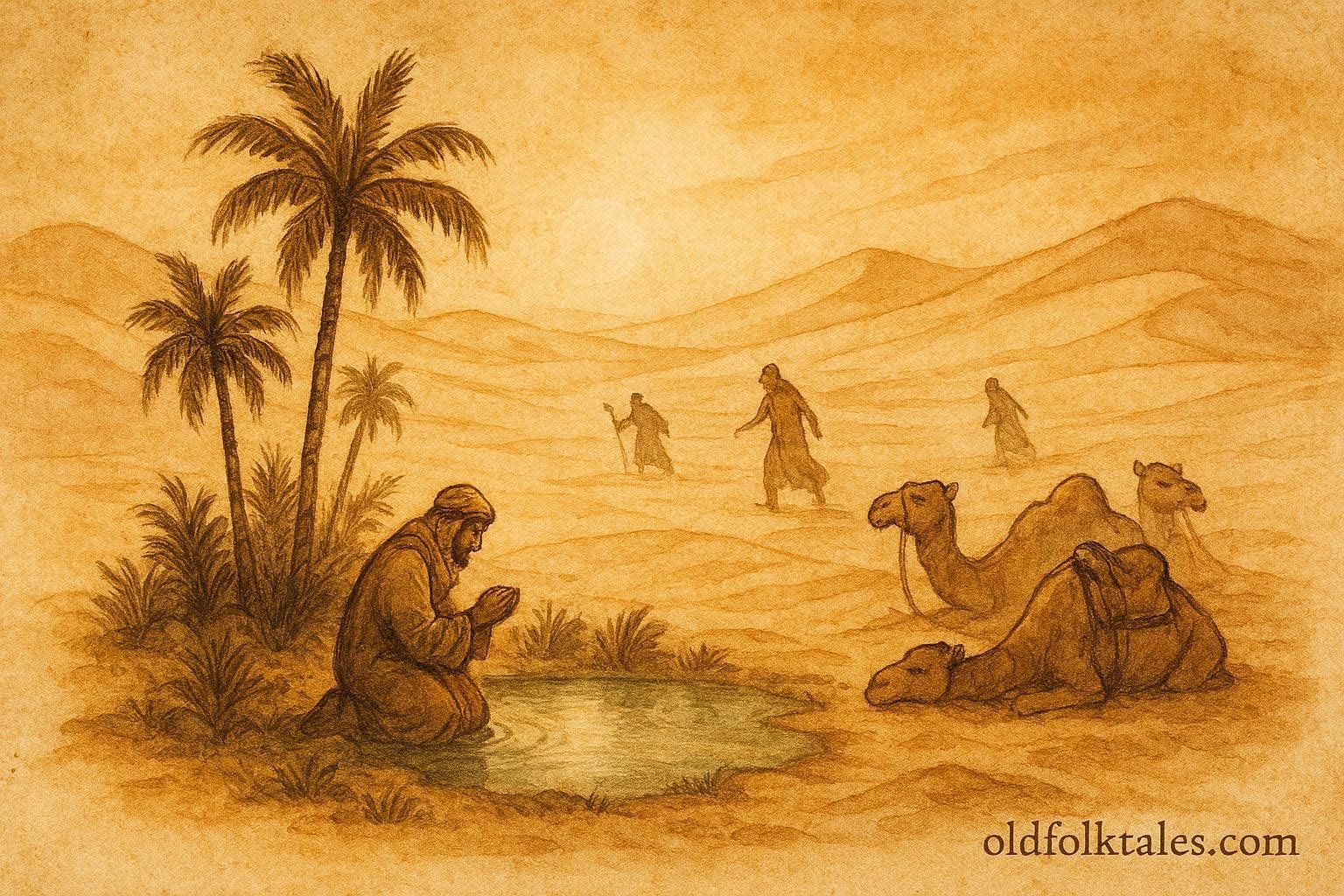
When the Honest Trader finally reached the place where the oasis stood, he found it exactly as he had seen: real, cool, and life-giving.
Palm trees stretched overhead, their leaves whispering softly in a wind that had not touched the open desert. Clear water pooled in a basin, reflecting the sky like polished glass.
He knelt and drank.
The water was sweet.
Behind him, a few others arrived, those who had traded fairly, who had not cheated, who had walked their path without deception. They too saw the oasis, and they too drank deeply.
But those who had rushed ahead dishonestly, those who had cheated and taken advantage of others along the journey, found nothing.
To them, the oasis remained a mirage.
They wandered in confusion, circling the same empty sands, unable to see what lay before them.
Some cried out in frustration.
“It was here! I saw it!”
Others accused the desert itself.
“This place is cursed!”
But the oasis did not reveal itself to them.
The Realization
As the Honest Trader rested beneath the shade of the palms, understanding settled over him like evening light.
This was no ordinary place.
The desert had judged them, not by wealth, not by cleverness, but by the truth in their dealings.
The oasis was not hidden by distance.
It was hidden by character.
Those who had dealt honestly could see clearly. Those who had embraced deceit were blinded, not by the sun, but by their own choices.
When the time came to leave, the Honest Trader filled his waterskins and prepared to continue his journey.
He looked once more at the oasis, committing its presence to memory, not as a place on a map, but as a truth carried within.
The Return
When the caravan reunited beyond the shifting dunes, the stories began.
Some spoke of a miraculous oasis that had saved their lives.
Others swore there had been nothing but sand.
Disagreements flared once again, but this time, the Honest Trader did not argue.
He simply traded as he always had, fairly, openly, without deception.
And those who listened closely began to understand.
Fascinated by this tale? Discover more North African folktales
Moral Lesson
Honesty does not always bring immediate reward, but it reveals truths that deceit can never access. Like the hidden oasis, the greatest blessings are often invisible to those who choose greed over integrity.
Knowledge Check
- What is the main lesson of “The Lost Oasis of the Honest Trader”?
The story teaches that honesty and fairness reveal opportunities and blessings that greed and deceit cannot access. - Why could only some merchants see the oasis?
Only those who traded honestly and acted with integrity were able to see the real oasis, while dishonest merchants saw only a mirage. - What does the oasis symbolize in the folktale?
The oasis represents spiritual reward, truth, and the hidden benefits of living with integrity. - How does the desert function in the story?
The desert acts as a moral force, revealing truth and testing the character of each merchant. - What role does the Honest Trader play in the folktale?
He represents integrity, patience, and moral clarity, serving as an example of ethical behavior in trade. - What cultural themes are reflected in this Libyan folktale?
The story reflects Saharan trade values, emphasizing fairness, trust, spiritual awareness, and the consequences of greed.
Source: African folktale, Libya. Referenced in 19th–20th century Saharan trade folklore recordings and later compiled in North African oral tradition collections.
Cultural Origin: Southern Libyan caravan routes (Saharan trade culture influenced by Amazigh and Arab merchants)