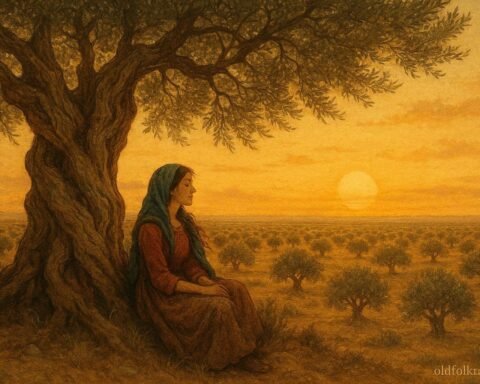
In the quiet town of Testour, where whitewashed houses carried the memory of Andalusian craftsmanship and tiled rooftops glowed softly under the North African sun, life moved with a measured rhythm.
The town was known for its beauty and its order. Narrow streets curved gently between homes decorated with subtle geometric patterns, and the sound of flowing water from old fountains blended with the distant call to prayer. Testour was a place shaped by history, built by communities who had brought with them memories, skills, and traditions from across the sea after leaving Andalusia generations earlier.
Click here to discover more legendary tales from West Africa
Among the many stories passed down in Testour, one stood apart.
It was said that in the early days of the town’s settlement, when its foundations were still being shaped, a mysterious lantern appeared in the possession of an old craftsman. No one knew where it came from. Some said it was a gift carried across the sea. Others believed it had been forged with knowledge long lost.
The lantern looked simple at first glance, made of aged metal and glass, its frame etched with faint markings that seemed neither fully Arabic nor entirely foreign. But its true nature revealed itself only under one condition: when it was lit.
For when the lantern was lit, it did not simply brighten the darkness.
It revealed truth.
Not metaphorically. Not symbolically. But unmistakably, laying bare hidden realities, exposing what lay beneath words, actions, and appearances.
At first, the people of Testour treated the lantern with reverence.
It was kept in the home of the craftsman, and only lit on rare occasions, often during disputes where clarity was needed. When two merchants disagreed over trade, the lantern was brought forth. When neighbors argued over boundaries or debts, its light was used to settle confusion.
And in those early days, it seemed like a blessing.
Disputes ended quickly. False claims were exposed. Dishonesty had nowhere to hide. The town began to believe it had been gifted with a perfect tool for justice.
But as time passed, something began to change.
People grew curious, not only about fairness, but about each other.
“What does the lantern reveal about this person?”
“What truths lie hidden in that home?”
Slowly, the purpose of the lantern shifted in the minds of the villagers. What had once been a tool for resolving conflict began to be seen as a means of uncovering secrets.
One evening, during a gathering in the town square, a disagreement arose between two families. It was a small matter at first, but voices grew louder, emotions sharpened, and the crowd gathered around them.
Someone suggested the lantern.
“Let it show us the truth,” they said.
Others agreed.
The old craftsman hesitated. He had always used the lantern carefully, aware of its weight. But the pressure of the crowd was strong, and at last, he brought it forward.
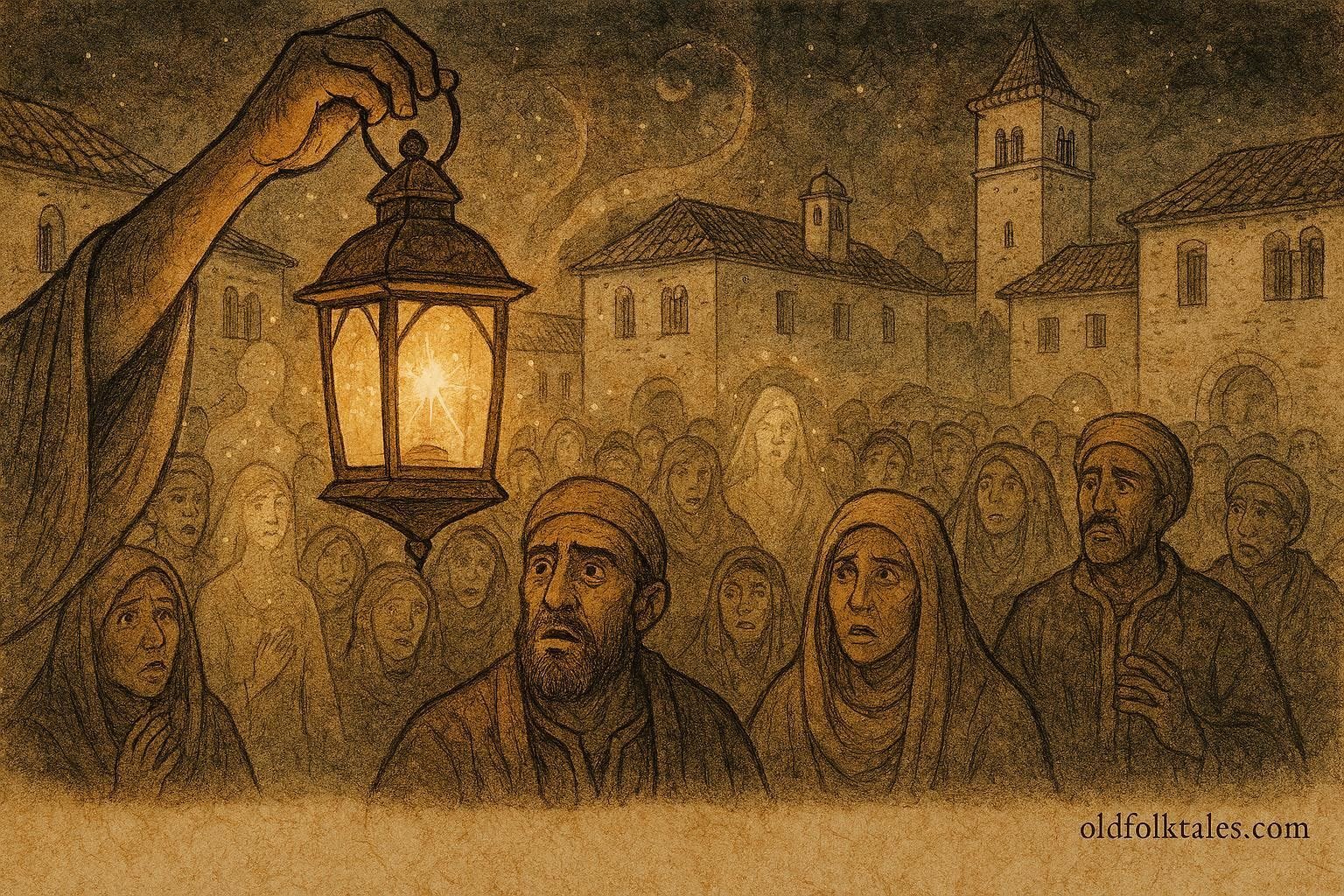
When the lantern was lit, its light spread across the square in a soft, steady glow.
At once, the air seemed to shift.
What had been spoken in anger was now seen in full clarity. But so too were thoughts unspoken, intentions hidden, and private feelings never meant for public view. The lantern did not distinguish between harmful deceit and harmless imperfection. It revealed everything.
Gasps rose from the crowd.
Whispers followed.
The argument ended, but not in peace. Instead, discomfort settled over those present. People began to look at one another differently, their understanding replaced by sudden awareness of things they had never wished to see.
Still, some believed this was necessary.
“If truth is shown,” they said, “then there can be no lies.”
So the lantern’s use expanded.
It was brought out more frequently. Used not only in disputes, but in everyday matters. People began requesting its light for reassurance, for suspicion, for curiosity.
At first, it seemed to strengthen accountability.
But slowly, something else began to emerge.
Relationships strained under the weight of exposed thoughts. Neighbors who once greeted each other warmly now hesitated, remembering what the lantern had revealed. Friends who had once trusted each other began to question every word, every glance.
The town grew quieter.
Not in peace, but in caution.
The old craftsman watched this change with growing concern.
One evening, he spoke to the council.
“This lantern was never meant to be used so freely,” he said. “Truth is not something to be pulled into the light without care. It must be handled with wisdom.”
But his words were not easily accepted.
“If truth causes discomfort,” one council member replied, “then it is still truth. Better to know than to be deceived.”
The craftsman lowered his gaze.
“Knowing everything,” he said softly, “is not the same as understanding what to do with it.”
But the lantern remained in use.
And so did its consequences.
One day, during a moment of tension between two respected families, the lantern was lit again.
The truth it revealed was not a single deception, but layers of emotion, past grievances, unspoken resentments, private fears. What emerged was not clarity, but overwhelming exposure.
The conflict that followed was not immediate anger, but something more difficult to mend: distance.
People began to withdraw from one another.
Trust weakened, not because lies had increased, but because too much had been revealed.
The town elders called for reflection.
Gathering in the same square where the lantern had been used so many times, they spoke openly.
“We thought truth alone was enough,” one elder said. “But we forgot that truth without compassion can wound as deeply as falsehood.”
Another nodded.
“A light that reveals everything,” he said, “does not always show what should be seen.”
The craftsman stepped forward once more.
“I did not create this to divide you,” he said. “I believed it would bring clarity. But clarity without kindness becomes harshness.”
The council listened in silence.
At last, a decision was made.
The lantern would no longer be used for curiosity or suspicion. It would only be lit in the presence of mutual agreement, and only when all parties understood the weight of what might be revealed. And even then, its use would be guided by those trained to interpret its light with care.
Gradually, its use declined.
Not because truth was rejected, but because it was now understood differently.
In time, the town of Testour learned to speak more carefully, to listen more deeply, and to resolve conflict not through exposure alone, but through understanding.
The lantern itself remained, stored safely, no longer a tool of frequent revelation, but a reminder.
A reminder that truth, when removed from compassion, loses balance.
And that harmony in a community depends not only on what is revealed, but on how it is received.
Explore the wisdom and wonder of North African folktales
Moral Lesson
Truth must be guided by compassion and wisdom. Without kindness, honesty can harm relationships and disrupt social harmony instead of healing it.
Knowledge Check
- What is the main message of The Lantern of Testour?
The story teaches that truth must be balanced with compassion, as honesty without care can damage relationships. - What does the magical lantern do in the folktale?
It reveals hidden truths whenever it is lit, exposing what people try to conceal. - Why did the villagers begin to misuse the lantern?
They started using it out of curiosity and suspicion rather than for resolving genuine disputes. - What problem did the lantern create in the community?
It exposed too much personal truth, leading to mistrust, emotional harm, and weakened relationships. - How was the lantern’s use eventually changed?
It was restricted to carefully agreed situations where truth was needed for fairness, not curiosity. - What cultural values are reflected in this Tunisian folktale?
The story reflects values of social harmony, wisdom in communication, ethical truth, and community responsibility.
Source & Cultural Origin
Source: African folktale, Tunisia. Adapted from Andalusian-Tunisian folklore shaped by post-Andalus migration stories, recorded in North African folklore studies (late 20th century).
Cultural Origin: Tunisian communities with Andalusian heritage