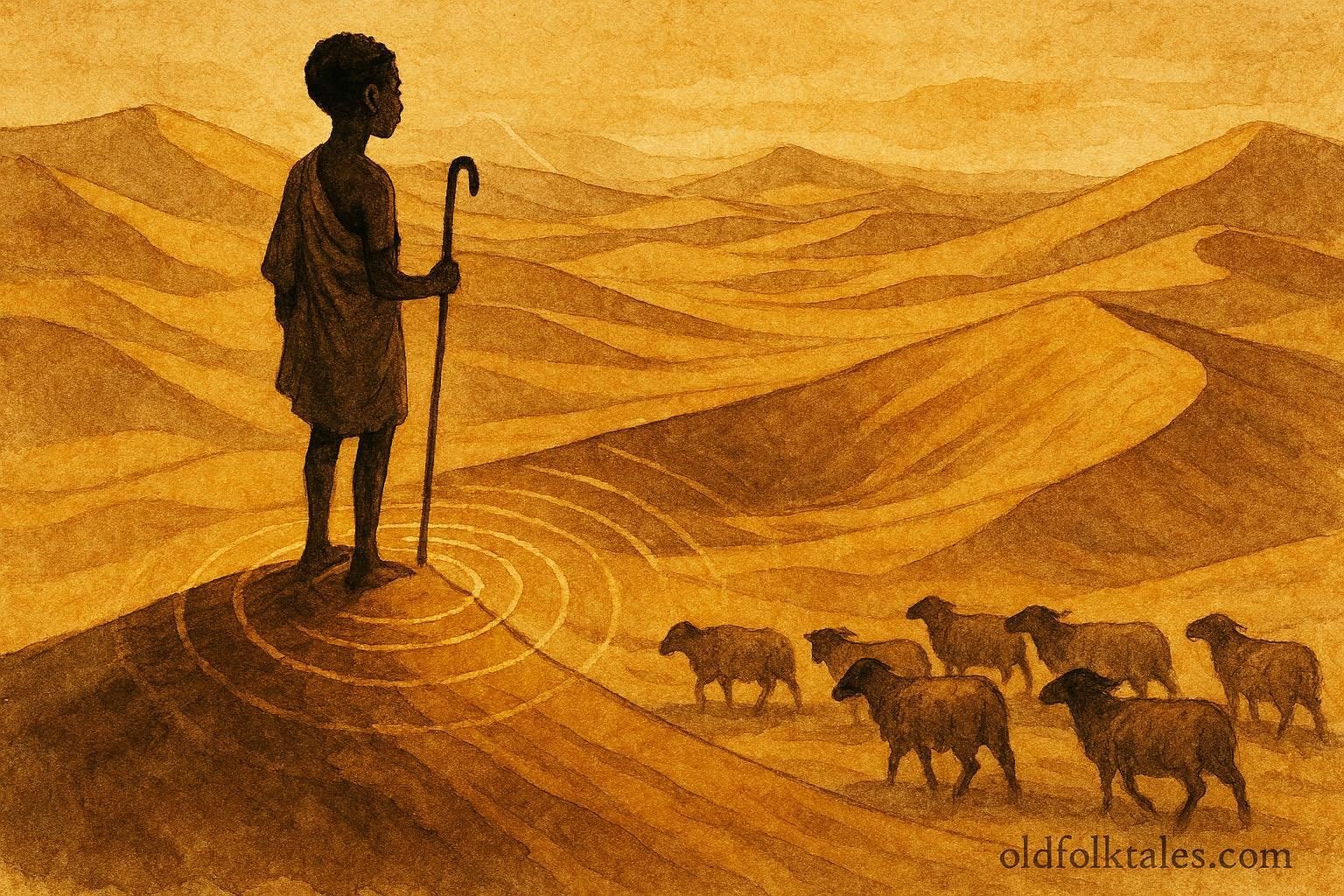
In the far reaches of southwestern Libya, where the Sahara stretches beyond sight and the wind writes its stories across endless dunes, there lived a young shepherd whose life was shaped by silence.
The desert is not empty, as outsiders often believe. It breathes. It shifts. It remembers. And for those who listen closely, it speaks.
Want more? Read more West African folktales now
The boy had grown up among the Tuareg and other nomadic people who understood this truth. From his earliest days, he had been taught that the land was not merely a place to cross, but a presence to respect. The dunes were not just sand, they were living forms, shaped by wind and time, capable of warning and wisdom.
Still, he was young.
And youth often hears less than it listens.
The First Song
It began on an afternoon that seemed like any other.
The sun stood high and unyielding, casting sharp shadows beneath the sparse shrubs that dotted the landscape. The boy guided his herd carefully, watching for signs of danger, loose sand, hidden dips, or the faint tracks of predators.
The air was still.
Then, without warning, a sound rose from the dunes.
It was soft at first, like a distant hum carried on the wind. But the air had not moved. The sky was clear. There was no storm approaching.
The boy paused.
The sound deepened, stretching into a low, trembling note that seemed to come from beneath the earth itself. It rose and fell, almost like a voice, but not one formed by human breath.
He turned slowly, scanning the dunes.
They stood as they always had, curving, golden, unmoving.
Yet the sound continued.
A strange melody.
Not random. Not chaotic.
Measured.
Intent.
The boy felt a shiver run through him, though the heat remained unbroken.
He had heard stories, whispers among the elders about dunes that sang. Some said it was the wind passing through grains of sand in just the right way. Others said it was the land speaking in a language older than memory.
The boy had never believed them fully.
Until now.
The Choice to Follow
The herd shifted behind him, restless.
The sound came again, clearer this time, more insistent.
The boy hesitated.
He had responsibilities. The herd depended on him. Straying from his path could put them at risk.
Yet something within him stirred, a quiet pull, like a hand guiding his thoughts.
This was not fear.
It was awareness.
He turned to the dunes.
“I hear you,” he said softly, though he did not know why.
The sound seemed to respond, rising slightly, stretching across the air like a thread waiting to be followed.
The boy made his decision.
He guided his herd carefully in the direction of the sound, moving slowly, watching each step.
The dunes ahead were higher, steeper, their slopes sharper than those behind him. The sand beneath his feet shifted more easily, slipping with a faint whisper at each movement.
The melody grew stronger.
The Warning in the Sand
As the boy climbed the ridge of a tall dune, the sound reached its fullest voice.
It was no longer a distant hum.
It was a deep, resonant tone, vibrating through the ground, through the air, through his very bones.
He stopped at the crest and looked down.
What he saw tightened his chest.
Below, the land dipped into a wide basin of sand, smooth, untouched, and deceptively calm. But even as he watched, the surface shifted slightly, as though the ground itself were breathing.
He had seen this before.
Not often. Not clearly.
But enough to know.
The sand there was unstable.
A hidden collapse waiting to happen.
If the herd had continued on their original path, they would have crossed that basin.
And the ground would have given way beneath them.
Animals would be lost.
Perhaps lives as well.
The boy stood very still.
The sound of the dunes pulsed once more, then softened.
Not a call now.
A confirmation.
Turning Away
He wasted no time.
Moving quickly but carefully, he guided the herd away from the basin, leading them along a safer route that curved around the dangerous ground.
The animals resisted at first, sensing neither danger nor reason. But the boy was firm, his voice steady, his movements deliberate.
Slowly, they followed.
As they moved farther from the basin, the sound of the dunes began to fade.
The melody softened, then thinned, until at last it disappeared entirely.
The desert returned to silence.
But it was no longer the same silence.
The Return to the Village
When the boy returned to his people, the sun was lowering, painting the dunes in shades of gold and shadow.
The elders noticed immediately.
“You have taken a longer path,” one of them said.
“There was danger,” the boy replied.
They listened as he spoke, not interrupting, not dismissing, but weighing his words carefully.
He told them of the sound.
The melody.
The shifting basin.
The warning.
When he finished, there was a long pause.
Then one of the elders nodded slowly.
“You heard the dunes,” he said.
Others murmured in agreement.
“This is not new,” another added. “But it is rare.”
The boy looked at them, searching their faces.
“You believe me?” he asked.
The first elder met his gaze.
“The desert speaks,” he said. “But not everyone listens.”
Understanding the Song
That night, the elders gathered with the boy beneath the open sky.
The stars stretched wide above them, clear and endless.
“You must understand,” one elder said, “the dunes are shaped by wind, by heat, by movement deep beneath the surface. Sometimes, when the sand shifts in just the right way, it produces sound.”
“But it is more than sound,” another added. “It is a sign. A signal. A warning.”
The boy listened closely.
“You did not only hear it,” the elder continued. “You trusted it. That is what matters.”
The boy looked out toward the darkened dunes.
“They were trying to help,” he said quietly.
The elders nodded.
“The land does not exist against us,” one said. “It exists with us. But we must learn how to hear it.”
The Weight of Responsibility
From that day forward, the boy was no longer seen as just a shepherd.
He had become a listener.
Others began to look to him when the desert felt uncertain, when the wind changed direction suddenly, when the sand shifted in unfamiliar ways, when silence carried a different weight.
He did not claim special power.
He did not boast.
He simply paid attention.
And when the dunes sang again, rarely, but unmistakably, he listened.
Explore the wisdom and wonder of North African folktales
Moral Lesson
Those who live in harmony with nature must learn to listen beyond what is seen. True wisdom comes not only from knowledge, but from awareness, respect, and the courage to trust subtle warnings before danger appears.
Knowledge Check
- What is the main lesson of “The Shepherd and the Singing Dunes”?
The story teaches that listening to nature and trusting intuition can prevent danger and guide wise decisions. - What are the “singing dunes” in the folktale?
They are desert dunes that produce mysterious sounds, symbolizing nature’s way of communicating warnings. - How did the shepherd save his herd and village?
He followed the sound of the dunes, discovered unstable ground, and redirected the herd away from danger. - What does the singing of the dunes symbolize?
It represents unseen warnings, environmental awareness, and the voice of nature guiding those who listen. - Why is the shepherd respected after the event?
He demonstrated responsibility, awareness, and trust in the land, qualities valued in desert communities. - What cultural values are reflected in this Libyan folktale?
The story highlights harmony with nature, respect for the environment, and the importance of wisdom in survival.
Source: African folktale, Libya. Referenced in ethnographic studies of Saharan acoustic phenomena and oral storytelling traditions (1960s–1990s).
Cultural Origin: Saharan regions of southwestern Libya (Tuareg and desert nomadic traditions)