At the northern edge of Morocco, where the Mediterranean Sea met the Atlantic Ocean and ships arrived from distant lands across Europe, Africa, and the Middle East, the city of Tangier stood as one of the most mysterious trading centers in North Africa. Its crowded streets echoed with different languages, while merchants filled the markets with spices, carpets, lanterns, jewelry, leather goods, and rare treasures gathered from across the world.
Tangier never truly slept.
Even after sunset, the city remained alive beneath glowing lanterns and moonlit alleyways. Travelers wandered through narrow streets lined with cafés and hidden courtyards while traders continued business deep into the night.
But among the people of Tangier, not every market was believed to belong entirely to the human world.
Old storytellers spoke quietly about hidden sections of the city where supernatural beings sometimes walked among ordinary people unnoticed. According to Moroccan oral traditions, djinn could disguise themselves as travelers, merchants, musicians, or wandering strangers.
Some were harmless.
Some were wise.
And others were dangerous beyond imagination.
If you enjoyed this story, explore our full West African folktales collection
Elders warned that greed often attracted the attention of darker spirits who tempted humans with promises of wealth, power, or secret knowledge.
One of the oldest supernatural legends from Tangier became known as the story of the Djinn Market, a tale passed carefully through generations as a warning against temptation and spiritual corruption.
Long ago, during a period when Tangier’s ports flourished with international trade, there lived a young merchant named Samir. He inherited a small spice shop from his father near one of the city’s busiest markets.
Though hardworking and intelligent, Samir struggled financially.
Wealthier traders controlled most profitable trade routes, leaving smaller merchants competing constantly for survival. While some shopkeepers succeeded through patience and honesty, others secretly relied on bribery, smuggling, or deception to expand their fortunes.
Samir often felt frustrated watching dishonest men grow rich while his own business barely survived.
Every evening, after closing his shop, he wandered through Tangier’s crowded night markets listening to traders boast about their success. Deep inside, envy slowly began growing within him.
One cold autumn night, as thick sea fog drifted through the city streets, Samir stayed unusually late at the market hoping to sell his remaining spices before returning home.
Most merchants had already packed their goods.
The streets grew quieter.
Lanterns flickered weakly beneath the fog.
Then Samir noticed something strange.
At the far end of a narrow alleyway he had never seen before, golden light glowed beneath a large archway covered with unfamiliar symbols.
Curious, he walked closer.
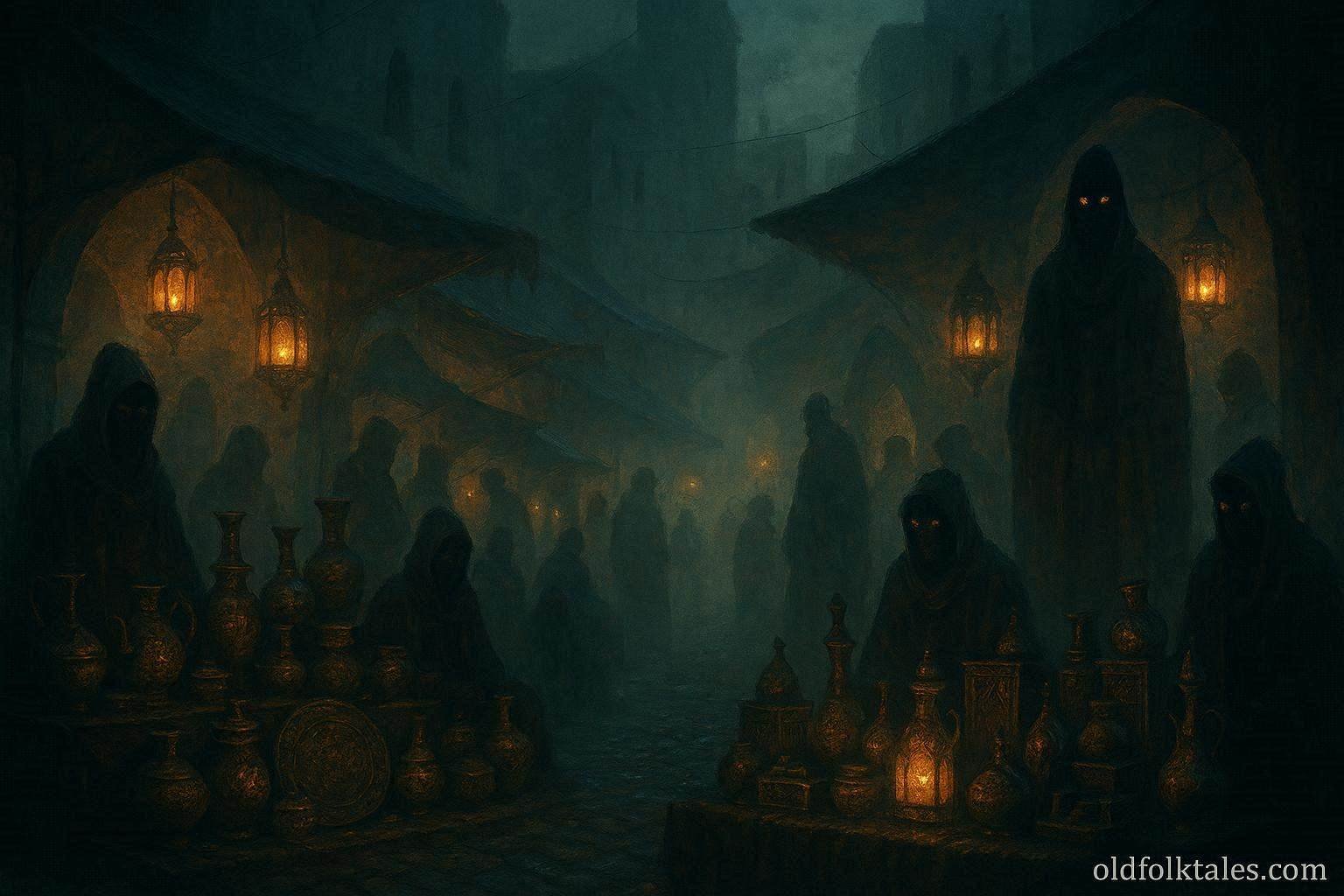
Beyond the arch stood a hidden marketplace unlike anything he had ever witnessed.
Dozens of stalls filled the narrow square illuminated by silver lanterns hanging from above. Merchants dressed in elegant robes displayed extraordinary objects unlike ordinary market goods.
Jewels brighter than sunlight.
Ancient books bound with silver thread.
Perfumes carrying impossible fragrances.
Coins engraved with unfamiliar markings.
The atmosphere felt strangely silent despite the number of people moving through the market.
No shouting.
No bargaining.
Only whispers.
A tall merchant standing beside a table of golden objects smiled as Samir approached.
“You seek fortune,” the stranger said calmly.
The man’s voice sounded unusual, almost echoing slightly beneath the market noise.
At first, Samir assumed he had discovered a secret trading market used by wealthy elites within Tangier. Yet something about the people surrounding him felt unnatural.
Their movements seemed too smooth.
Their eyes reflected light strangely.
And none of them appeared surprised by his presence.
The merchant offered Samir a small pouch filled with glittering coins.
“In exchange,” he explained softly, “you must return tomorrow night with something valuable from your own life.”
Samir hesitated.
“What kind of payment?” he asked carefully.
The merchant only smiled.
“Something you will not miss at first.”
Uneasy but tempted by the wealth before him, Samir accepted the coins and hurried home before dawn.
The next morning, he discovered the gold was real.
Using the money, he purchased rare spices and expanded his business immediately. Customers flooded his shop, and for the first time in years, Samir experienced financial success beyond anything he imagined.
Yet strange things soon began happening.
He slept poorly.
Shadows moved strangely inside his home at night.
And although surrounded by new wealth, he felt increasingly restless and empty.
Still, greed overcame caution.
The following night, Samir returned to the hidden market.
Again the mysterious merchant waited for him.
This time the merchant offered even greater wealth in exchange for another “small sacrifice.”
Without fully understanding why, Samir agreed.
Over the following months, his fortune grew rapidly.
He purchased a larger home.
Servants worked in his shop.
Other merchants envied his success.
But with each visit to the hidden market, something inside him slowly changed.
His laughter disappeared.
Friendships faded.
Even his own family noticed a coldness growing within him.
Worst of all, Samir began forgetting important memories.
At first, the losses seemed small.
A childhood song.
The sound of his mother’s voice.
The face of an old friend.
But gradually the forgetting worsened.
One evening, while speaking with his younger sister, Samir suddenly realized he could no longer remember his father’s face at all.
Fear finally entered his heart.
That night he returned desperately to the hidden market demanding answers.
The merchant listened calmly before revealing the truth.
The marketplace did not belong to humans.
It belonged to djinn.
Every bargain required payment taken not from wealth, but from the soul itself.
Each exchange slowly stripped away the memories, emotions, and spiritual connections that made a person truly human.
Eventually, those who continued accepting the bargains became empty shells consumed entirely by greed and desire.
Terrified, Samir begged to end the agreement.
The merchant’s expression darkened.
“All bargains carry consequences,” he replied.
Then the lanterns throughout the market suddenly dimmed.
For the first time, Samir noticed the true appearance of the figures surrounding him.
Their faces shifted unnaturally beneath the shadows.
Their eyes glowed like fire.
And the air itself seemed heavy with unseen voices whispering through the fog.
Samir fled the market in panic.
But afterward, the hidden archway vanished completely from Tangier’s streets.
No matter how desperately he searched, he could never find it again.
Over the following weeks, his wealth began disappearing mysteriously.
Trade deals collapsed.
His expensive goods spoiled unexpectedly.
Servants abandoned his business.
Within months, Samir lost nearly everything he had gained through the bargains.
Yet the spiritual damage remained.
Many of his lost memories never returned fully.
Ashamed and frightened, Samir sought guidance from an elderly scholar known for understanding supernatural traditions and religious teachings.
After hearing the story, the scholar warned that greed had opened a dangerous spiritual path allowing dark forces influence over his life.
Recovery, he explained, would require humility, prayer, honesty, and abandoning all desire for wealth gained through corruption or temptation.
For many years afterward, Samir lived quietly and simply.
Though no longer wealthy, he slowly rebuilt his life honestly through hard work and service to others. He often shared his experience privately with younger merchants tempted by greed and easy fortune.
As generations passed, the legend of the Djinn Market spread throughout Tangier.
Some claimed the hidden marketplace still appeared during foggy nights near the old city walls.
Others insisted mysterious strangers continued offering impossible wealth to desperate traders.
Even today, elders in Tangier warn people never to trust fortune that arrives too easily or wealth offered without clear cost.
Because according to Moroccan tradition, the most dangerous bargains are often the ones that promise exactly what the human heart desires most.
Explore the wisdom and wonder of North African folktales
Moral Lesson
Greed and temptation can destroy a person spiritually, while honesty and humility protect the soul.
Knowledge Check
- Where is the story set?
It is set in the night markets of Tangier, Morocco. - Who was Samir?
He was a struggling spice merchant tempted by supernatural wealth. - What was unusual about the hidden market?
It was secretly operated by djinn disguised as merchants. - What payment did the djinn demand?
They slowly took Samir’s memories and spiritual connection in exchange for wealth. - Why did Samir regret the bargains?
He realized greed was destroying his humanity and peace. - What lesson does the story teach?
Easy wealth gained through greed often comes with dangerous consequences.
Source
North African folklore. Adapted from Tangier supernatural traditions preserved in Moroccan oral narratives and folklore research studies.