In the days when God’s daughters could be sought in marriage, a remarkable announcement spread across the land. God was looking for a husband for his eldest daughter, but he had decided that no ordinary bride price would be accepted. Instead, he created a challenge that seemed almost impossible.
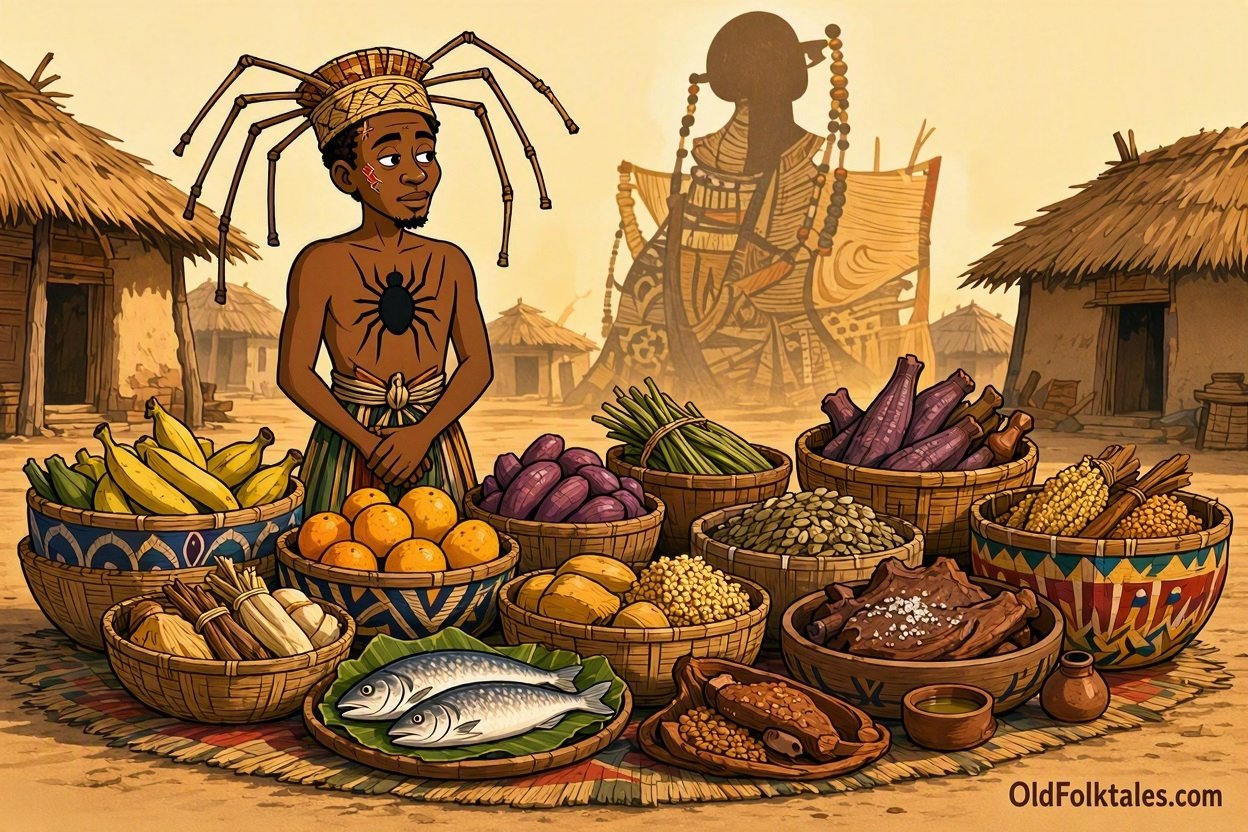
The man who wanted to marry his daughter had to bring him a specimen of everything that was eaten on earth.
The announcement was repeated for several days, so there could be no doubt that the challenge was genuine. The prospective suitor would have only thirty days to complete it.
People everywhere began talking about the strange demand. Some laughed at it. Others thought it was a trick. Many wondered how anyone could possibly gather a specimen of everything that human beings, animals and other creatures ate.
After all, what did people eat?
There were grains, roots, fruits, vegetables, meat, fish, insects, shellfish and countless other things. Different communities ate different foods, and there were creatures whose diets were known only to themselves.
The task appeared endless.
Yet the reward was extraordinary.
Who would not want to become the son in law of God?
Love this story? Discover our full Southern African folktales collection
Soon, people began preparing for the challenge. Some competitors searched everywhere. Others tried to buy rare foods. Some depended on their strength, while others relied on their connections.
Kacou Ananzè watched them carefully.
He was wealthy and famously clever, but he was also careful with his possessions. He did not want to spend his fortune simply to participate in a competition that might prove impossible.
He watched the Hare.
He watched the Fox.
He watched the Lion.
He watched the Panther.
Each competitor was trying to find a way to satisfy God’s demand.
Ananzè hesitated.
He wanted God’s eldest daughter, but he did not want to waste his wealth or lose the reputation he had built as an intelligent and resourceful creature.
Eventually, however, his ambition overcame his hesitation.
He decided to compete.
But Kacou Ananzè did not intend to complete the challenge in the ordinary way.
He intended to use his greatest weapon: his cunning.
On the fourth day after the announcement, he went to the ocean to think.
He stood at the meeting place between land and water, looking at the creatures around him. He saw crabs, starfish and sea urchins. He listened to the sound of the ocean and allowed his mind to work.
How could one creature possibly gather everything that was eaten on earth?
He needed a plan that would allow him to collect many different foods without paying for them.
Then he saw a crab.
An idea came to him.
He caught the crab and carried it away.
Kacou Ananzè roasted the crab and went to visit an elderly woman he knew.
He showed her the beautifully cooked crab.
The woman’s eyes immediately lit up.
She admired it and admitted that it looked delicious.
Ananzè began praising the crab even more. He told her that he had been eating crabs for months and that they had made him stronger and healthier.
The old woman became increasingly interested.
Then Ananzè offered her a taste.
She accepted.
The moment she ate one of the crab’s legs, Ananzè suddenly became furious.
He accused her of stealing his food.
The old woman was confused.
She reminded him that he had invited her to taste it.
But Ananzè insisted that he had only allowed her to taste the crab, not eat it.
He demanded that she return the piece she had swallowed.
Of course, that was impossible.
The woman could not return what she had already eaten.
An argument followed.
Eventually, Ananzè saw a chicken nearby.
He seized it and walked away.
The old woman protested, accusing him of stealing her chicken.
Ananzè calmly replied that she should return his crab leg.
The old woman could not understand his logic.
But Ananzè had already begun constructing his chain.
The crab had come from the ocean.
The ocean belonged to God.
God had created him.
Therefore, in his twisted reasoning, everything he encountered could eventually be traced back to God.
He continued on his journey.
Soon he encountered a young girl drying peanuts.
Ananzè greeted her and told her that he had bought the chicken he was carrying. He asked her to prepare it so they could eat together.
The girl recognised his resemblance to the famous Kacou Ananzè.
She wondered whether he might be related to him.
Ananzè denied being the famous Spider.
He claimed to be an ordinary traveller who was simply hungry.
The girl prepared the chicken.
As the meat cooked, its delicious smell filled the air. Ananzè watched the pot carefully, even though he was desperately tempted to eat the meal himself.
He could not forget the challenge.
He wanted to become God’s son in law.
Eventually, the girl tasted a piece of chicken to check whether it was properly cooked.
That was exactly what Ananzè had been waiting for.
He immediately accused her of eating his chicken.
The girl explained that tasting food while cooking was normal.
Ananzè refused to listen.
He demanded another chicken.
The girl began crying.
Ananzè took the chicken and some peanuts and continued his journey.
Once again, he had gained another food item without paying for it.
He continued travelling, following the same principle.
Every person he met became part of his elaborate chain.
Every food item could be linked to another.
The crab came from the ocean.
The chicken came from the woman.
The peanuts came from the girl.
Each person who had eaten or handled something became another link in Ananzè’s argument.
But he still needed many more foods.
Time was running out.
He travelled farther and met blacksmiths who were preparing meat and cicadas.
He greeted them warmly and pretended that he had no interest in the competition.
Instead, he told them that he was simply travelling to attend a family funeral.
The blacksmiths believed him.
Ananzè then asked them to roast some peanuts for him.
They agreed.
Before leaving, the blacksmiths counted the peanuts.
There were thirty.
Ananzè told them that the exact number did not matter.
While they roasted them, he pretended to sleep.
When he woke, he counted the peanuts again.
There were only twenty nine.
Ananzè immediately complained that one was missing.
The blacksmiths laughed.
They reminded him that he had said the number did not matter.
But Ananzè changed his position.
Now, one peanut mattered enormously.
Between twenty nine and thirty, he argued, there was one whole peanut.
The argument became heated.
The blacksmiths protested.
Ananzè seized some of their meat and cicadas and escaped.
Again, he continued his strange chain of reasoning.
He had obtained more food without spending his own money.
He now had an impressive collection.
But he was still not finished.
He met a palm wine tapper.
He met a fisherman.
He met a farmer.
He encountered monkeys, lions, parrots and hunters.
He passed fruit trees.
He encountered mysterious beings and spirits.
To each one, Ananzè used friendliness, deception or clever negotiation.
Little by little, his collection grew.
Before the thirty days were over, he had gathered an astonishing variety of things that were eaten on earth.
He was delighted.
He had succeeded where others had failed.
A large group of carriers followed him as he travelled toward God’s dwelling place, carrying the collection.
Kacou Ananzè was proud.
He believed he had finally outsmarted God.
When he arrived, God looked at him carefully.
Ananzè sat confidently before him.
He had brought everything that had been requested.
He believed the marriage was now guaranteed.
God did not immediately challenge him.
Instead, Ananzè was given food and treated generously.
For three days, he enjoyed himself.
He believed victory was already his.
On the fourth morning, however, God summoned him.
“Kacou Ananzè,” God said, “you have shown remarkable intelligence.”
Ananzè smiled.
He was ready to hear that he had won.
But God explained that there was a problem.
Ananzè had gathered his collection through deception.
He had taken a chicken from the young girl.
He had taken food from the old woman.
He had taken meat and cicadas from the blacksmiths.
All along his journey, people had suffered because of his tricks.
Ananzè protested.
Had he not brought what God requested?
Had he not gathered specimens of everything that was eaten?
God agreed that he had accomplished an extraordinary feat.
But he refused to give him his daughter’s hand.
The reason was simple.
Ananzè had not completed the task honestly.
The challenge had tested more than intelligence.
It had also tested character.
Ananzè had mistaken cleverness for wisdom.
He had assumed that because he could deceive people, he could also deceive God.
Then God gave him one final opportunity.
He told Ananzè to examine the collection carefully and identify what was missing.
Ananzè searched through everything.
He checked the foods.
He checked the animals and plants.
He searched again.
Still, he could not find the missing item.
Then God asked him a simple question.
Was there anything that was eaten but missing from his collection?
Ananzè thought carefully.
He realised that he had forgotten something.
It was the bôdoah, a kind of fly.
The omission was enough.
Ananzè had failed.
Despite all his cleverness, all his travelling and all his tricks, he had not brought everything that was eaten on earth.
He had also failed morally because many of the things he collected had been obtained through deception and caused others to suffer.
His great plan had collapsed.
He had wanted to become God’s son in law through cleverness.
Instead, the challenge exposed the limits of his cunning.
Kacou Ananzè had succeeded in gathering an enormous collection, but he had failed to understand the true nature of the test.
The task was not simply about collecting things.
It was also about how the task was accomplished.
His intelligence had helped him go farther than the other competitors, but his dishonesty prevented him from receiving the reward.
The story therefore presents cleverness as both a gift and a danger.
Kacou Ananzè is resourceful, fearless and determined. He refuses to accept that an impossible task is truly impossible.
Yet he uses those qualities selfishly.
Rather than cooperating with others, he manipulates them.
Rather than earning what he needs, he takes advantage of their weaknesses.
And rather than admitting that the challenge may be beyond him, he convinces himself that he can outsmart everyone.
In the end, the smallest overlooked creature defeats his entire plan.
The bôdoah that Ananzè had forgotten becomes more powerful than all his clever schemes.
His story teaches that intelligence can open doors, but character determines whether we deserve what lies behind them.
Want more? Read more West African folktales now
Moral Lesson
Cleverness and determination are valuable, but intelligence without honesty can turn success into failure. A worthy reward should be earned through both ability and integrity.
Knowledge Check
1. What challenge did God set for anyone who wanted to marry his eldest daughter?
The suitor had to bring a specimen of everything that was eaten on earth within thirty days.
2. Why did Kacou Ananzè decide to participate?
He wanted to become God’s son in law and believed his intelligence could help him overcome the difficult challenge.
3. How did Ananzè gather many of the food specimens?
He used deception, manipulation and clever tricks to obtain food from different people and creatures.
4. Why did God refuse to give Ananzè his daughter’s hand?
Although Ananzè had gathered an enormous collection, he had obtained many items dishonestly and caused others to suffer.
5. What food did Ananzè forget to collect?
He forgot the bôdoah, a type of fly that was eaten.
6. What is the main lesson of the tale?
Intelligence and resourcefulness are not enough when they are used without honesty and good character.
Source
Adapted from F. J. Amon d’Aby, La mare aux crocodiles: contes et légendes populaires de Côte d’Ivoire, “La force du serment.”