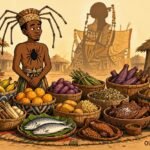
Aïwa entered the world on the same day she lost her mother. Her mother died after a difficult childbirth, and the baby’s first cry came at almost the same moment as her mother’s final breath.
Her father mourned his wife deeply and gave her a grand funeral. But as the years passed, he eventually remarried.
With his second marriage, Aïwa’s life changed.
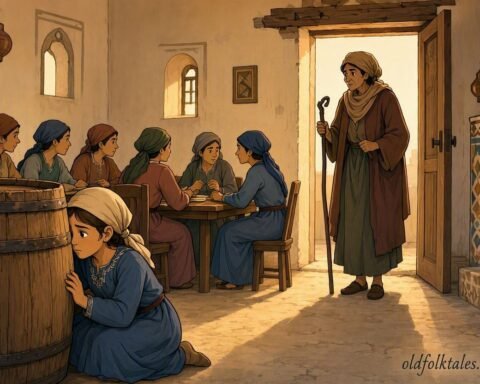
Her stepmother treated her with cruelty. She gave the young girl endless chores, humiliations and insults. Aïwa was expected to rise before everyone else and remain busy until the rest of the household had gone to sleep.
Yet Aïwa did not become bitter.
She remained gentle and cheerful. She smiled even when she was tired. She sang while she worked, and her courage never seemed to disappear.
That happiness irritated her stepmother even more.
Aïwa was beautiful too, and her beauty only increased the woman’s jealousy. The more the girl endured, the more radiant she seemed to become.
Her stepmother could not understand it.
She had tried deprivation.
She had tried insults.
She had tried exhausting work.
Nothing could destroy Aïwa’s cheerful spirit.
So she began searching for a task that would finally defeat the girl.
One morning, she found what she believed would be the perfect challenge.
She took a black cloth and handed it to Aïwa.
“Take this cloth,” she ordered. “Wash it until it becomes as white as kaolin.”
The task was impossible.
A black cloth could not simply be washed until it became white.
Don’t stop yet! See our complete East African folktales collection
But Aïwa did not argue.
She took the cloth and left.
Her smile remained on her face.
She walked away from the village and entered the forest, carrying the black cloth with her.
The deeper she went, the more unfamiliar the surroundings became.
She searched for water that might accomplish what ordinary washing could not.
She tried different places, but the cloth remained black.
She did not give up.
Days passed.
Aïwa continued her search through the forest, moving farther into places that were strange and mysterious.
The task that had been intended as a punishment had become a journey.
Still, she remained determined.
When she reached a quiet and mysterious part of the forest, she found a source of water.
The place was unlike anywhere she had seen before.
The forest seemed unusually silent.
Aïwa was alone.
She held the black cloth and began to sing.
Her song was a call to her mother.
She sang of the cloth.
She sang of her suffering.
She called for the mother she had lost on the very day she was born.
Her voice travelled through the quiet forest.
Then something extraordinary happened.
Aïwa’s dead mother appeared.
The encounter was not like an ordinary meeting between mother and daughter. Her mother came from beyond the world Aïwa knew.
She brought with her a white cloth.
It was whiter than kaolin.
She gave the white cloth to Aïwa and took the black one from her.
Without saying much, she disappeared.
Aïwa was left standing beside the source, holding the beautiful white cloth.
The impossible task had been completed.
But Aïwa had not achieved it through force.
She had endured.
She had continued searching when the task seemed hopeless.
And when she finally reached the mysterious source, her song had brought her into contact with the mother she had lost.
Aïwa returned home carrying the white cloth.
Her stepmother was expecting failure.
She had sent the girl away believing that the impossible task would finally break her spirit.
Instead, Aïwa returned with a cloth whiter than kaolin.
The sight frightened her stepmother.
The cloth was not simply white.
It carried a deeper meaning.
It was connected to the woman who had died years earlier, the first wife of Aïwa’s father.
The stepmother recognised something that made the impossible task suddenly seem much more serious than she had imagined.
Aïwa had gone into the forest as a mistreated orphan carrying a black cloth.
She returned with something that connected her to her mother and to a world beyond the reach of her stepmother’s cruelty.
The girl had survived another attempt to destroy her happiness.
Her stepmother had tried to turn an impossible task into a punishment.
Instead, the task became the beginning of Aïwa’s extraordinary encounter.
The black cloth had taken her away from the village and deep into the forest.
It had forced her to search.
It had tested her patience.
And it had eventually led her to her mother.
Aïwa’s strength was not the strength of someone who never suffered.
She suffered greatly.
But suffering did not change the kindness within her.
She continued to smile.
She continued to sing.
She continued to work.
And she refused to allow cruelty to determine the person she would become.
Her journey through the forest therefore became more than a search for water.
It became a passage from suffering toward hope.
The girl who left home carrying an impossible burden returned with a remarkable gift.
Her stepmother had wanted to silence her smile.
Instead, the ordeal revealed how powerful that smile had always been.
Aïwa’s story reminds us that cruelty does not always have the final word.
Sometimes, the person who appears powerless possesses a strength that cannot easily be broken.
And sometimes an impossible task can lead somewhere no one expected.
Aïwa entered the forest because she was ordered to wash a black cloth.
She returned having found something far more precious: a connection with the mother she had lost and a sign that her suffering had not erased her hope.
Click here to discover more legendary tales from West Africa
Moral Lesson
Cruelty may create suffering, but courage, patience and hope can carry a person through even the most impossible circumstances.
Knowledge Check
1. Why was Aïwa treated badly by her stepmother?
Her stepmother was jealous of her beauty, happiness and courage.
2. What impossible task was Aïwa given?
She was ordered to wash a black cloth until it became as white as kaolin.
3. What did Aïwa do when the task seemed impossible?
She continued searching for a source of water and refused to give up.
4. What happened when Aïwa sang in the forest?
Her deceased mother appeared and gave her a white cloth.
5. What did the white cloth represent?
It represented Aïwa’s extraordinary connection with her deceased mother and the resolution of the impossible task.
6. What is the main lesson of the story?
Perseverance and hope can help someone overcome cruelty and seemingly impossible challenges.
Source
Bernard Binlin Dadié, Le Pagne noir: Contes africains, Présence Africaine, 1955.