At the edge of the Sahara Desert, where ancient kasbahs rose from red earth valleys and caravan roads disappeared into endless dunes, the city of Ouarzazate stood as an important gateway between Morocco’s imperial centers and the vast trade routes of the south. For centuries, merchants, travelers, and royal envoys crossed the harsh desert carrying gold, salt, fabrics, spices, manuscripts, and precious treasures between kingdoms separated by enormous distances.
The desert brought wealth to those who understood its dangers.
But it also swallowed countless lives.
Sandstorms erased entire routes overnight.
Bandits hid among rocky canyons.
And many caravans vanished without explanation beneath the silence of the Sahara.
Among Saharan Moroccan communities, one legend became more famous than all the others.
The story of the Golden Caravan of Ouarzazate.
Even generations later, travelers still whispered about the lost treasure convoy said to have disappeared somewhere between the mountains and the desert dunes, taking unimaginable riches with it into mystery.
The legend began during a period when Morocco’s rulers maintained powerful trade relationships across North Africa and beyond the Sahara. Royal caravans regularly traveled through Ouarzazate carrying taxes, diplomatic gifts, and treasures collected from distant territories.
Keep reading: Discover more Central African folktales
One such caravan became unlike any before it.
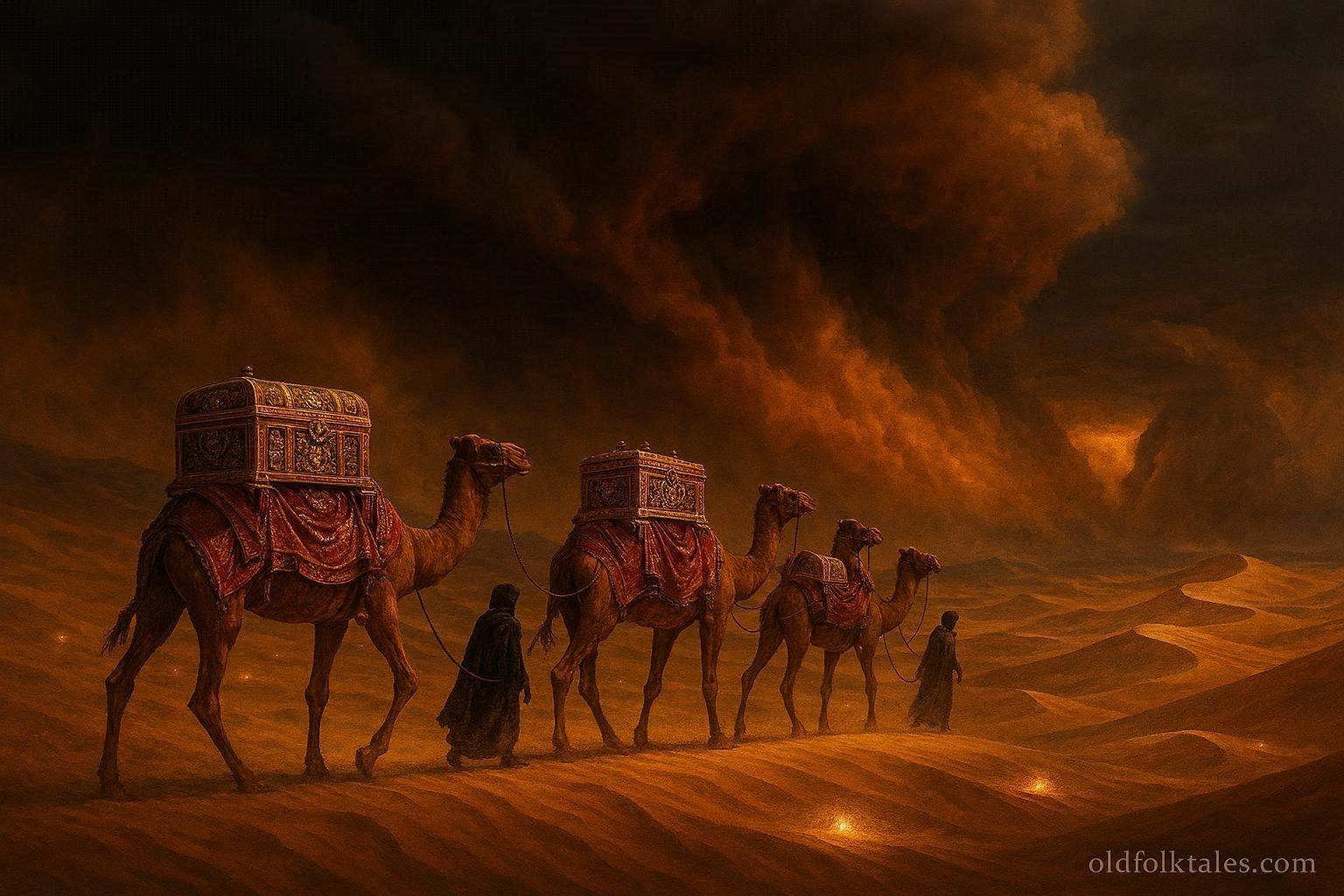
According to oral tradition, Sultan Abdelkarim ordered the transport of an enormous royal treasury from the northern cities toward allied territories far beyond the desert trade routes. The convoy included gold coins, jeweled ornaments, ceremonial weapons, silver chests, silk fabrics, rare manuscripts, and gifts intended for influential desert leaders whose loyalty protected important trade passages.
The journey would be long and dangerous.
To ensure the treasures reached their destination safely, the sultan selected one of the kingdom’s most respected caravan commanders, a man named Farouk.
Farouk was known throughout Morocco for surviving routes that many other guides feared to travel. Calm, disciplined, and highly experienced, he understood the desert better than most men understood their own homes.
He trusted preparation more than luck.
Before every expedition, he studied weather patterns, consulted nomadic guides, and inspected every camel personally.
Many believed no caravan under Farouk’s leadership could ever truly be lost.
Yet the journey that awaited him would test even his knowledge.
The Golden Caravan departed from Ouarzazate beneath clear skies during the cooler months when desert crossings were considered safest. Hundreds of camels stretched across the valley carrying sealed treasure chests protected by armed guards and skilled guides familiar with the southern routes.
Villagers gathered to watch the magnificent convoy disappear toward the horizon.
Sunlight reflected from golden ornaments and decorated saddles while drums echoed across the city walls in celebration of the royal mission.
At first, the journey progressed smoothly.
The caravan crossed rocky plains and narrow valleys without difficulty. At night, campfires illuminated the desert while guards protected the treasure beneath the stars.
But several days into the expedition, unusual events began disturbing the travelers.
One evening, an elderly nomad approached the caravan camp unexpectedly from the darkness.
His clothing was covered in sand, and his face carried the exhaustion of someone who had wandered the desert for many days alone.
The old man warned Farouk that dangerous signs had appeared along the southern routes.
According to him, violent storms moved strangely across the dunes, and travelers reported hearing unexplained sounds echoing through abandoned desert passages at night.
Most unsettling of all, the old nomad claimed another caravan had vanished recently without leaving tracks behind.
Several guards dismissed the warnings as superstition.
But Farouk listened carefully.
The desert rarely gave warnings without reason.
The following morning, he changed the caravan’s route slightly, hoping to avoid unstable weather deeper within the dunes.
For several more days, nothing unusual occurred.
Then the winds changed.
At first, only experienced guides noticed the difference. The air felt heavier. Sand moved strangely across the ground despite calm skies.
The camels became restless.
Birds disappeared entirely from the horizon.
Farouk sensed danger approaching but struggled to identify its source.
One night, while camped near towering rock formations outside the open dunes, several guards reported seeing distant lights moving silently across the desert after midnight.
The lights resembled lanterns carried by travelers.
Yet no sound accompanied them.
No camel bells.
No voices.
Only flickering lights drifting slowly through the darkness before disappearing completely.
Fear spread quietly through the caravan.
Some whispered about desert spirits protecting hidden territories.
Others believed bandits followed them secretly waiting for the right moment to attack.
Farouk increased the guards and ordered strict discipline throughout the camp.
But tension continued growing.
The next evening, a violent sandstorm appeared suddenly from the southern horizon.
The storm moved unnaturally fast.
Within minutes, massive clouds of sand swallowed the sky, turning daylight into darkness.
Farouk immediately ordered the caravan to secure the treasure and move toward nearby rock shelters for protection.
But the storm struck with terrifying force before the convoy could fully regroup.
Winds screamed across the desert.
Camels panicked.
Visibility disappeared completely beneath walls of swirling sand.
Travelers struggled to hear one another even from a few steps away.
For hours, chaos consumed the caravan.
Farouk fought desperately to maintain order while guiding the treasure convoy through the storm.
Then something strange happened.
According to the few survivors who later returned, the storm suddenly became unnaturally silent near the center of the dunes.
The wind stopped.
The air grew cold.
And through the darkness, several travelers claimed they saw shadowy figures moving between the camels carrying lanterns of pale golden light.
No one understood who or what they were.
Moments later, confusion erupted again as sections of the caravan became separated within the storm.
By dawn, the desert stood silent once more.
But the Golden Caravan was gone.
Only scattered supplies, abandoned camels, and broken equipment remained near the edge of the dunes.
Most of the treasure convoy had vanished completely.
Search parties organized from Ouarzazate spent weeks exploring the desert routes without success. They discovered fragments of tracks buried beneath sand but no clear evidence explaining what happened.
No bodies.
No treasure chests.
No complete caravan route.
Even Farouk disappeared without trace.
Rumors spread quickly across Morocco.
Some believed the caravan was destroyed by bandits who buried the treasure somewhere beneath the dunes.
Others insisted the storm itself concealed supernatural forces guarding forbidden desert territory.
Certain storytellers claimed the caravan still wandered the Sahara eternally, appearing during storms before vanishing again into the sands.
Years later, a wandering trader returned to Ouarzazate carrying a strange story.
While lost during a sandstorm, he claimed to see an enormous caravan moving silently through the desert beneath moonlight.
Camels decorated with royal banners crossed the dunes without making sound.
At the front rode a man matching Farouk’s description.
The trader attempted to approach them for help.
But before he reached the caravan, both the travelers and the moonlight disappeared suddenly beneath blowing sand.
The man barely escaped the desert alive.
Over generations, similar stories continued emerging from travelers crossing isolated regions near Ouarzazate.
Some reported hearing distant camel bells during storms despite seeing no caravan nearby.
Others claimed to glimpse golden lights moving across the dunes at night before vanishing completely.
Treasure hunters searched for decades hoping to uncover the lost royal convoy.
Few returned successfully.
And none ever found the missing treasure.
Among Saharan Moroccan communities, the legend of the Golden Caravan became both a mystery and a warning.
Because according to desert tradition, wealth without humility often invites disaster.
The desert, elders say, remembers every ambition carried across its sands.
And sometimes, it chooses never to return what it takes.
Explore the wisdom and wonder of North African folktales
Moral Lesson
Greed and ambition cannot control fate, and respect for nature’s power is essential for survival.
Knowledge Check
- Where is the story set?
It is set near Ouarzazate and the Sahara Desert in Morocco. - What was the Golden Caravan carrying?
It carried royal treasures, gold, manuscripts, and valuable gifts. - Who led the caravan?
An experienced caravan commander named Farouk led the expedition. - What warning did the old nomad give?
He warned about strange storms and disappearing caravans in the desert. - What happened during the sandstorm?
The caravan vanished mysteriously within the storm. - What lesson does the story teach?
Human ambition cannot overcome the dangers and mysteries of nature.
Source
North African folklore. Adapted from trans-Saharan trade legends preserved in Moroccan oral history and desert folklore studies.