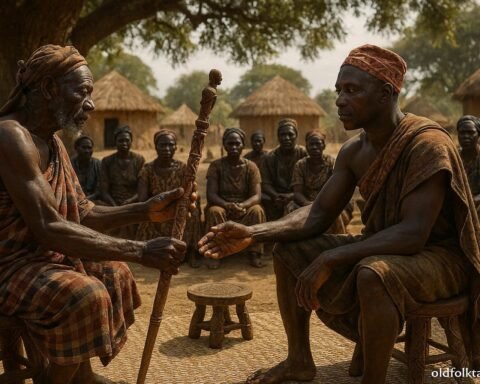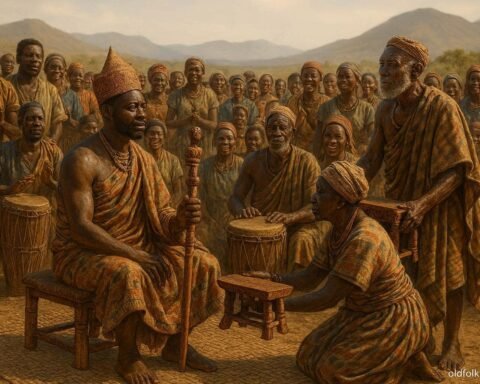
Across the woodlands and open plains of eastern Angola, the Chokwe people preserved knowledge in many remarkable ways. Elders shared history through storytelling, musicians passed traditions from one generation to the next with songs, and skilled craftsmen expressed cultural identity through carving and weaving. Among these treasured customs was another practice that quietly combined art, education, memory, and careful reasoning.
This tradition was known as sona.
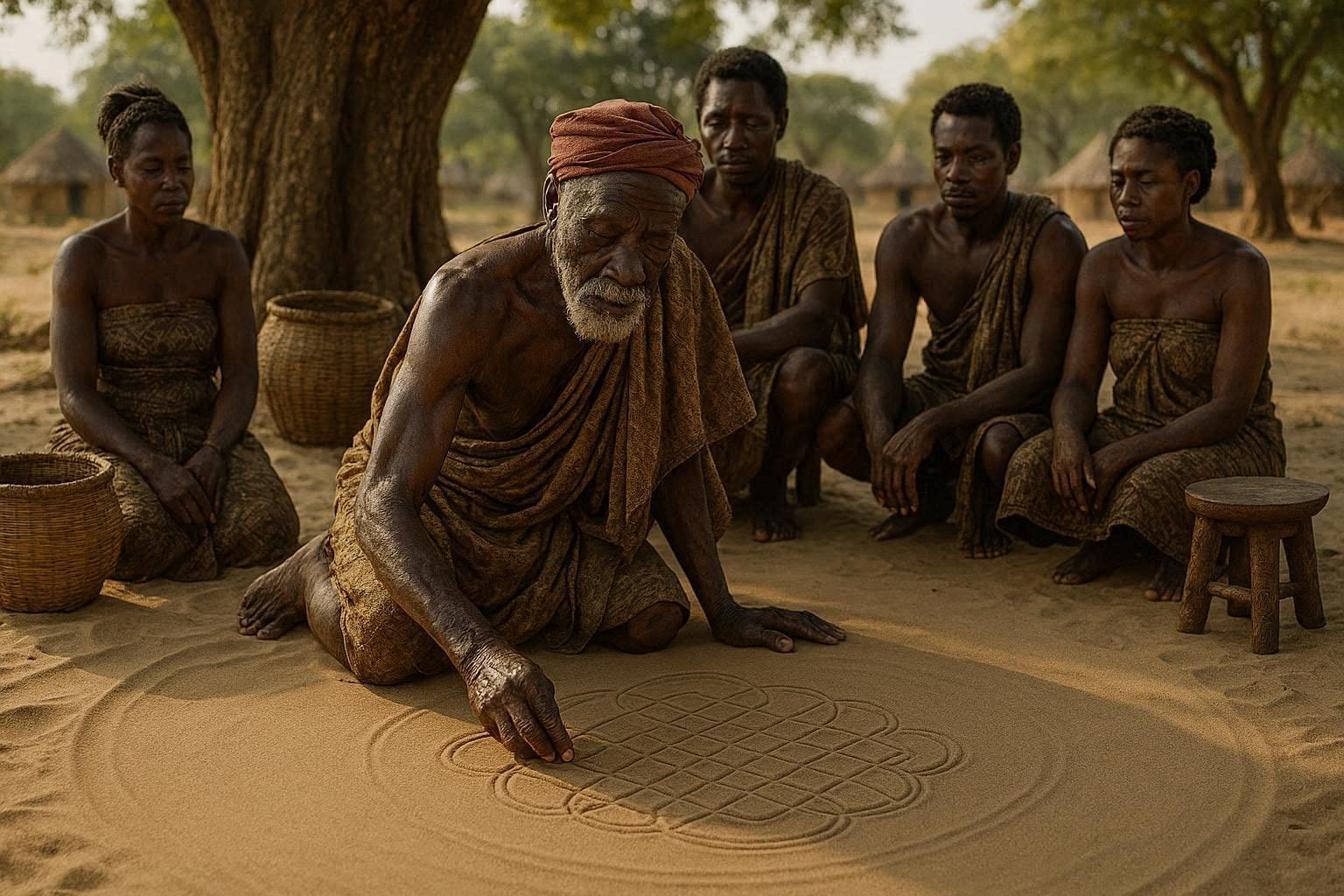
Unlike books filled with written words, sona consisted of carefully drawn geometric figures traced into smooth sand. To an unfamiliar visitor, these intricate patterns appeared to be little more than decorative designs. Yet the Chokwe elders knew that every line carried meaning. Hidden within the drawings were stories about animals, families, cooperation, wisdom, and the responsibilities people owed to one another. The patterns also challenged young learners to think carefully, recognize relationships, and solve problems through observation and logic.
One village was especially well known for its skilled sona masters.
People traveled from neighboring communities to watch experienced elders create astonishing designs using only a single finger and smooth ground prepared beneath the shade of large trees.
Among the children who often watched these demonstrations was a curious boy named Mwepu.
If you liked this story, see our Central African folktales collection
Every afternoon, after helping his family with daily chores, Mwepu hurried to the gathering place where the elders taught.
He admired the graceful movements of their hands as lines appeared across the sand.
Some drawings resembled winding paths.
Others looked like stars, woven nets, or the branches of great trees.
No matter how closely he watched, he could never understand how the elders completed such complicated figures without lifting their fingers.
One day he finally gathered enough courage to ask.
“Grandfather,” he said respectfully to the oldest teacher, “are these drawings only meant to be beautiful?”
The elder smiled gently.
“If beauty were their only purpose,” he replied, “we would not spend generations teaching them.”
The answer surprised the young boy.
The elder invited him to sit beside the smooth patch of sand.
Using a stick, he marked several evenly spaced points.
He then erased the stick marks and used only his finger to connect the invisible pattern in one continuous movement.
When the drawing was complete, it formed an elegant design that surrounded every point without crossing itself carelessly.
“What do you see?” the elder asked.
Mwepu hesitated.
“I see lines.”
The elder nodded.
“And what else?”
The boy studied the drawing again.
After several moments he noticed something new.
“The lines work together.”
The elder smiled.
“Exactly.”
He explained that every part of the design depended upon every other part.
Removing even one section would change the entire figure.
The lesson, he said, reflected life within the community.
Families depended upon one another just as every line depended upon the whole design.
During the following weeks Mwepu attended every lesson.
The elders never rushed their teaching.
Instead, each drawing introduced a different story.
One sona pattern accompanied a tale about hunters who succeeded only because they cooperated instead of competing.
Another illustrated how neighbors shared water during a long season of drought.
A third explained why patience often solved problems that force could not.
Each story ended with questions rather than immediate answers.
The elders encouraged children to examine the drawings carefully before offering their thoughts.
Sometimes there were many correct observations.
Learning required careful thinking rather than memorizing fixed responses.
As Mwepu grew more confident, he attempted to create his own sona figures.
At first, his finger wandered uncertainly through the sand.
Lines crossed where they should not.
Patterns ended before they were complete.
Instead of criticizing him, the elders encouraged him to begin again.
One teacher reminded him that every mistake revealed another opportunity to learn.
Gradually his movements became steadier.
He learned to imagine the entire pattern before touching the sand.
He discovered that successful drawings required patience, planning, and concentration.
The elders explained that these same qualities guided wise decision making throughout life.
One afternoon, visitors arrived from another Chokwe settlement.
Among them was an elderly sona master famous for creating particularly difficult designs.
Children gathered eagerly as he prepared the smooth sand.
Without speaking, he placed a series of points across the surface.
Then, with remarkable confidence, he traced an elaborate figure in one uninterrupted motion.
When he finished, the children applauded.
Mwepu stared in amazement.
The visiting elder laughed kindly.
“You admire the finished drawing,” he said.
“But the true work happened before my finger touched the sand.”
He explained that every pattern first existed in the mind.
Careful thought always came before skilled action.
Those words remained with Mwepu for many years.
As seasons passed, the lessons became increasingly challenging.
Some sona figures represented journeys requiring thoughtful choices.
Others illustrated fairness by showing balanced paths connecting every point equally.
The elders occasionally invited students to complete unfinished designs, encouraging them to predict how each pattern should continue.
These activities strengthened observation, reasoning, and creativity at the same time.
Parents noticed changes in the children who regularly attended the lessons.
They solved disagreements more patiently.
They planned their work more carefully.
They listened before speaking.
The education offered through sona extended far beyond drawing patterns.
It shaped the way young people approached everyday life.
Years later, Mwepu himself became an accomplished sona teacher.
Children gathered beneath the same large tree where he had once sat as an eager apprentice.
He began every lesson with the same question that had once changed his own understanding.
“What do you see?”
Most children answered exactly as he once had.
“I see lines.”
Mwepu smiled.
“And what else?”
Slowly they discovered that every drawing contained stories waiting to be understood.
One dry season, a disagreement arose between two neighboring families over the boundary between their farms.
Rather than allowing the argument to grow, the village elders invited everyone to gather beneath the teaching tree.
Instead of beginning with speeches, Mwepu quietly drew a familiar sona pattern.
He asked both families to explain what they observed.
As they described how every line depended upon the others, they gradually recognized the lesson themselves.
Communities remained strongest when every person considered the well being of others.
The discussion that followed ended peacefully.
The families reached an agreement without anger.
Many people later remarked that a simple drawing in the sand had accomplished what long arguments could not.
As generations passed, the Chokwe continued preserving the tradition of sona.
Although wind erased each drawing within hours, the knowledge itself never disappeared.
Students carried the lessons in their memories.
Teachers shared them with new learners.
Parents encouraged their children to observe carefully, think patiently, and value wisdom above haste.
Modern researchers later became fascinated by sona.
Ethnographers documented the stories associated with the drawings, while mathematicians recognized the remarkable geometric reasoning embedded within many of the patterns.
Educators around the world admired the tradition as a powerful example of learning that united art, storytelling, mathematics, and moral education.
Today, sona remains one of the most celebrated intellectual traditions of the Chokwe people.
Its patterns continue to inspire scholars, artists, and teachers while reminding the world that knowledge can be preserved in many forms.
The story of Sona: The Sand Drawings of Wisdom reminds us that the simplest classroom may be a patch of smooth sand, and that the greatest lessons often begin with a single thoughtful line.
Explore more Southern African folktales here
Moral Lesson
True wisdom grows through observation, patience, and a willingness to learn from every lesson, no matter how simple it may seem.
Knowledge Check
1. What is sona?
Sona is a Chokwe tradition of creating geometric sand drawings to teach stories, moral lessons, and logical thinking.
2. What did Mwepu first think the drawings were?
He believed they were only beautiful patterns.
3. What did the elders teach through the sona drawings?
They taught wisdom, cooperation, history, creativity, and careful reasoning.
4. Why did the visiting sona master say the real work happened before drawing?
Because careful planning and thoughtful thinking came before making the first line.
5. How did Mwepu use a sona drawing to settle a dispute?
He used it to help two families understand the importance of cooperation and mutual responsibility.
6. What is the main lesson of the story?
Knowledge becomes lasting wisdom when it is shared with patience and understanding.
Source
Adapted from Chokwe oral traditions, documented sona sand drawing practices, ethnomathematics research, and materials preserved in Chokwe sona archives and ethnomathematics collections.