In the rolling plains and woodlands of central Angola, music was more than entertainment. It accompanied births and weddings, welcomed visitors, comforted grieving families, encouraged farmers during harvests, and united entire villages during festivals. Every melody carried meaning, and every rhythm connected people to the memories of those who had come before them.
Among the Mbundu, one instrument held a particularly special place in community life.
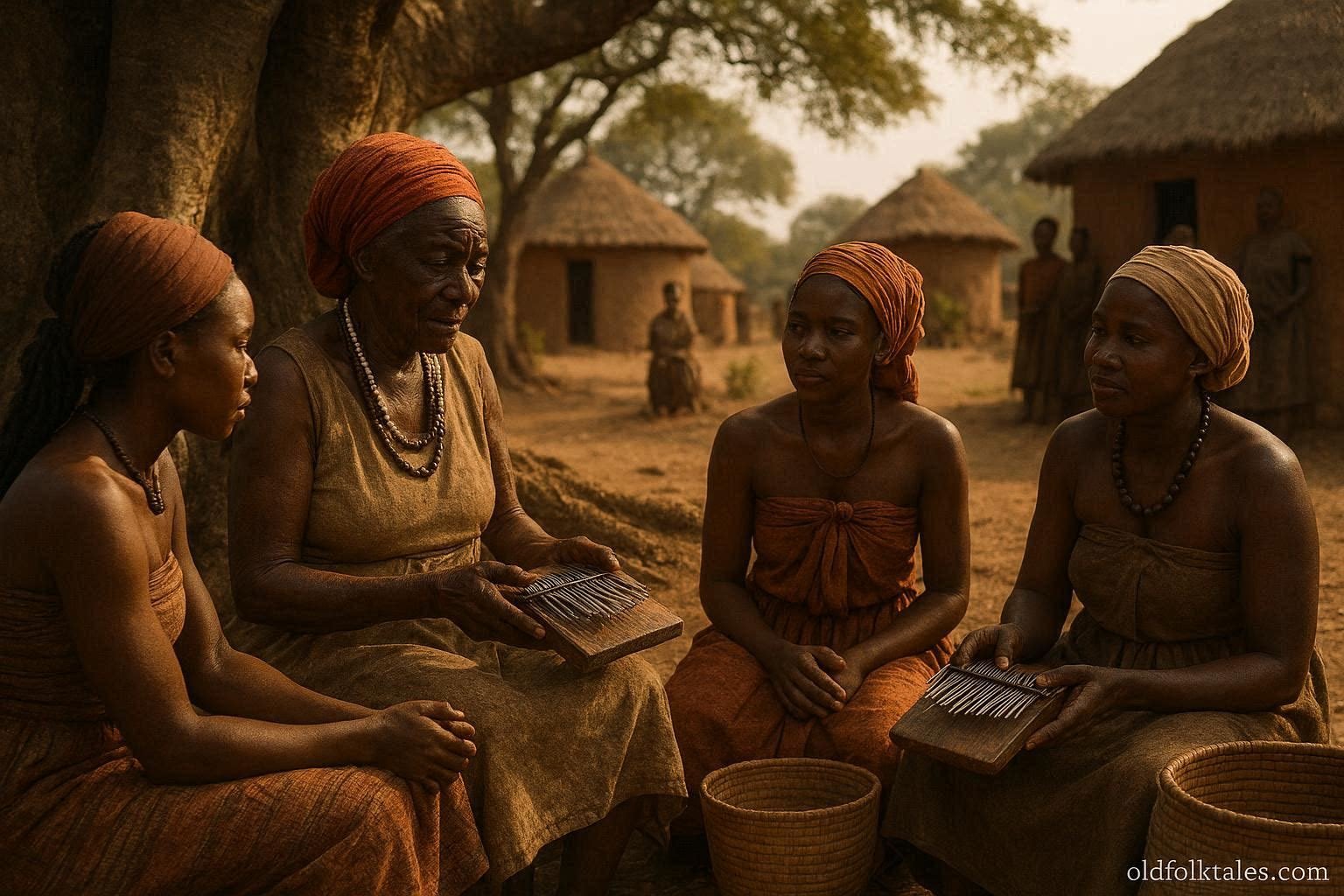
It was the kissange, a beautifully crafted thumb piano made from a wooden soundboard fitted with carefully shaped metal keys. Though modest in appearance, its gentle melodies carried remarkable depth. Elders often remarked that a single performance on the kissange could recall stories that even the oldest storyteller might forget.
While many members of the community learned to play the instrument, oral traditions speak especially of a respected circle of women who became its greatest guardians. They were admired not only for their musical talent but also for their extraordinary memories. Through songs performed on the kissange, they preserved family histories, celebrated important events, and reminded younger generations of the values that shaped Mbundu society.
Don’t stop yet! See our complete East African folktales collection
Among these women was a gifted musician named Kambela.
From childhood, Kambela had been fascinated by music. Whenever she heard the soft notes of the kissange drifting through the evening air, she quietly followed the sound until she found the musicians performing beneath the shade of large trees or beside glowing cooking fires.
She watched every movement of their hands.
She listened carefully to every melody.
Before long, one of the village’s oldest musicians noticed her curiosity.
The elder invited Kambela to sit nearby and observe more closely.
“The kissange does more than produce beautiful sounds,” she explained.
“It remembers.”
Those words remained with Kambela throughout her life.
Under the guidance of experienced musicians, she gradually learned how to tune the metal keys, create balanced rhythms, and accompany traditional songs. Her teachers insisted that every melody carried a purpose. Some celebrated joyful occasions, while others honored respected ancestors or recalled important moments in the community’s history.
Learning the instrument required patience.
The young apprentice practiced every day.
At first, her fingers moved awkwardly across the keys.
Sometimes she forgot melodies.
Sometimes her rhythm faltered.
Rather than becoming discouraged, she practiced with determination until every movement became natural.
Years passed.
Kambela’s confidence grew, and so did her understanding of the traditions connected to the kissange.
She soon realized that the songs themselves were as important as the instrument.
Each one carried knowledge.
Some described the founding of villages.
Others praised hardworking farmers.
Many reminded listeners that generosity strengthened families while selfishness weakened communities.
When elders grew older, they entrusted Kambela with an important responsibility.
She was asked to help preserve songs that only a few people still remembered.
The task demanded extraordinary concentration.
She listened as elderly women sang melodies learned from their own grandmothers decades earlier.
Rather than changing the words or rhythms, Kambela carefully memorized every detail.
She believed that even the smallest variation could alter the meaning passed from one generation to the next.
Soon, younger girls began gathering around her just as she had once gathered around her own teachers.
She welcomed them warmly.
Instead of treating knowledge as a secret, she believed music became stronger when shared.
Lessons often took place beneath a large tree at the center of the village.
The girls first learned to care for the instrument.
They polished its wooden surface, adjusted the metal keys, and practiced producing clear, gentle notes.
Only after mastering these basics did Kambela begin teaching the traditional songs.
Each lesson included more than music.
She explained the stories behind every melody.
One song recalled a season of abundant harvests that had saved several neighboring communities from hunger.
Another praised women whose weaving skills became famous throughout the region.
Others celebrated acts of kindness, courage, and cooperation.
The girls soon discovered that every performance carried history within its notes.
One dry season, a traveling merchant arrived from a distant settlement.
During an evening gathering, he listened as Kambela and her students performed several traditional songs.
When the music ended, he remarked that some melodies sounded familiar.
His own grandmother had taught similar songs many years before.
The discovery delighted everyone present.
It reminded the community that music could travel across great distances while preserving shared cultural roots.
As the years passed, Kambela’s reputation spread throughout neighboring villages.
Families invited her to perform during important celebrations.
Young musicians traveled long distances to learn from her.
Visitors admired not only her musical skill but also the respect she showed toward the traditions entrusted to her care.
One year, severe storms damaged several homes and disrupted normal village life.
People worked tirelessly to rebuild what had been lost.
Although everyone remained busy, Kambela insisted that evening musical gatherings should continue.
Some questioned her decision.
She explained that songs provided more than entertainment.
They reminded people of their shared identity and gave them strength during difficult times.
As rebuilding progressed, the familiar melodies encouraged cooperation and restored hope.
The community emerged stronger than before.
In later years, Kambela herself became one of the respected elders she had once admired.
Her hair turned silver, but her hands continued to move gracefully across the kissange.
Children gathered eagerly to hear both her music and the stories hidden within each song.
Whenever asked why she devoted so much time to teaching others, she smiled.
“A song forgotten is a memory lost,” she would say.
“But a song shared becomes a bridge between generations.”
Her students carried those words wherever they traveled.
Some established musical gatherings in distant villages.
Others taught their own children.
The tradition continued, not because it was written in books, but because dedicated people cared enough to preserve it.
Today, the kissange remains one of Angola’s best-known traditional instruments, celebrated for its distinctive sound and cultural significance.
Its melodies continue to accompany storytelling, ceremonies, and community gatherings.
The women remembered in Mbundu oral traditions remind us that history is preserved not only through written records but also through music, memory, and patient teaching.
The story of the Women of the Kissange celebrates creativity, heritage, and the quiet determination of those who dedicate their lives to preserving culture.
Their legacy lives on every time the gentle notes of the kissange echo across an Angolan village, carrying with them the voices of generations past.
Love this story? Discover our full Southern African folktales collection
Moral Lesson
Culture survives when knowledge is shared with care and passed faithfully from one generation to the next.
Knowledge Check
1. What is the kissange?
A traditional thumb piano used in Angola to accompany songs and storytelling.
2. Why were the women who played the kissange respected?
They preserved songs, history, and cultural traditions through music.
3. What did Kambela believe about traditional songs?
That every melody carried important history and values that should be preserved.
4. Why did Kambela continue musical gatherings after the storms?
Because music strengthened the community and reminded people of their shared identity.
5. What did younger girls learn alongside music?
They learned the stories, history, and cultural values connected to each song.
6. What is the main lesson of the story?
Sharing knowledge and traditions helps preserve a community’s heritage.
Source
Adapted from Mbundu oral traditions, Angolan musical heritage, ethnographic studies of the kissange, and materials preserved in Angola musical heritage archives.