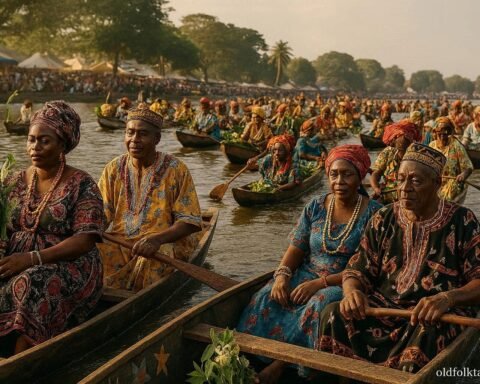
Where the Wouri River widens before meeting the Atlantic Ocean, generations of the Duala people built thriving river communities whose lives were closely connected to the water. The broad estuary provided abundant fish, served as a gateway for commerce, and linked villages that might otherwise have remained separated by forests and winding waterways. Long before modern roads reached the region, canoes carried families, traders, messengers, and visitors from one community to another.
Among the most respected craftsmen were the master canoe builders.
Their work demanded patience, precision, and deep knowledge of the forests surrounding the river. Every canoe began as a carefully selected tree. Elders taught that only healthy, mature trees should be chosen and that each one should be used wisely, ensuring that the forest continued providing for future generations.
The people often said that a well-built canoe was more than a vessel.
It became a bridge between communities.
It carried harvests to market.
It reunited families during festivals.
It transported elders who settled disputes and strengthened friendships between neighboring villages.
One respected canoe builder was an elderly craftsman named Ekema.
For many decades he had shaped graceful wooden canoes that traveled safely across the Wouri River and its many channels. His work was admired because every canoe balanced strength with careful design, allowing it to move steadily through calm waters and changing tides.
Don’t miss out: Read more Southern African folktales
As the years passed, Ekema accepted a young apprentice named Mbolo.
Mbolo admired the large canoes that returned each evening filled with fishermen, merchants, and travelers. He dreamed of building vessels that would one day carry people throughout the estuary.
On his first day, however, he was surprised.
Instead of carving wood, Ekema handed him simple tasks.
He swept the workshop.
He gathered tools.
He learned to sharpen carving blades.
For several weeks he never touched a canoe.
Finally, unable to hide his curiosity, Mbolo asked why.
The old craftsman smiled.
“A canoe is shaped long before the first cut is made.”
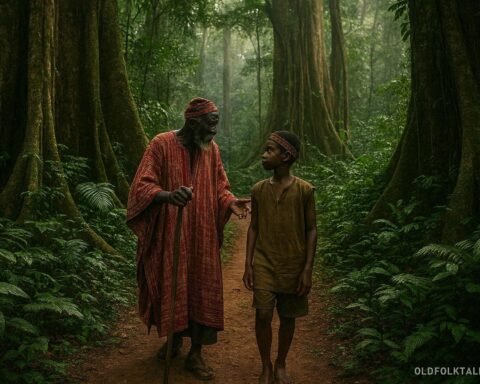
He led the apprentice into the forest where towering trees grew beneath the warm tropical sky.
Ekema carefully examined each tree before moving to the next.
Some stood too close to rivers where the wood absorbed excessive moisture.
Others were too young.
A few showed hidden cracks beneath their bark.
Only after many hours did he stop beside a tall hardwood tree.
“This one,” he said quietly.
Mbolo wondered why this tree had been chosen while so many others had been rejected.
“The canoe must begin with good character,” Ekema explained.
“If its foundation is weak, no amount of skill can correct it.”
The apprentice remembered those words.
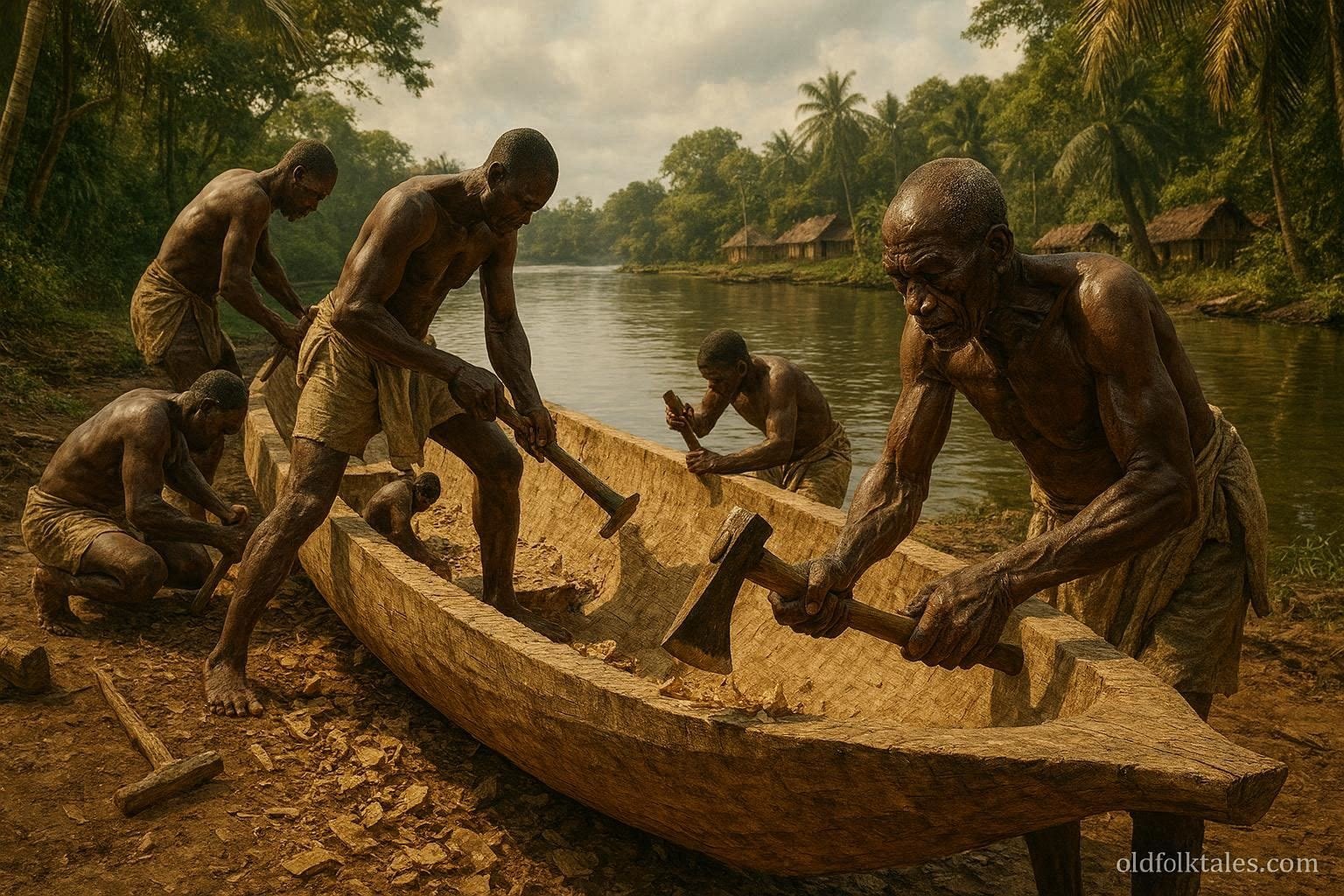
After the tree had been prepared according to community customs, the real work began.
Together they carefully shaped the long trunk into the outline of a canoe.
The work required steady hands rather than great strength.
Each stroke removed only what was necessary.
Whenever Mbolo tried rushing ahead, Ekema reminded him that one careless mistake could weaken the entire vessel.
Weeks turned into months.
Gradually the canoe took shape.
Its smooth sides reflected countless hours of careful craftsmanship.
Its balanced form allowed it to move easily across the water.
When the final polishing was complete, the villagers gathered along the riverbank to watch its first journey.
The canoe glided gracefully through the water.
Children cheered from the shore.
Fishermen nodded with approval.
The elders congratulated both teacher and apprentice.
Soon the new canoe began serving the community.
At sunrise it carried fishermen to productive fishing grounds.
Later it transported baskets of smoked fish, woven mats, palm oil, and pottery to neighboring settlements.
On festival days it carried families dressed in colorful traditional clothing as they traveled to celebrate important ceremonies with relatives across the river.
One season, unusually heavy rains caused the river to rise higher than expected.
Several smaller crossings became difficult to navigate.
Many people depended upon the larger canoes to reach nearby communities safely.
Ekema organized experienced canoe builders and skilled navigators to inspect every vessel before each journey.
“We are not only protecting canoes,” he told Mbolo.
“We are protecting lives.”
The apprentice realized that every careful decision made in the workshop affected families throughout the region.
During another journey, traders from distant communities arrived carrying salt, woven cloth, carved wooden objects, and other valuable goods.
Although they spoke different languages, the river welcomed them all.
The canoes became places where merchants exchanged stories as readily as merchandise.
Friendships formed across cultural boundaries.
Children learned unfamiliar songs.
Visitors returned home with new ideas alongside their purchases.
Mbolo noticed that the canoe often carried something more valuable than trade.
It carried understanding.
Years later, Ekema grew too old to continue building large vessels.
The community gathered to honor his many decades of service.
Fishermen thanked him for dependable boats.
Merchants praised the journeys his canoes had made possible.
Village elders spoke of the peaceful relationships strengthened through travel along the river.
When the ceremony ended, Ekema presented Mbolo with his favorite carving adze.
“The tool is only wood and iron,” the old craftsman said.
“What matters is the care of the hands that use it.”
Mbolo accepted the gift with gratitude.
He became the community’s new master canoe builder.
Just as his teacher had done, he welcomed young apprentices into the workshop.
Before teaching them to carve, he first taught them to observe.
Before shaping wood, he taught them to respect the forest.
Before launching a canoe, he reminded them of the people whose hopes would rest upon their work.
Generations continued passing these lessons from one builder to the next.
Although new forms of transportation eventually appeared, the traditional canoe remained an enduring symbol of the Duala people’s connection to the Wouri River and to one another.
Today, historians and ethnographers recognize traditional canoe building as an essential part of the cultural heritage of the Wouri estuary. Oral traditions continue to celebrate the master builders whose craftsmanship connected communities through fishing, trade, diplomacy, and shared experience.
The story of The Great Canoes of the Wouri reminds us that true craftsmanship is measured not only by what we build but by the relationships our work helps create.
Explore more Southern African folktales here
Moral Lesson
The greatest skills are those that strengthen communities and bring people together.
Knowledge Check
1. Why were canoes important to the Duala communities?
They connected villages through fishing, trade, travel, and diplomacy.
2. What did Ekema teach Mbolo before carving a canoe?
To choose the right tree carefully and understand that strong work begins with a good foundation.
3. Why did the master refuse to rush the work?
Because careful craftsmanship ensured the canoe would be safe and durable.
4. How did the canoes help during the rainy season?
They safely transported people across the swollen river when smaller crossings became dangerous.
5. What gift did Ekema give Mbolo?
His favorite carving adze, symbolizing the responsibility of preserving the craft.
6. What is the main lesson of the story?
True craftsmanship serves people and strengthens relationships within the community.
Source
Adapted from Duala oral traditions, Wouri estuary ethnographic studies, and historical research on traditional canoe building in coastal Cameroon.