Rising above the plains of northern Cameroon, the Mandara Hills have long been home to resilient communities whose lives were shaped by farming, craftsmanship, and cooperation. Among the rocky slopes and terraced fields, the Mafa and neighboring peoples built villages that thrived through hard work and mutual support. Every planting season, every harvest, and every new home depended upon the skills of artisans who transformed the resources of the mountains into tools for everyday life.
Among all craftsmen, none were more respected than the blacksmiths.
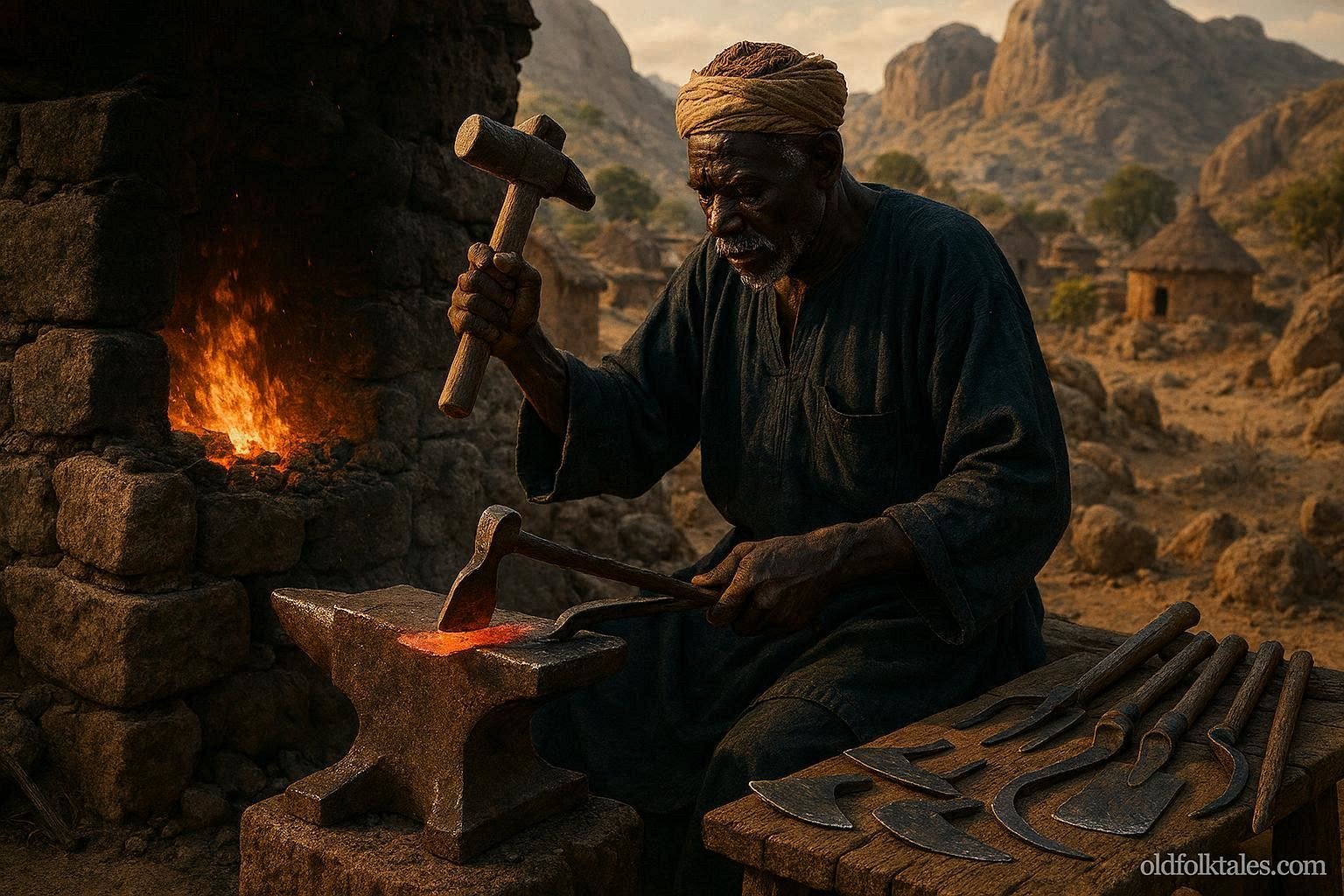
Their workshops echoed with the steady rhythm of hammers striking glowing iron. From dawn until sunset, they shaped hoes for farmers, knives for households, spearheads for hunters, and tools for builders. Their work supported nearly every family in the community, and their knowledge was carefully preserved from one generation to the next.
The elders often reminded young people that iron was more than metal.
In the hands of a wise blacksmith, it became food for hungry families, shelter for growing villages, and prosperity for future generations.
Continue your journey: Read more East African folktales
One such blacksmith was an elderly master named Gwanda.
For more than forty years, he had worked beside the same stone forge near the edge of the village. Farmers trusted his craftsmanship because his tools remained strong through many seasons of planting and harvest.
Although many admired his skill, Gwanda never considered himself greater than anyone else.
He believed every tool existed to serve the community.
As his hair turned gray, he realized the time had come to pass his knowledge to another generation.
Among the young apprentices working in his workshop was a determined young man named Bako.
Bako possessed quick hands and sharp eyes.
He learned new techniques faster than the other apprentices.
Within months he could shape simple farming tools without assistance.
His growing confidence pleased Gwanda, but it also worried him.
The young apprentice had begun believing that speed mattered more than patience.
One morning, Bako proudly completed a new farming hoe before any of the other apprentices.
He smiled as he presented it to his teacher.
Gwanda examined the tool quietly.
Without speaking, he handed it to an elderly farmer waiting nearby.
The farmer tested its balance.
He studied the handle.
Finally he returned it gently.
“It is beautiful,” the farmer said.
“But it will not last through a full planting season.”
Bako looked surprised.
The edge had been shaped correctly.
The handle fit comfortably.
He could not understand the problem.
Gwanda invited him closer to the forge.
He placed another piece of iron into the fire.
“Watch carefully,” he said.
The master waited patiently as the metal gradually became bright with heat.
Only then did he remove it from the fire.
He struck it steadily, never rushing.
Between each series of hammer blows, he returned the iron to the flames.
Again and again he repeated the process.
Hours later, a second hoe lay beside the first.
To Bako, both appeared nearly identical.
Gwanda handed the new tool to the farmer.
The old man smiled immediately.
“This one will serve my family for many years.”
Bako finally understood.
The difference could not always be seen.
It rested within the strength carefully built through patience.
From that day forward, Gwanda’s lessons changed.
Instead of teaching only technique, he explained the purpose behind every task.
A hoe represented future harvests.
A knife prepared family meals.
A hammer built homes.
Every tool connected the blacksmith to people he might never meet.
Weeks later, traders arrived from neighboring villages carrying grain, woven cloth, pottery, and salt.
Many stopped at Gwanda’s workshop before continuing their journey.
Strong iron tools from the Mandara Hills were widely respected throughout the region.
The traders explained that communities preferred buying tools crafted by patient masters because they remained dependable through years of hard work.
Bako realized the reputation of the workshop had been built slowly through generations of honest craftsmanship.
One afternoon, a traveler requested several farming tools before the rainy season began.
The order was larger than usual.
Bako suggested finishing the work as quickly as possible.
“If we hurry,” he said, “we can complete twice as many.”
Gwanda shook his head.
“A poor tool wastes more time than a careful craftsman.”
Together they worked steadily, inspecting every blade before it left the workshop.
The traveler departed satisfied, promising to return the following year.
As the seasons passed, Bako’s skill continued improving.
He learned how different soils required slightly different tools.
He adjusted the balance of hoes for older farmers whose hands had grown weaker.
He crafted lighter implements for younger workers beginning their first planting season.
The forge became more than a place of production.
It became a place of service.
One dry season brought unexpected hardship.
Several villages faced poor harvests after irregular rains.
Many families could no longer afford new tools.
Some craftsmen refused to continue working without immediate payment.
Gwanda chose another path.
He instructed his apprentices to continue repairing damaged hoes and knives for struggling farmers.
“The fields cannot wait for better times,” he explained.
“If the harvest fails again, everyone will suffer.”
Bako watched families return gratefully to their farms.
Months later, when harvests improved, many returned voluntarily with grain and other gifts to thank the workshop.
The kindness shown during difficult days strengthened friendships across the region.
Years later, Gwanda grew too old to work beside the forge every day.
The villagers gathered to honor his lifetime of service.
Rather than praising the number of tools he had made, they spoke about the families he had helped, the apprentices he had trained, and the prosperity his work had brought to countless households.
When the time came for Bako to become the village’s master blacksmith, Gwanda presented him with the old forging hammer that had served him throughout his life.
“It is only iron and wood,” Bako said respectfully.
Gwanda smiled.
“No.”
“It carries every lesson the forge has ever taught.”
From that day, Bako guided new apprentices with the same patience he had once learned.
Whenever eager students rushed their work, he repeated the lesson that had changed his own life.
“The hands that use this tool are trusting yours.”
Generations passed.
The sound of hammers continued echoing through the Mandara Hills.
The names of individual blacksmiths gradually faded from memory, but the values they preserved endured.
Communities remembered that strong craftsmanship depended upon patience, honesty, and service rather than speed alone.
Today, researchers studying the Mandara Mountains recognize the region’s long tradition of ironworking as one of the foundations of local agriculture, trade, and community life. Oral traditions continue to honor the master blacksmiths whose skill supported generations of farmers and artisans throughout northern Cameroon.
The story of The Iron Masters of the Mandara Hills reminds us that true craftsmanship is measured not only by what we create but also by the lives our work improves.
Click here to explore more Central African folktales
Moral Lesson
The greatest craftsmanship combines skill with patience, integrity, and a commitment to serving others.
Knowledge Check
1. Why were blacksmiths highly respected in the Mandara Hills?
They made and repaired tools that supported farming, trade, and daily life.
2. What mistake did Bako make at the beginning of the story?
He believed working quickly was more important than working carefully.
3. What lesson did Gwanda teach using the two farming hoes?
That patience creates stronger and longer-lasting work than haste.
4. Why did Gwanda continue repairing tools during the difficult season?
He wanted farmers to continue working so the community could recover from poor harvests.
5. What did Gwanda give Bako before retiring?
His old forging hammer, symbolizing the knowledge and values of the craft.
6. What is the main lesson of the story?
True craftsmanship is about serving people with care, patience, and excellence.
Source
Adapted from Mafa and Mandara Mountains oral traditions, ethnographic studies of traditional ironworking, and materials preserved in the Mandara Mountains ethnographic archives.