Across the fertile plains of the Tunisian Sahel, where ancient olive trees stretch across the landscape from village to village, farming has shaped everyday life for thousands of years. The region’s mild climate and rich soil have long made it one of North Africa’s most important centers of olive cultivation. Every harvest season, families gather beneath silver-green branches to collect the fruit that has sustained both their communities and their traditions for generations.
Yet the olive harvest is remembered not only for its abundant crops.
It is also remembered for its songs.
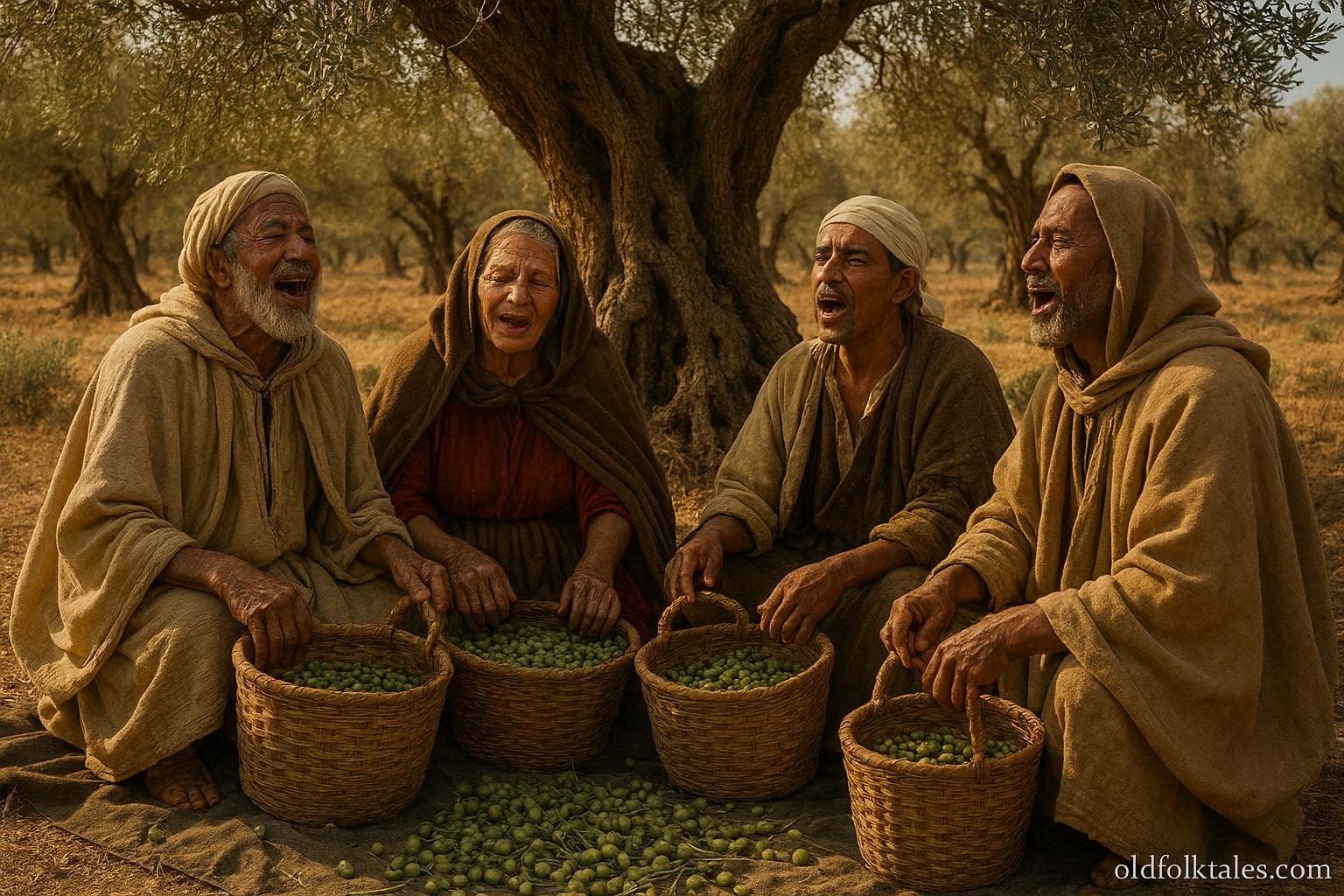
Known throughout the villages of the Sahel, these harvest songs have been passed from one generation to the next. Sung while families worked together among the olive trees, they celebrated gratitude for the land, encouraged cooperation, and reminded everyone that every successful harvest depended upon unity as much as hard work.
In one small village lived a young farmer named Sami.
Although he had helped gather olives since childhood, he paid little attention to the songs sung by his parents and grandparents. To him, they were simply familiar melodies carried by the autumn breeze.
Don’t stop yet! See our complete East African folktales collection
His grandmother, Amina, thought differently.
“These songs are part of our harvest,” she often said.
“If the olives feed our bodies, the songs nourish our hearts.”
As the next harvest season approached, families throughout the village prepared their tools, woven baskets, and linen cloths used for gathering olives beneath the trees.
Neighbors agreed on schedules so that everyone could help one another from grove to grove.
No family harvested alone.
The success of one household strengthened the entire community.
Before sunrise on the first day, villagers gathered beneath the oldest olive tree near the edge of the fields.
The village elder offered a prayer of gratitude for the coming harvest and wished for safety, cooperation, and abundance.
As the work began, voices slowly rose into the crisp morning air.
The harvest songs returned once again.
Some songs thanked the Creator for the gift of fertile land.
Others praised the patience of farmers who cared for trees through every season.
Many celebrated friendship, family, and the joy of sharing the harvest together.
Their steady rhythm helped workers keep time as baskets gradually filled with olives.
Sami noticed something he had never observed before.
Whenever the singing grew stronger, the work seemed lighter.
Laughter spread more easily.
Children learned the melodies while working beside their parents.
Even visitors from neighboring villages joined the chorus.
One afternoon, a sudden wind scattered freshly gathered olives across the ground.
Instead of complaining, nearby families immediately stopped their own work to help collect them.
As they worked together, the singing continued without interruption.
Amina smiled.
“The songs remind us,” she said, “that we harvest together.”
Later that week, Sami asked one of the oldest singers where the melodies had come from.
The elder replied gently.
“No one remembers who first sang them.”
“They belong to every generation.”
“Each family adds its voice, and each generation passes them forward.”
Those words remained with Sami.
As the harvest continued, baskets overflowed with olives destined for the village press.
There, skilled workers carefully transformed the fruit into fragrant olive oil, a product valued throughout Tunisia for cooking, hospitality, and celebration.
Before the first jars were distributed, villagers shared a simple meal together beneath the olive trees.
Fresh bread, olives, and newly pressed oil were placed on long tables where everyone was welcome.
No one ate alone.
The songs returned once more, this time celebrating gratitude rather than labor.
Years passed.
Sami grew into one of the village’s respected farmers.
Whenever new harvest seasons arrived, he encouraged children to learn both the farming techniques and the traditional songs.
He reminded them that healthy trees required careful hands, but thriving communities required grateful hearts.
Visitors often admired the beauty of the ancient olive groves.
Sami welcomed them warmly.
Yet he always explained that the true harvest could not be measured only by the baskets of olives collected each autumn.
It could also be heard in the voices of neighbors singing together beneath the trees.
Today, the olive-growing traditions of the Tunisian Sahel remain an important part of the region’s cultural identity. Alongside farming practices passed down through generations, traditional harvest songs continue to reflect gratitude, cooperation, and the enduring relationship between people, the land, and the changing seasons.
The story of Harvest Songs of the Sahel reminds us that communities flourish when they work together with thankful hearts and preserve the traditions that unite them.
Explore the wisdom and wonder of North African folktales
Moral Lesson
Gratitude, shared work, and cherished traditions make every harvest richer than its fruits alone.
Knowledge Check
1. Why were harvest songs important in the Tunisian Sahel?
They encouraged gratitude, cooperation, and preserved cultural traditions during the olive harvest.
2. What did Sami’s grandmother teach him about the songs?
That they nourished the community’s spirit just as olives nourished their bodies.
3. Why did families harvest together?
Because cooperation helped every household succeed.
4. What happened when the wind scattered the olives?
Neighbors immediately helped gather them while continuing to sing together.
5. What lesson did Sami learn from the elder singer?
That the harvest songs belonged to every generation and should be passed on.
6. What is the main lesson of the story?
Communities become stronger when they work together with gratitude and preserve their traditions.
Source
Adapted from Tunisian agricultural folklore, olive harvest traditions of the Sahel region, and materials preserved in Tunisian folklore archives.