Across the plains of Central Zambia, towering baobab trees have stood for centuries, silently watching seasons come and go. Among the Lenje people, elders tell of one remarkable tree near Mumbwa unlike any other. They say it speaks only to travelers whose hearts are honest and whose intentions are pure. While many have rested beneath its enormous branches, only a few have ever heard its quiet voice. The legend teaches that true wisdom belongs not to those who speak the most, but to those who patiently listen.
The road leading through the plains near Mumbwa had existed long before wagons or motorcars ever crossed the land.
For generations it served hunters, traders, farmers, and families traveling between villages.
The path wound through open grasslands before disappearing beneath scattered groves of ancient trees.
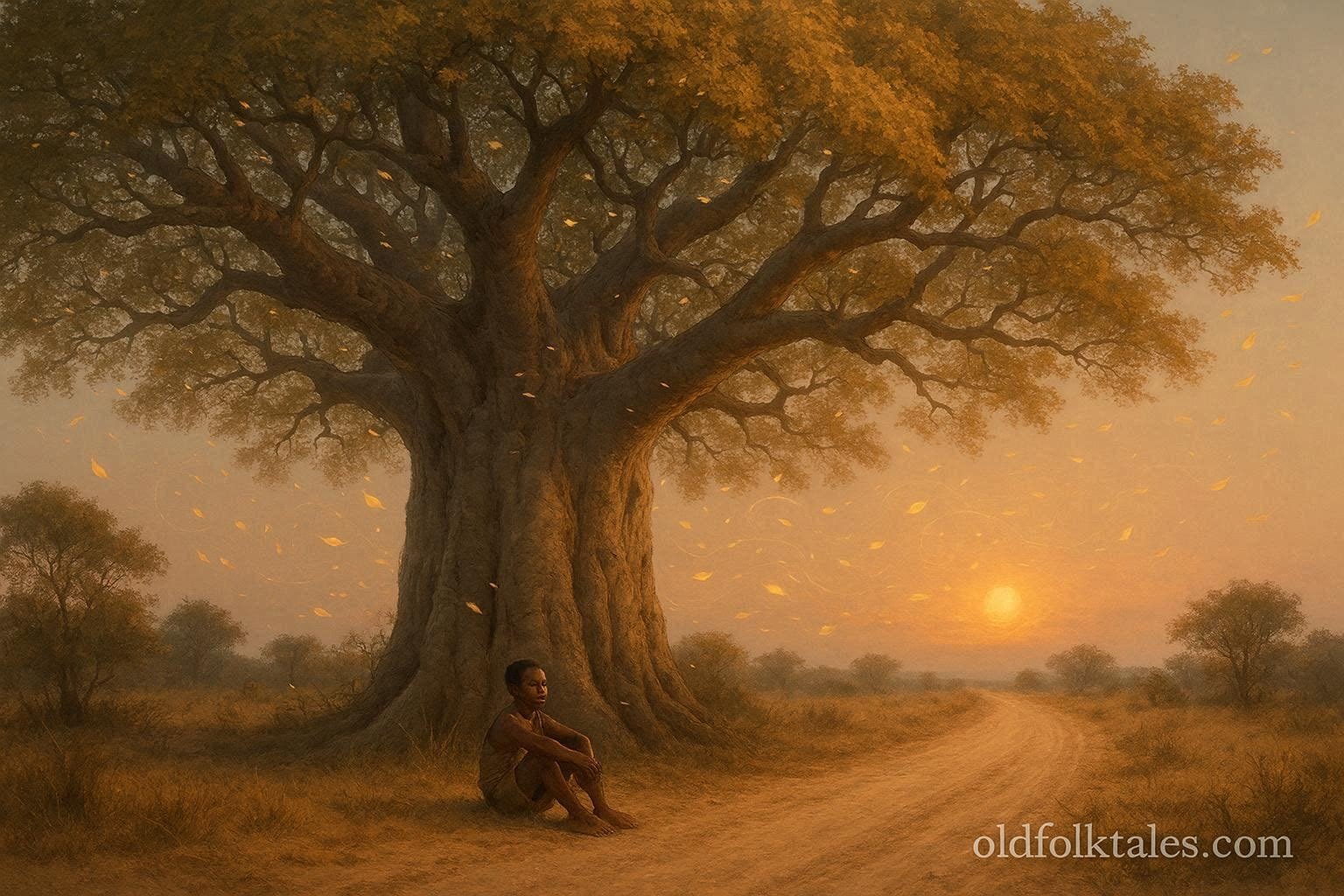
Among them stood one enormous baobab unlike any other.
Its trunk was so wide that several grown men could not join hands around it.
Its branches stretched across the sky like the arms of an old guardian protecting everyone who rested beneath its shade.
Want more? Read more West African folktales now
The Lenje people simply called it The Great Baobab.
Children loved climbing its broad roots.
Travelers stopped there during the hottest hours of the day.
Elders greeted it with quiet respect whenever they passed.
According to an old legend, the tree carried the wisdom of countless generations.
It listened to every conversation.
It remembered every promise.
And once in a great while, it whispered advice to travelers whose hearts were honest.
Many people laughed at the story.
Others believed every word.
In one nearby village lived a thoughtful young boy named Chola.
Unlike many children, Chola rarely interrupted others.
He enjoyed sitting quietly beside his grandfather, listening to stories about the old days.
Whenever the elders mentioned the Talking Baobab, he listened more carefully than anyone else.
One evening he finally asked,
“Grandfather, have you ever heard the tree speak?”
The old man smiled.
“I have heard many things beneath its branches.”
“But not everyone hears the same voice.”
“What does it sound like?”
“Like the wind carrying wisdom.”
Chola thought about that answer for many days.
Soon afterward his grandfather announced that they would travel to a neighboring village to visit relatives.
Their journey would take them directly past the famous baobab.
Chola could hardly wait.
They began walking before sunrise.
Birds welcomed the morning with cheerful songs.
The cool air gradually warmed as the golden sun climbed higher above the plains.
After several hours they finally saw the enormous tree standing alone beside the ancient path.
It looked even larger than Chola had imagined.
Its thick branches spread like the roof of a great house.
Its rough bark carried deep marks left by countless seasons.
Several travelers already rested beneath its shade.
Some quietly ate their meals.
Others filled water containers before continuing their journeys.
Chola eagerly looked toward his grandfather.
“Can we rest here?”
The old man nodded.
“Every traveler deserves the shade of the baobab.”
They sat quietly against the great trunk.
At first Chola listened carefully.
He heard birds.
He heard insects.
He heard leaves moving gently in the breeze.
But the tree remained silent.
After several minutes he whispered,
“Grandfather.”
“I don’t hear anything.”
His grandfather smiled.
“You are listening for words.”
“The tree speaks differently.”
Before Chola could ask another question, two strangers approached the tree.
They had been arguing loudly throughout the morning.
Each blamed the other for losing their way.
One complained constantly about the heat.
The other refused to admit his own mistakes.
They threw their bags onto the ground and continued arguing beneath the branches.
The wind blew softly through the leaves.
Nothing happened.
After resting briefly, the strangers left as frustrated as they had arrived.
A little later an elderly woman reached the tree carrying a heavy basket of vegetables.
She placed the basket gently upon the ground before quietly thanking the tree for its shade.
Then she closed her eyes for several moments.
The wind moved once again through the branches.
This time Chola noticed something unusual.
The leaves rustled together in a slow, gentle rhythm unlike the ordinary sound of wind.
The woman smiled peacefully.
When she opened her eyes, she stood, lifted her basket with renewed strength, and continued along the path.
Curious, Chola hurried after her.
“Grandmother.”
“Did the tree say something?”
She smiled warmly.
“It reminded me not to worry about tomorrow before finishing today’s journey.”
Chola looked back toward the baobab.
The leaves had become still again.
When he returned, his grandfather simply smiled.
“The tree gives each traveler the wisdom they most need.”
Chola frowned thoughtfully.
“But I still heard nothing.”
His grandfather placed one hand upon the rough bark.
“Wisdom never rushes.”
“Be patient.”
Later that afternoon another traveler arrived.
He was a wealthy merchant carrying expensive cloth and ornaments.
He proudly announced that no one in the surrounding villages possessed greater knowledge than he did.
He laughed when someone mentioned the legend.
“A talking tree?”
“I have traveled farther than anyone here.”
“If the tree knows anything, let it prove itself.”
He sat beneath the branches for nearly an hour.
Only silence greeted him.
When he finally left, he shook his head.
“The tree knows nothing.”
The elders quietly watched him disappear along the dusty road.
One of them smiled gently.
“Sometimes silence is the wisest answer.”
As the afternoon grew cooler, Chola wandered around the enormous trunk, carefully studying its bark.
He noticed small birds nesting inside natural hollows.
Tiny insects crawled across its roots.
Young plants grew safely beneath its broad shade.
The tree quietly protected countless forms of life without asking for praise.
As evening approached, the travelers prepared to continue their journeys. Chola remained beneath the great baobab for a few moments longer while his grandfather filled their water gourds at a nearby stream.
The boy gently placed his hand against the rough bark.
He closed his eyes.
“I don’t want to hear a miracle,” he whispered.
“I only want to become wise enough to make good choices.”
For several moments, nothing happened.
Then a gentle breeze passed through the enormous branches.
Unlike the stronger winds that had blown earlier, this one moved slowly, causing thousands of leaves to rustle together in a soft, steady whisper.
Chola could not distinguish clear words.
Yet one thought filled his heart with surprising clarity.
“Listen before speaking.”
His eyes opened.
The breeze stopped.
The branches became still once again.
His grandfather returned carrying the water gourds.
“You heard something.”
It was not a question.
Chola smiled.
“I think I did.”
“What did the tree tell you?”
The boy thought carefully before answering.
“It did not really speak.”
“It helped me understand.”
His grandfather nodded with satisfaction.
“The oldest teachers often use the fewest words.”
As they continued their journey, Chola noticed how differently he viewed the world around him.
He listened carefully whenever elders spoke.
He no longer interrupted conversations.
Before making decisions, he paused to think instead of acting quickly.
The lesson of the baobab quietly shaped the way he lived.
Years later, a difficult disagreement arose between two neighboring villages over the use of a small stream during a dry season.
The people argued for many days without finding peace.
Finally, both village chiefs invited Chola, now a respected young elder, to help settle the dispute.
Rather than speaking immediately, Chola listened patiently to every family.
He allowed everyone to explain their concerns.
Only after hearing every voice did he offer a solution that allowed both villages to share the water fairly.
When the meeting ended, one elderly chief smiled.
“You have become like the Talking Baobab.”
“You listened before giving advice.”
Chola quietly remembered the whisper beneath the ancient tree many years earlier.
The story of the Talking Baobab spread from village to village.
Some believed the tree truly possessed a voice.
Others believed its wisdom came from the peace people found beneath its branches.
Either way, the legend continued because it reminded travelers that the greatest answers often come during moments of quiet reflection.
Even today, ancient baobab trees remain important landmarks across Zambia. Many communities regard them as symbols of endurance, wisdom, and community life. They have served as traditional meeting places, resting sites for travelers, and locations where elders shared oral history and settled disputes. The legend of The Talking Baobab of Mumbwa reflects these enduring cultural traditions while teaching that wisdom belongs to those who patiently listen, think carefully, and speak honestly.
The greatest voice is not always the loudest. Sometimes, like the whisper of leaves moving through the branches of an ancient baobab, true wisdom comes softly to those willing to hear it.
Explore more Southern African folktales here
Moral Lesson
Wisdom grows in patient hearts. Those who listen carefully, speak honestly, and think before acting become trusted guides for others.
Knowledge Check
1. Why did travelers stop beneath the Great Baobab?
They rested in its shade during their journeys and many hoped to receive its wisdom.
2. Why did the arguing strangers hear nothing from the tree?
Their hearts were filled with pride and anger instead of honesty and humility.
3. What did the elderly woman receive beneath the baobab?
She found quiet encouragement that reminded her to focus on the present journey instead of worrying about tomorrow.
4. What lesson did Chola receive from the tree?
He learned to listen before speaking and to seek wisdom with patience.
5. How did Chola later use the lesson of the baobab?
He listened carefully to both villages before helping them peacefully resolve a dispute over water.
6. What is the central message of the story?
True wisdom comes through humility, careful listening, and honest reflection.
Source
Inspired by Lenje oral traditions of Central Zambia and the cultural significance of baobab trees, with reference to Central Zambia oral literature, ethnographic studies, and research on indigenous storytelling and sacred natural landmarks.