Deep within the forests of northwestern Zambia, Luvale elders tell of a cave unlike any other. Hidden among towering rocks and ancient trees, it is said to possess a mysterious gift. The cave answers only those who speak with honesty. Those who enter with lies, pride, or deceit hear nothing except the silence of stone. For generations, the legend has reminded young and old alike that truth carries a strength no falsehood can ever match.
Long before roads crossed the forests of the Luvale people, travelers depended upon winding footpaths that disappeared beneath tall trees and thick vines. The forests were beautiful but mysterious. Every stream, rocky hill, and ancient tree seemed to hold a story that elders carefully passed from one generation to the next.
Among all those stories, none inspired greater curiosity than the tale of the Echoing Cave.
The cave rested beyond a narrow valley where smooth stone cliffs rose above the surrounding woodland. Few people visited it, not because the journey was difficult, but because everyone understood that it was a sacred place.
The elders always gave the same warning.
“The cave listens before it speaks.”
Children often asked what those words meant.
The elders would simply smile.
“When your heart becomes honest enough, you will understand.”
In one nearby village lived a young boy named Kavuta.
Continue your journey: Read more East African folktales
Unlike many children his age, Kavuta asked endless questions.
He loved listening to stories, but he also wanted to discover whether they were true.
Whenever the elders mentioned the Echoing Cave, his curiosity grew stronger.
One evening, while sitting beside the cooking fire, he finally asked his grandmother,
“Has anyone truly heard the cave answer?”
She looked thoughtfully into the flames before replying.
“Yes.”
“But not everyone.”
“What does it say?”
“It speaks differently to each truthful person.”
“What if someone tells a lie?”
“The cave remains silent.”
Kavuta laughed softly.
“Perhaps the cave simply has no answer.”
His grandmother smiled patiently.
“One day you may decide to find out.”
The thought remained in Kavuta’s mind for many weeks.
At last, when the dry season arrived and the forest paths became easier to travel, he asked his grandfather for permission to visit the cave.
The old man studied him carefully.
“Why do you wish to go?”
“I want to know whether the stories are true.”
His grandfather nodded.
“Curiosity is good.”
“But remember this.”
“The cave is not testing your ears.”
“It is testing your heart.”
Before sunrise the next morning they began walking through the forest.
The air smelled of fresh leaves.
Sunlight filtered gently through the tall trees.
Birds sang above them while monkeys leaped from branch to branch.
After several hours they reached a narrow valley surrounded by enormous stone cliffs.
Hidden among the rocks stood the entrance to the cave.
It was larger than Kavuta had imagined.
Cool air drifted quietly from its dark opening.
His grandfather stopped.
“From this point forward we speak only when necessary.”
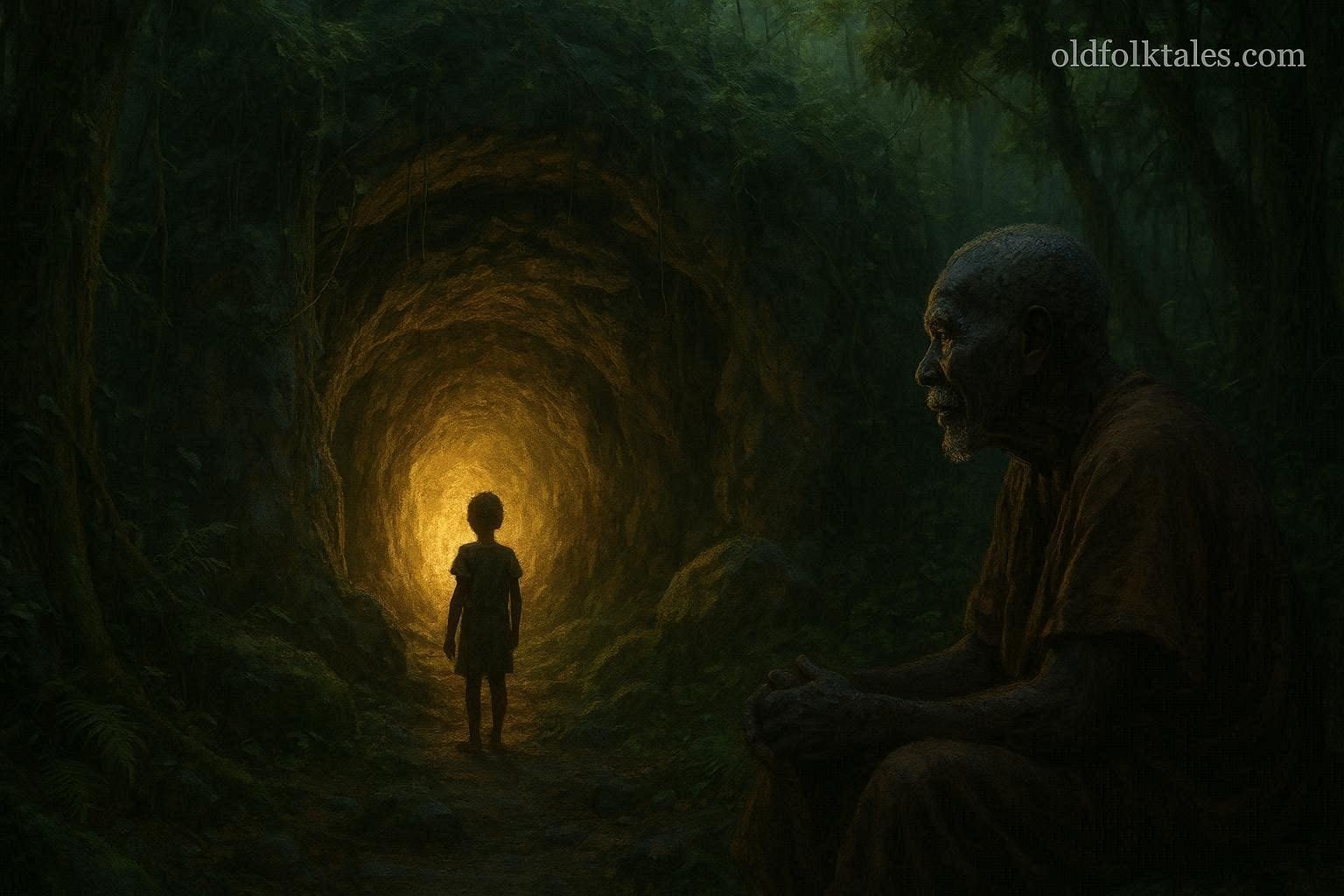
They entered slowly.
Inside, the cave stretched deep beneath the mountain.
Its walls glistened with tiny drops of water.
Every footstep echoed softly through the darkness.
At last they reached a wide stone chamber.
His grandfather pointed toward the center.
“This is where people ask their questions.”
Then he quietly stepped aside.
Kavuta looked around.
The cave was perfectly still.
He cleared his throat.
“Is anyone here?”
His voice echoed naturally through the chamber.
Then silence returned.
He smiled.
“Perhaps Grandmother was right.”
He thought for a moment before asking another question.
“Will I become a great hunter?”
Again his words echoed.
Again only silence followed.
Nothing unusual happened.
He turned toward his grandfather.
The old man remained calm.
“You are asking with your mouth.”
“Not with your heart.”
Kavuta frowned.
“I don’t understand.”
His grandfather said nothing more.
Instead he encouraged the boy to sit quietly.
Several minutes passed.
The cave remained silent except for the occasional sound of dripping water.
Gradually Kavuta stopped thinking about proving the legend true.
Instead he began thinking about himself.
He remembered a small lie he had told his mother several days earlier after breaking one of her clay pots.
He remembered blaming another child for his own mistake.
He remembered pretending to complete his chores when he had actually gone swimming with friends.
The memories made him uncomfortable.
For the first time that day he lowered his head.
Softly he whispered,
“I have not always been truthful.”
His words echoed gently through the cave.
He continued.
“I wanted to prove the elders wrong.”
“But perhaps I should first become honest myself.”
The chamber became completely still.
Then something unexpected happened.
From deep within the cave came a clear echo unlike the ordinary reflections of sound.
It repeated only one word.
“Truth.”
Kavuta’s eyes widened.
He looked quickly toward his grandfather.
The old man remained perfectly calm, as though he had expected nothing less.
A moment later the cave fell silent once again.
Kavuta spoke no further.
He understood that he had already received his answer.
As they walked back through the forest, neither of them spoke for a long time.
Finally Kavuta asked quietly,
“Did the spirits truly answer?”
His grandfather smiled.
“What do you believe?”
Kavuta thought carefully.
“I believe the cave answered when I finally spoke honestly.”
His grandfather nodded with quiet satisfaction.
“That is the lesson our ancestors wished every generation to learn.”
Several months later another young man from a neighboring village visited the cave after hearing stories about its mysterious power.
Unlike Kavuta, he entered with pride.
He loudly declared that he was the bravest hunter in every village.
He claimed never to have told a lie.
He demanded that the cave reveal hidden treasures.
His words echoed against the stone walls.
Then complete silence returned.
No unusual sound followed.
No mysterious voice answered.
When he returned home disappointed, the elders simply smiled.
“The cave had nothing to say.”
Years passed.
Kavuta grew into a respected young man known throughout the villages for his honesty.
Whenever disagreements arose, people trusted him because they believed his words.
One afternoon several children gathered around him beneath a large tree.
They eagerly asked,
“Is the cave really magical?”
Kavuta smiled.
“It is.”
“But not in the way most people imagine.”
The children leaned closer.
“What is its magic?”
He looked toward the distant mountains before answering.
“The cave teaches people to listen to the truth already living inside themselves.”
He paused before continuing.
“When your heart becomes honest, even silence can become a teacher.”
As the years passed, the story of the Echoing Cave spread far beyond the Luvale villages. Travelers often arrived hoping to witness a miracle or uncover hidden treasures. The elders welcomed every visitor with kindness, but they always offered the same advice before anyone entered the cave.
“Do not expect the cave to change you.”
“Be willing to change yourself.”
Some visitors laughed, believing the words were only part of an old legend.
Others listened with respect.
Those who entered seeking riches or hoping to prove themselves usually left disappointed. They heard only the ordinary echoes of their own voices returning from the stone walls.
Those who entered with humility often left quietly, carrying no treasure except a clearer understanding of themselves.
Kavuta grew into one of the village elders, and each year he guided young people to the sacred cave. Before they reached its entrance, he asked them a simple question.
“What is the hardest thing for a person to do?”
Some answered,
“To climb a mountain.”
Others replied,
“To defeat a wild animal.”
Kavuta smiled gently.
“The hardest thing is to tell the truth when a lie seems easier.”
The children remembered those words long after their visit ended.
Over time, the cave became more than a mysterious place. It became a symbol of honesty throughout the Luvale community. When disagreements arose, elders sometimes reminded people,
“Speak as though you were standing inside the Echoing Cave.”
The reminder was enough to encourage truthful words and peaceful resolutions.
Whether the cave was truly guarded by ancestral spirits or whether its greatest power was the lesson it inspired remained a mystery. Yet the legend continued because every generation discovered that honesty brought peace of mind, while deceit carried its own burden.
Today, stories of sacred caves remain part of the rich oral traditions of many communities across Zambia. Among the Luvale people, such legends reflect the belief that truth, integrity, and respect for ancestral wisdom are essential virtues. Archaeological studies and oral tradition research also show that caves have long served as places of shelter, ceremony, and cultural significance, making them natural settings for stories that teach important moral values.
The legend of The Echoing Cave of the Spirits reminds us that the greatest voice we will ever hear is the voice of our own conscience. When we choose truth over deception, we gain wisdom that no treasure can equal.
Love this story? Discover our full Southern African folktales collection
Moral Lesson
Honesty is a treasure that cannot be stolen. Those who live truthfully earn trust, wisdom, and peace, while deceit leaves only silence and regret.
Knowledge Check
1. Why was the Echoing Cave considered sacred?
It was believed to answer only those who spoke with complete honesty.
2. What lesson did Kavuta’s grandfather teach before entering the cave?
He explained that the cave tested a person’s heart rather than their voice.
3. Why did the cave respond after Kavuta admitted his mistakes?
Because he spoke sincerely and honestly from his heart.
4. Why did the proud hunter hear only silence?
He entered with pride and dishonesty instead of humility and truth.
5. How did the legend influence the Luvale community?
It encouraged honesty, peaceful conflict resolution, and respect for truth.
6. What is the central message of the story?
True wisdom begins with honesty, and a clear conscience is more valuable than material wealth.
Source
Inspired by Luvale oral traditions concerning sacred places and moral storytelling, with reference to Zambian folklore archives, archaeological research on sacred caves, and oral tradition studies documenting indigenous beliefs and cultural heritage.