The hunter had gone into the forest in search of food. He was hungry, and the day’s hunt had not given him what he needed. He continued moving through the bush, hoping that something would eventually cross his path.
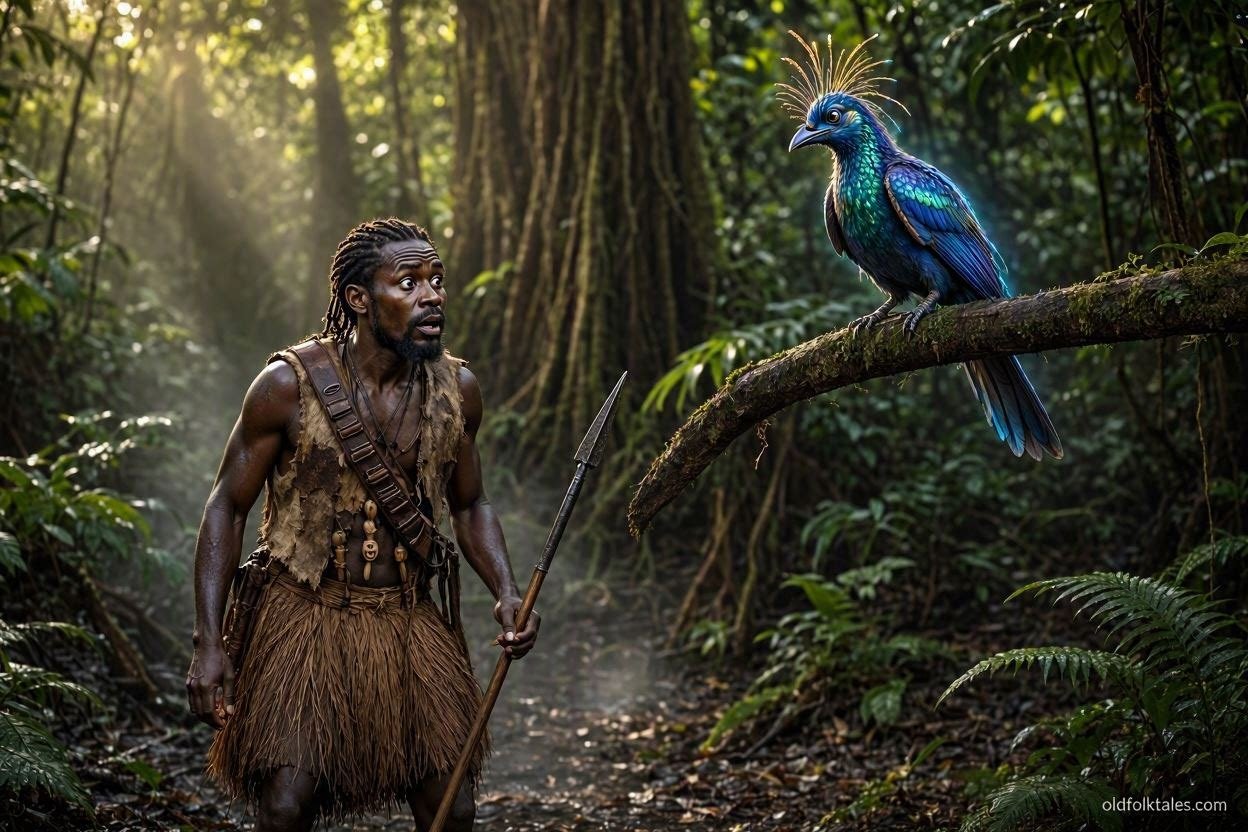
As he walked, he noticed a strange bird.
There was something unusual about it. It did not behave like an ordinary bird, and before the hunter could decide what to do, the bird spoke to him.
The hunter was startled.
A bird speaking like a human was something he had never encountered before.
Instead of flying away immediately, the strange bird remained where it was and warned the hunter not to kill it.
The hunter listened.
But his hunger made the warning difficult to accept.
He was a hunter, after all. He had entered the forest to find something he could take home. A bird that could be caught could provide him with food.
Yet the bird warned him again.
The hunter hesitated.
The strange creature seemed to know exactly what he was thinking.
Again, it told him not to kill or handle it.
The hunter now faced a choice.
He could listen to the warning and leave the mysterious bird alone, or he could ignore it and attempt to take advantage of the unusual creature he had discovered.
His curiosity and desire eventually overcame his caution.
He decided to pursue the bird.
The creature continued to warn him.
But the hunter refused to listen.
What happened next began a series of extraordinary events that would make him regret ignoring the bird’s repeated warnings.
Want more? Read more West African folktales now
The hunter had entered the forest expecting an ordinary hunting trip. Instead, he had encountered something beyond the ordinary world.
The bird was not simply a creature he could treat like ordinary game.
Its ability to speak was already a warning that there was something unusual about it.
Yet the hunter continued.
His hunger had become mixed with determination.
Rather than wondering why the bird could speak or why it was so desperate to be left alone, he focused on what he might gain from capturing it.
The bird continued to resist him.
Each warning gave the hunter another opportunity to stop.
He could have walked away.
He could have returned home.
He could have accepted that the strange encounter was not meant to become a successful hunt.
But he chose otherwise.
The hunter’s actions set the extraordinary events of the story into motion.
What began as a search for food became an encounter with the supernatural.
The bird’s warnings were not meaningless.
They were opportunities for the hunter to reconsider his actions before the consequences arrived.
Instead, every warning he ignored brought him closer to what was waiting for him.
The hunter eventually discovered that the strange bird could not be treated like ordinary prey.
The creature possessed knowledge and powers beyond what he understood.
The hunter had entered the forest believing that he was the one in control.
He carried the tools of a hunter and understood the ways of the forest.
But the speaking bird changed the situation completely.
The hunter was no longer simply pursuing an animal.
He was dealing with something mysterious.
Something that could speak.
Something that could warn him.
And something that seemed to know what would happen if he refused to listen.
The hunter’s greatest mistake was not that he encountered the bird.
It was that he refused to recognize the meaning of the encounter.
The strange creature had given him several chances to stop.
But his desire to take it overcame his judgment.
The events that followed showed him that not everything encountered in the forest should be treated as an opportunity for personal gain.
Some things require caution.
Some warnings should be respected.
And sometimes, the safest decision is to walk away.
The hunter eventually had to face the consequences of his decision.
The extraordinary events surrounding the bird demonstrated that his actions had carried a cost.
What he had expected to be a simple hunt had become something much more serious.
His experience became a lesson about greed and the danger of ignoring warnings.
The bird had not attacked him without reason.
It had warned him first.
Again and again, it had given him the opportunity to change his mind.
But the hunter believed that he could ignore the warnings and still escape the consequences.
He was wrong.
The forest had presented him with a mystery, and instead of respecting it, he tried to possess it.
That decision changed the course of his journey.
The story also raises an important question about human desire.
When people see something unusual, they may immediately think about what they can gain from it.
The hunter saw a bird.
Then he saw food.
He did not stop to consider why the bird could speak.
He did not ask why it feared being touched.
He did not consider whether the warning itself might be protecting him from danger.
His desire prevented him from thinking beyond the immediate benefit.
The strange bird therefore became more than a supernatural creature.
It became a warning in itself.
Its repeated words gave the hunter opportunities to choose differently.
But he continued down the path he had chosen.
Eventually, the hunter learned that the forest contained mysteries beyond his understanding.
His encounter with the bird became a reminder that not every opportunity should be pursued.
Sometimes, wisdom means knowing when to stop.
Sometimes, courage means walking away rather than continuing toward danger.
And sometimes, the warning we would rather ignore is the very warning that could save us.
The hunter had entered the forest hungry and determined to find something to take home.
He encountered a magical bird that spoke to him and warned him repeatedly.
Instead of listening, he allowed his desire to guide him.
What followed transformed an ordinary hunting trip into an extraordinary experience.
The hunter learned that the consequences of ignoring a warning can be far greater than the reward one hoped to gain.
And the mysterious bird left behind a lesson that reaches beyond the forest:
When a clear warning comes before danger, wisdom lies in listening.
If you liked this story, see our Central African folktales collection
Moral Lesson
Greed can make people ignore important warnings. When something clearly warns us of danger, we should think carefully before allowing desire or curiosity to overcome good judgment.
Knowledge Check
1. Why did the hunter enter the forest?
He went into the forest because he was hungry and wanted to find food.
2. What was unusual about the bird he encountered?
The bird could speak to him like a human being.
3. What did the bird repeatedly warn the hunter not to do?
It warned him not to kill or handle it.
4. Why did the hunter ignore the bird’s warnings?
His hunger, curiosity and desire to capture the bird caused him to disregard its warnings.
5. What happened after the hunter ignored the warnings?
His actions set off an extraordinary chain of supernatural events and consequences.
6. What is the main lesson of the story?
The story teaches that greed and curiosity can lead people to ignore warnings, and that wisdom sometimes means knowing when to walk away.
Source
Adapted from André Raponda-Walker’s Contes gabonais (1967), from the narrative “L’Oiseau magique,” p. 52 onward.