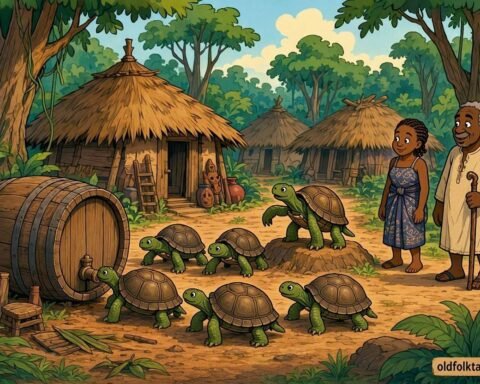
Lendjè wanted to marry Ilombè, but winning her hand was not going to be simple. Her family had established a frightening condition for the man who wished to become her husband. The custom demanded that, when the time came, the bridegroom would be buried in the same grave as his mother in law.
It was a condition that could make any man reconsider his intentions.
Marriage was supposed to bring a man into a new family, but in this case, accepting Ilombè meant accepting something far more troubling. Lendjè knew what the condition meant, yet his desire to marry Ilombè was strong enough for him to continue.
He set out on his journey, carrying the hope of eventually becoming Ilombè’s husband.
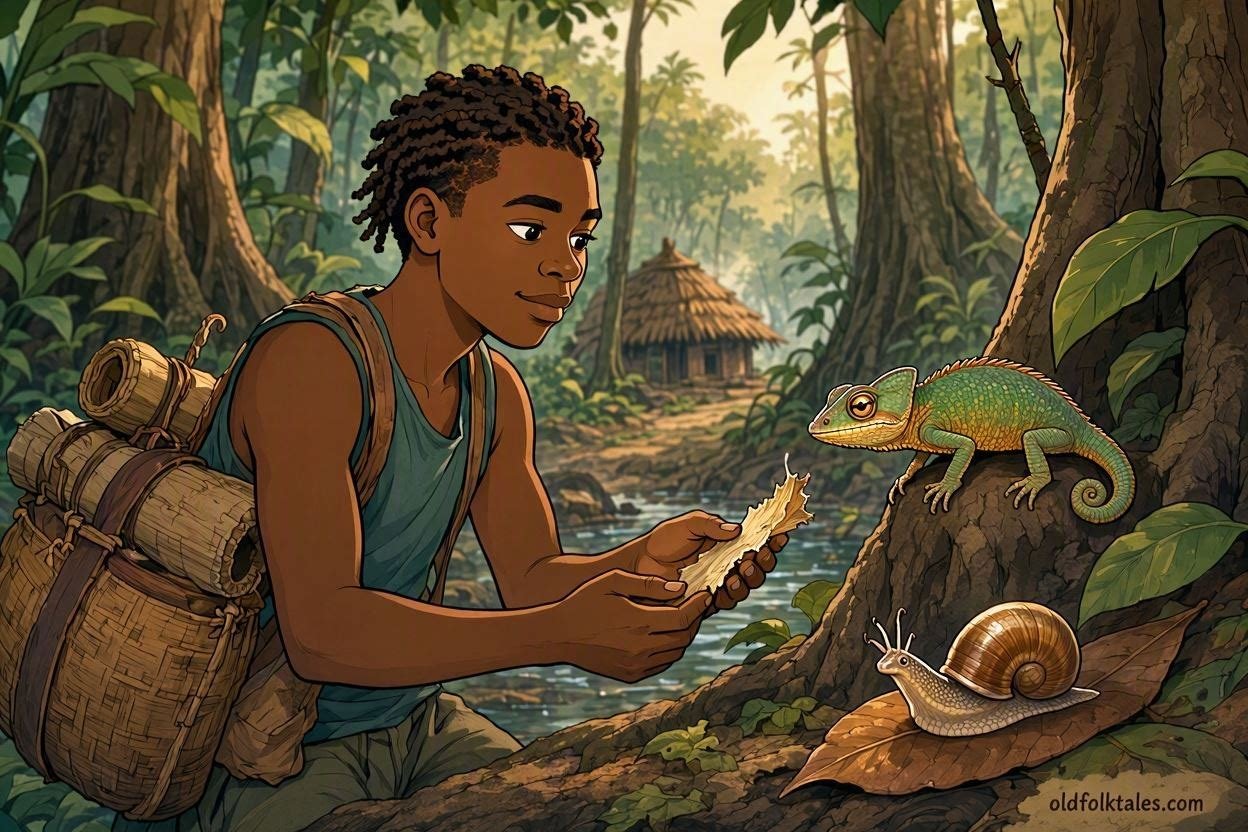
Along the way, Lendjè encountered two small creatures that were struggling to survive. A chameleon and a snail were desperately hungry. They had little chance of finding enough food on their own, and their situation attracted Lendjè’s attention.
He could have ignored them.
After all, he was travelling for an important purpose of his own. He had no reason to stop and concern himself with creatures that could not offer him anything in return.
But Lendjè chose to help them.
He gave them food and continued on his way.
He did not expect anything in return.
The act seemed small, and Lendjè probably did not imagine that it would become important later. He was simply helping two creatures that were in need.
His journey eventually brought him closer to Ilombè and her family.
Continue your journey: Read more East African folktales
The marriage arrangement remained in place.
Lendjè had to accept the frightening condition attached to the union.
For a man who wanted to marry the woman he loved, it was a terrible price to contemplate.
Yet he continued.
The circumstances surrounding the marriage eventually placed Lendjè in a situation where the threat became real. What had initially sounded like a frightening custom was no longer merely a condition discussed by a family.
His life was at stake.
The prospect of being buried alive became a terrifying reality.
Lendjè now had to find a way to escape the fate that awaited him.
This was the moment when the kindness he had shown on his journey became important.
The chameleon and the snail had not forgotten him.
The small creatures he had helped when they were hungry were now in a position to help him when he was in desperate need.
Their return was unexpected.
Lendjè had never helped them because he wanted a reward. He had helped them because they were hungry and needed assistance.
But his kindness had created a bond.
Now, when his own life was in danger, that kindness returned to him in a way he could never have predicted.
The chameleon and the snail became part of the solution to his problem.
Their abilities, which might have seemed insignificant to a human being, became valuable when Lendjè needed help.
The very creatures that he could easily have ignored became important allies.
Lendjè’s situation was dangerous, but he did not surrender.
He had already demonstrated courage by accepting the unusual condition attached to his marriage.
Now he needed another quality: cleverness.
He had to find a way out of a situation designed to leave him with little choice.
The assistance of the chameleon and the snail gave him an opportunity.
The creatures remembered the man who had helped them when they were vulnerable.
Their gratitude became a source of protection.
What appeared to be an insignificant act of kindness during Lendjè’s journey had eventually become the difference between danger and survival.
The story therefore turns the frightening marriage condition into a lesson about kindness.
Lendjè could not have known what would happen when he stopped to help the hungry creatures.
He could not have predicted that the chameleon and snail would later be able to help him.
He simply did what seemed right at the time.
That is what makes his kindness significant.
He did not help them because he expected them to repay him.
He helped them because they were in need.
Later, when he needed assistance, they remembered him.
The story also shows that help can come from unexpected places.
The chameleon and snail were small creatures.
They were not powerful warriors.
They did not appear capable of changing the fate of a man facing such a frightening situation.
Yet their contribution became important.
Lendjè learned that the value of a helper should never be judged by appearance or size.
The creatures he had helped were able to return his kindness when he needed it most.
His experience also changed the meaning of the marriage condition.
What began as a terrifying obstacle became a test of his courage and determination.
Lendjè had to decide how far he was willing to go for the woman he wanted to marry.
He also had to face the consequences of accepting a condition that threatened his life.
But his journey showed that courage does not mean walking blindly into danger.
True courage can involve finding a way to overcome danger.
Lendjè did not simply accept his fate.
When his life was threatened, he looked for a solution.
The assistance of the chameleon and snail gave him the opportunity he needed.
Their actions demonstrated another important lesson.
Kindness may appear to disappear after it has been given.
A person may help someone today and never see that person again.
But kindness can leave a lasting impression.
The chameleon and snail remembered Lendjè because he had helped them when they were hungry.
When circumstances changed, they were able to help him.
The exchange was not planned.
It was simply the unexpected return of a good deed.
Lendjè’s journey therefore became more than a quest for marriage.
It became a test of courage, kindness and resourcefulness.
He faced a frightening custom.
He encountered creatures in need.
He chose to help them.
Later, when he faced danger himself, those creatures became his unexpected allies.
The experience demonstrated that compassion can have consequences far beyond what we can see at the moment we act.
A small act can travel a long way.
A simple kindness can return when it is least expected.
And sometimes, the person or creature we help today may be the one capable of helping us tomorrow.
Lendjè’s story also reminds us that difficult circumstances do not always determine the final outcome.
The marriage condition appeared to leave him with an impossible choice.
But his courage and cleverness, combined with the help of those he had previously assisted, gave him another possibility.
He was not simply a victim of a frightening custom.
He became someone capable of finding a way through it.
In the end, the man who had agreed to a marriage condition that could have cost him his life discovered that kindness could become a form of protection.
The chameleon and snail had once been helpless and hungry.
Lendjè had stopped to help them.
Later, when he was the one in need, they did not forget him.
His journey showed that kindness does not always return immediately, and it does not always return in the form we expect.
But a good deed can remain alive in the memory of those who receive it.
And when the right moment comes, that kindness may return with surprising power.
Keep reading: Discover more Central African folktales
Moral Lesson
Kindness given without expecting a reward can return when it is needed most. The story also teaches courage, resourcefulness and the importance of never underestimating those who appear small or powerless.
Knowledge Check
1. Why did Lendjè want to marry Ilombè?
He wished to marry Ilombè despite the frightening condition attached to the marriage.
2. What was the unusual marriage condition?
The future bridegroom was expected to be buried in the same grave as his mother in law.
3. Which creatures did Lendjè help during his journey?
He helped a hungry chameleon and a snail.
4. Why was Lendjè’s kindness important later?
The creatures remembered his kindness and eventually helped him when he was in serious danger.
5. What qualities helped Lendjè overcome his situation?
He demonstrated courage, kindness and cleverness.
6. What is the central lesson of the story?
The story teaches that kindness can return unexpectedly and that courage and cleverness can help people overcome frightening circumstances.
Source
Adapted from André Raponda-Walker’s Contes gabonais (1967), from the narrative “Enterré vivant avec sa belle-mère ?,” pp. 454 onward.