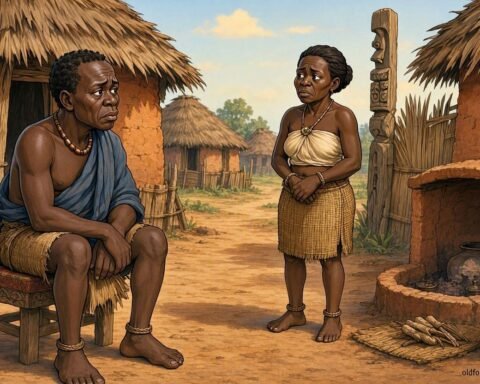
Long ago, there lived a great chief named R’Agnambiè. Like many powerful men of his time, he had several wives. Among them were Ngwè-Nkondé, Ngwè-Légè, Ngwanga, Arondo and the youngest, Ilombè.
Each woman had her own place in the household, but their fortunes were not the same. Ngwè-Nkondé was the oldest and had long enjoyed the confidence of her husband. She was proud of her position and was known for being jealous and suspicious of the other women.
Ilombè, on the other hand, was the youngest wife. She was gentle and had little reason to expect trouble from those around her.
There was an old custom in R’Agnambiè’s household. Whenever one of his wives was about to give birth, he would send her back to her own family so that she could have her child among her relatives.
When Ilombè’s time came, however, there was a serious problem.
She had no family left.
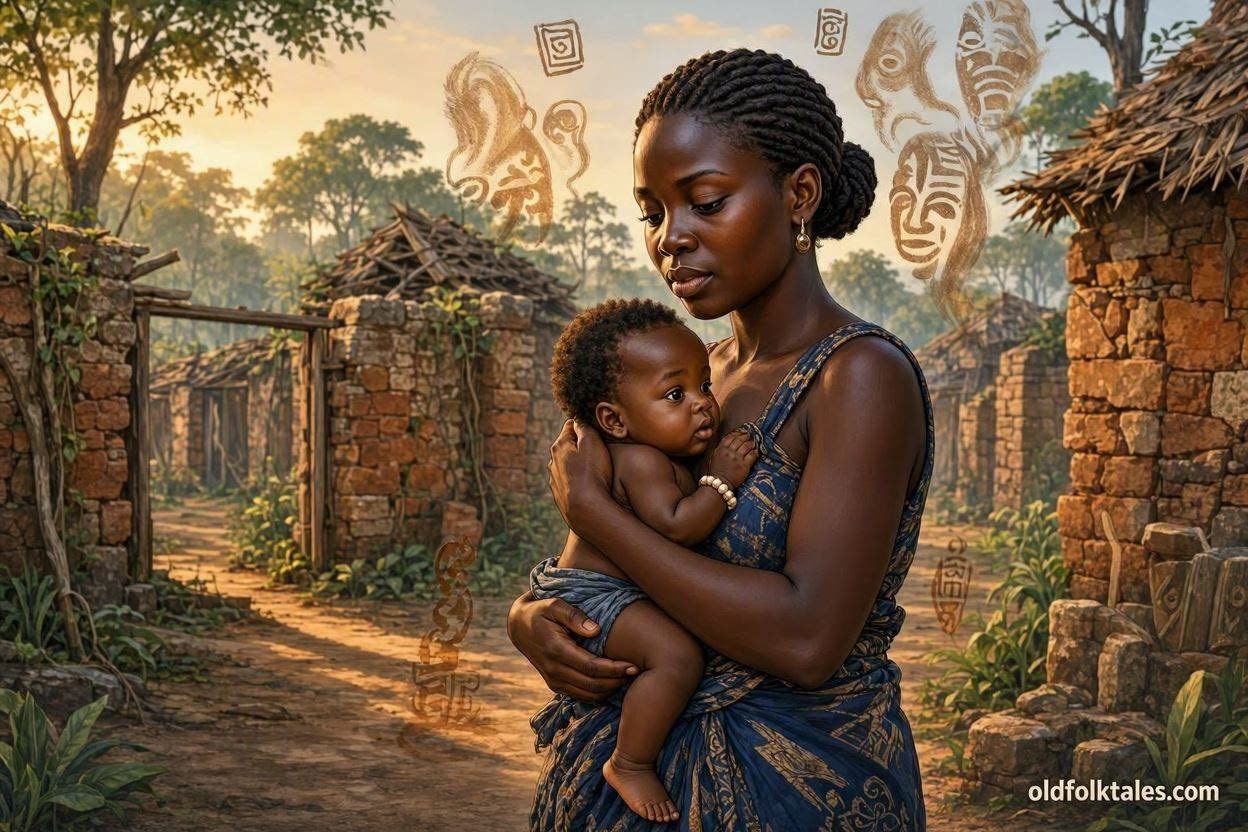
Her relatives had all died, and the village where her family had once lived had long been abandoned. The houses had fallen into ruin, and the surrounding bush had gradually taken over the settlement.
Nevertheless, R’Agnambiè instructed Ilombè to go there.
So the young woman set out alone.
When she arrived, she found the village almost completely deserted. The old houses were collapsing, weeds had grown everywhere and the place no longer looked like the home of a living family.
Want more? Read more West African folktales now
Ilombè searched through the ruins and chose the least damaged hut. She cleared away the grass, cleaned the area around the house and made herself as comfortable as she could.
There she remained, far away from the chief’s household and surrounded by silence.
But the silence did not last.
One day, while Ilombè was living in the abandoned village, she began to hear mysterious voices.
At first, she could not understand where they were coming from.
She looked around the ruined settlement, but there was nobody there.
The voices continued.
They sounded like the voices of kind beings who had come to comfort her. Although Ilombè could not see the people speaking to her, she felt that she was not alone.
Then she realized who they were.
They were the voices of her dead relatives.
Her family might have disappeared from the world of the living, but they had not forgotten her.
They spoke to her with encouragement.
“Ilombè, have courage.”
Their words gave strength to the young mother who had been living alone in a place where she had expected only loneliness.
The invisible relatives then blessed her.
They told her that her plantations would become fruitful and that she would become the mother of many children. They wished prosperity upon her and gave her blessings connected with fertility and motherhood.
The mysterious beings chewed the stems of a plant known as okosa, a type of aromatic plant, and placed the juice upon Ilombè’s head and in the palms of her hands.
It was their way of blessing her.
But the most important part of their visit was still to come.
Before Ilombè left the abandoned village, the mysterious voices gave her a serious warning.
“Whatever person you meet on your journey,” they told her, “do not allow that person to touch your daughter.”
Ilombè listened carefully.
She did not question the warning.
She knew that the voices belonged to her dead relatives, people who had come to her when she had nobody else to turn to.
She understood that the warning must have a reason.
So she continued her journey with her daughter, determined to follow the instruction she had received.
What Ilombè did not know was that another woman in R’Agnambiè’s household was carrying a secret burden of jealousy.
Ngwè-Nkondé had also recently given birth.
But while the other women had beautiful children, Ngwè-Nkondé had given birth to a strange and frightening creature with the head of a python.
She was proud of her position in the chief’s household, and seeing the beautiful child carried by Ilombè made her jealousy even stronger.
As Ilombè continued along the road, she eventually reached a crossroads.
There, she came face to face with Ngwè-Nkondé.
The two women greeted each other.
Ngwè-Nkondé immediately noticed Ilombè’s beautiful daughter.
She congratulated the young mother and admired the child.
Then she asked Ilombè if she could hold the baby.
Ilombè remembered the warning.
She refused.
Ngwè-Nkondé asked again.
Ilombè still refused.
She knew that the voices had specifically told her not to allow anyone she met on the road to touch her daughter.
But Ngwè-Nkondé was stronger than Ilombè.
She seized the child from her arms.
Before Ilombè could stop her, Ngwè-Nkondé ran away with the baby.
She left Ilombè behind carrying her own strange child in the other woman’s place.
Ilombè had been warned.
She had listened.
But she had still been unable to prevent Ngwè-Nkondé from taking the baby by force.
The two women eventually returned to the chief’s village.
And what happened next shocked everyone.
The people had expected Ilombè to return with her beautiful daughter and Ngwè-Nkondé to return with her own strange child.
Instead, Ngwè-Nkondé appeared carrying a beautiful baby.
Ilombè arrived carrying the ugly creature with the head of a python.
The villagers could hardly understand what they were seeing.
How had everything changed?
How had the child belonging to Ilombè ended up with Ngwè-Nkondé?
And why was Ilombè carrying the strange creature that had been born to Ngwè-Nkondé?
But there was another mystery.
The baby itself seemed to know that Ngwè-Nkondé was not its mother.
Whenever Ngwè-Nkondé tried to feed the child, the baby refused.
When she tried to comfort it, the baby cried.
When she held it in her arms, the child struggled and resisted.
Yet whenever Ilombè was nearby, the child reacted differently.
R’Agnambiè, the chief, noticed what was happening.
He became suspicious.
He began to believe that something dishonest had taken place.
The chief decided that he had to discover the truth.
He ordered each of his wives to prepare food.
Soon, different dishes were prepared and placed on a table.
The chief then instructed that each child should be given the food prepared by its own mother.
Everyone watched closely.
The beautiful baby was placed before the food prepared by Ngwè-Nkondé.
But the child refused it.
The baby cried and turned away.
Then the food prepared by Ilombè was brought forward.
Something remarkable happened.
The baby immediately moved away from the food prepared by Ngwè-Nkondé and went toward the food prepared by Ilombè.
It recognized its true mother.
The evidence was impossible to ignore.
R’Agnambiè understood what had happened.
Ngwè-Nkondé had stolen Ilombè’s daughter and left her own strange child in Ilombè’s arms.
The chief therefore ruled in favour of Ilombè.
Her daughter was returned to her.
Ngwè-Nkondé was punished severely for stealing another woman’s child.
The deception she had carefully planned had failed.
The child itself had revealed the truth.
For Ilombè, the journey that had begun in an abandoned village had ended with the recovery of what mattered most to her.
She had listened to the mysterious voices of her dead relatives.
They had warned her about danger.
They had blessed her motherhood.
And although she had been unable to prevent the theft of her daughter, the wisdom they had given her helped her understand that she must remain vigilant.
The story also revealed the danger of jealousy.
Ngwè-Nkondé already had a position of importance in the chief’s household, yet she could not be satisfied with what she possessed. When she saw Ilombè’s beautiful daughter, jealousy overcame her.
She wanted what belonged to another woman.
But the truth eventually exposed her.
The child could not be deceived.
Neither could the chief.
And the family of the dead, though invisible, had already seen the danger before anyone else.
Ilombè had entered the abandoned village believing that she had lost the protection of her family forever.
Instead, she discovered that the memory and influence of those who had died could still guide her.
Their voices came from beyond the visible world, but their warning proved real.
They knew that jealousy was waiting on the road.
They knew that Ilombè would encounter someone who would try to take her child.
And they gave her the knowledge she needed to face what was coming.
The mother who had travelled alone was therefore never truly alone.
Her family was watching.
Her daughter was protected.
And in the end, the truth found its way back home.
Keep reading: Discover more Central African folktales
Moral Lesson
Jealousy can drive people to commit terrible acts, but truth cannot remain hidden forever. The story also teaches us to value wise warnings and to remain vigilant when protecting those entrusted to our care.
Knowledge Check
1. Who was Ilombè?
Ilombè was the youngest wife of the great chief R’Agnambiè.
2. Why did Ilombè go to an abandoned village?
The chief traditionally sent his wives to their families when they were about to give birth, but Ilombè had no living relatives, so she went to her abandoned family village.
3. Who spoke to Ilombè while she was alone?
The mysterious voices belonged to her deceased relatives.
4. What important warning did the voices give Ilombè?
They warned her not to allow anyone she met on the road to touch her daughter.
5. Why did Ngwè-Nkondé steal Ilombè’s child?
She was jealous because Ilombè had a beautiful daughter while she had given birth to a strange child with a python’s head.
6. How did R’Agnambiè discover the true mother?
He had the wives prepare food and observed which mother’s food the baby naturally chose. The child rejected Ngwè-Nkondé’s food and went to Ilombè’s.
Source
Adapted from André Raponda-Walker’s Contes gabonais (1967), from the narrative “Ngwè-Nkondé et Ilombè,” pp. 196–199.