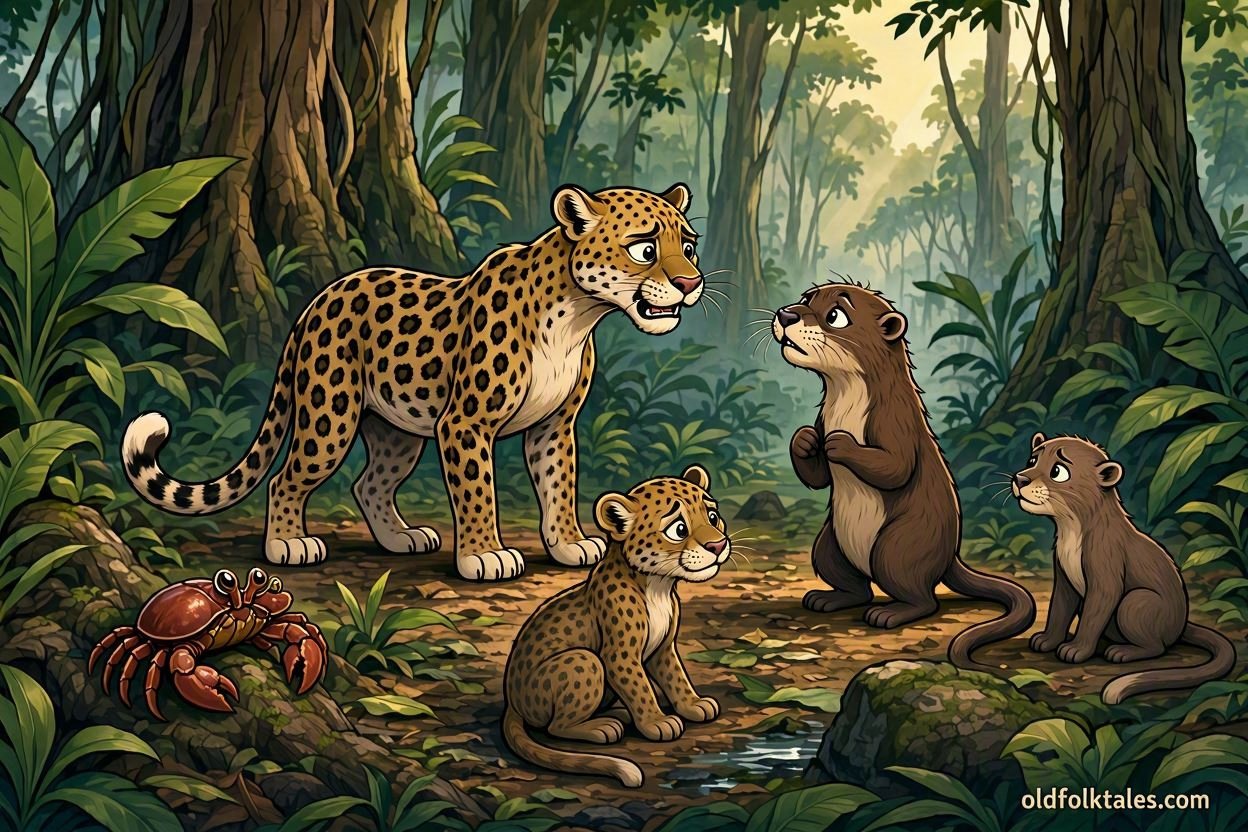
The leopard and the otter shared a close friendship. They trusted one another and enjoyed spending time together. Their friendship had grown strong over time, and their families were also closely connected. Their children grew up around one another, making the bond between the two households even stronger.
The two friends had no reason to expect trouble. They trusted each other enough to leave their children in one another’s company. Neither imagined that the peaceful relationship they had built would one day be destroyed by someone else’s jealousy.
But the crab watched their friendship with different feelings.
Rather than being pleased to see the leopard and the otter living peacefully together, the crab became jealous. He disliked the closeness between them and began thinking about how he could create a disagreement.
The crab knew that directly attacking their friendship would be difficult. The leopard and the otter trusted each other too much to believe an ordinary accusation. He therefore looked for a way to make them suspect one another without realizing that someone else was responsible.
He eventually found an opportunity involving their children.
Fascinated by this tale? Discover more North African folktales
The crab deliberately interfered with the situation surrounding the children and made it appear as though they had been mistreated. What the parents saw was disturbing, but neither the leopard nor the otter understood what had really happened.
The appearance of wrongdoing immediately created suspicion.
The leopard began wondering whether the otter had harmed his children.
The otter, seeing what appeared to have happened, began thinking the same about the leopard.
Neither realized that the crab had deliberately created the situation.
The misunderstanding quickly became more serious. Each friend believed that the other had betrayed the trust between them. The friendship that had once been built on confidence and cooperation was suddenly threatened by doubt.
The crab watched from the side as the disagreement grew.
His plan was working.
He had not needed to fight either animal. He had not needed to force them apart. All he had done was create a false impression and allow suspicion to do the rest.
The leopard was angry.
The otter was equally upset.
Both believed they had a reason to feel betrayed.
Their emotions made it difficult for them to think calmly. Instead of remembering the friendship they had shared for so long, they focused on what they believed the other had done.
The more they suspected one another, the harder it became for either friend to trust the other.
A friendship that had once seemed secure was beginning to collapse.
The tragedy was that neither animal had actually betrayed the other.
The conflict had been created by someone outside their friendship.
But because the leopard and the otter failed to discover the deception, the false impression became more powerful than the truth.
They eventually turned against one another.
The relationship between their families was damaged, and the friendship that had once brought them together was broken.
The crab had achieved what he wanted.
His jealousy had succeeded in separating the two friends.
Yet his apparent victory also revealed the destructive nature of deception. The crab had not gained a true friendship or improved his own situation. He had simply destroyed something valuable because he could not tolerate seeing others live peacefully together.
The leopard and the otter were left with the consequences of a misunderstanding that neither of them had created.
Their story shows how quickly suspicion can destroy trust.
A friendship may take years to build. People share experiences, help each other and gradually develop confidence in one another. But when deception introduces doubt, that trust can disappear surprisingly quickly.
The leopard and the otter had known each other well. Their long friendship should have encouraged them to question what they had seen before judging one another.
Instead, they allowed suspicion to replace communication.
Had they spoken openly about the situation, they might have discovered that something was wrong.
Had they asked questions instead of immediately blaming each other, the crab’s plan might have failed.
But neither friend looked beyond the appearance of what had happened.
This is what made the crab’s deception so effective.
The story also reveals the danger of jealousy.
The crab did not destroy the friendship because the leopard or otter had harmed him. He did it because he was unhappy with their closeness.
Rather than building relationships of his own, he focused on destroying someone else’s.
Jealousy can make people behave in ways that they might otherwise consider unthinkable. It can cause a person to interfere in relationships, spread suspicion and create conflict simply because they cannot accept another person’s happiness.
The crab’s actions demonstrate how damaging that attitude can be.
His deception did not affect only the two friends. Their children and families were also caught in the conflict.
This shows that one person’s dishonest actions can affect many others.
A lie or deception may begin with a small act, but its consequences can spread far beyond the original situation.
The story therefore emphasizes the importance of seeking the truth.
When something troubling happens between friends, it is dangerous to rely only on appearances. People should communicate with one another and investigate what happened before making accusations.
Trust does not mean ignoring problems.
It means giving people the opportunity to explain themselves before deciding that they have betrayed you.
The leopard and the otter lost that opportunity.
Their failure to communicate gave the crab’s deception enough space to destroy their relationship.
The lesson is especially important because the crab’s deception was successful without the two friends ever realizing immediately that they were being manipulated.
This is often the danger of deception.
The person being deceived may believe that they are making their own decision when, in reality, someone else has carefully influenced what they see and believe.
The leopard and the otter thought they were responding to each other’s actions.
In truth, they were responding to the crab’s scheme.
By the time the consequences became clear, the damage to their friendship was already severe.
Their story became a warning for others.
Do not allow jealousy to enter your relationships.
Do not accept every appearance as the truth.
And when a disagreement arises with someone you trust, communicate before allowing anger to make the decision for you.
The crab’s actions showed how easily suspicion can divide people.
The leopard and the otter’s experience showed how difficult it can be to repair a friendship once trust has been broken.
Their friendship had once been a source of companionship and security.
After the deception, it became a source of pain.
The story therefore leaves a lasting reminder that relationships need protection.
Friendship requires trust, but it also requires honest communication and patience.
When those qualities disappear, even a strong friendship can be destroyed.
The crab succeeded in breaking the friendship, but his actions did not make him stronger.
Instead, his jealousy exposed the destructive power of deception.
The leopard and the otter lost a valuable relationship because they allowed suspicion to come between them.
Their story reminds us that before accusing someone we trust, we should seek the truth.
A friendship should not be sacrificed because of a situation created by someone else.
Click here to explore more Central African folktales
Moral Lesson
Deception and jealousy can destroy relationships that took years to build. When misunderstandings arise, honest communication and a careful search for the truth can prevent suspicion from destroying trust.
Knowledge Check
1. How were the leopard and the otter connected?
They were close friends whose families and children also spent time together.
2. Why did the crab interfere with their friendship?
The crab was jealous of the strong relationship between the leopard and the otter.
3. How did the crab create suspicion?
He deliberately created a situation that made it appear as though the friends’ children had been mistreated.
4. Why did the friends turn against each other?
They believed the other had caused the apparent mistreatment and failed to discover the crab’s deception.
5. What could have protected their friendship?
Open communication, patience and a careful search for the truth could have exposed the deception.
6. What is the central lesson of the tale?
The story teaches that jealousy and deception can destroy strong relationships and that trust must be protected through honest communication.
Source
Adapted from André Raponda-Walker’s Contes gabonais (1967), from the narrative “Le Léopard, la Loutre et le Crabe,” pp. 28 onward.