The farmer had worked hard that season. From the first day he prepared the soil, he had looked forward to the harvest. He cleared the field, planted his crops carefully and returned day after day to remove weeds and protect the young plants. Among everything he had planted, the sweet potatoes were doing especially well. Their leaves spread across the ground, and beneath the soil the roots grew larger with every passing week.
For the farmer, the harvest meant more than food. It was the reward for months of labour. A good harvest would feed his household and leave enough to share with people who might need help. He therefore watched his field carefully.
Then something strange began happening.
Some of his crops started disappearing.
At first, the farmer thought he had simply miscounted. Perhaps he had harvested more than he remembered. Perhaps an animal had entered the field during the night. He searched for signs of goats, pigs or other animals, but he could not find enough evidence to explain the missing food.
A few days later, another crop was gone.
This time, he became suspicious.
Someone was taking his food.
Continue your journey: Read more East African folktales
The farmer examined the field carefully. He looked at the soil around the plants and searched for footprints. He checked the fence and inspected every possible entrance. Nothing immediately revealed who was responsible.
He could have accused his neighbours.
He could have gone from house to house demanding answers.
But the farmer knew that an accusation without proof could destroy relationships. People who had done nothing wrong might become offended, while the person responsible could simply deny everything.
So he decided to wait.
He continued tending his crops while quietly observing what happened.
Every time something disappeared, his frustration increased.
He had worked for the crops.
Someone else was enjoying the result.
The situation became even more troubling because the farmer had fewer and fewer crops left.
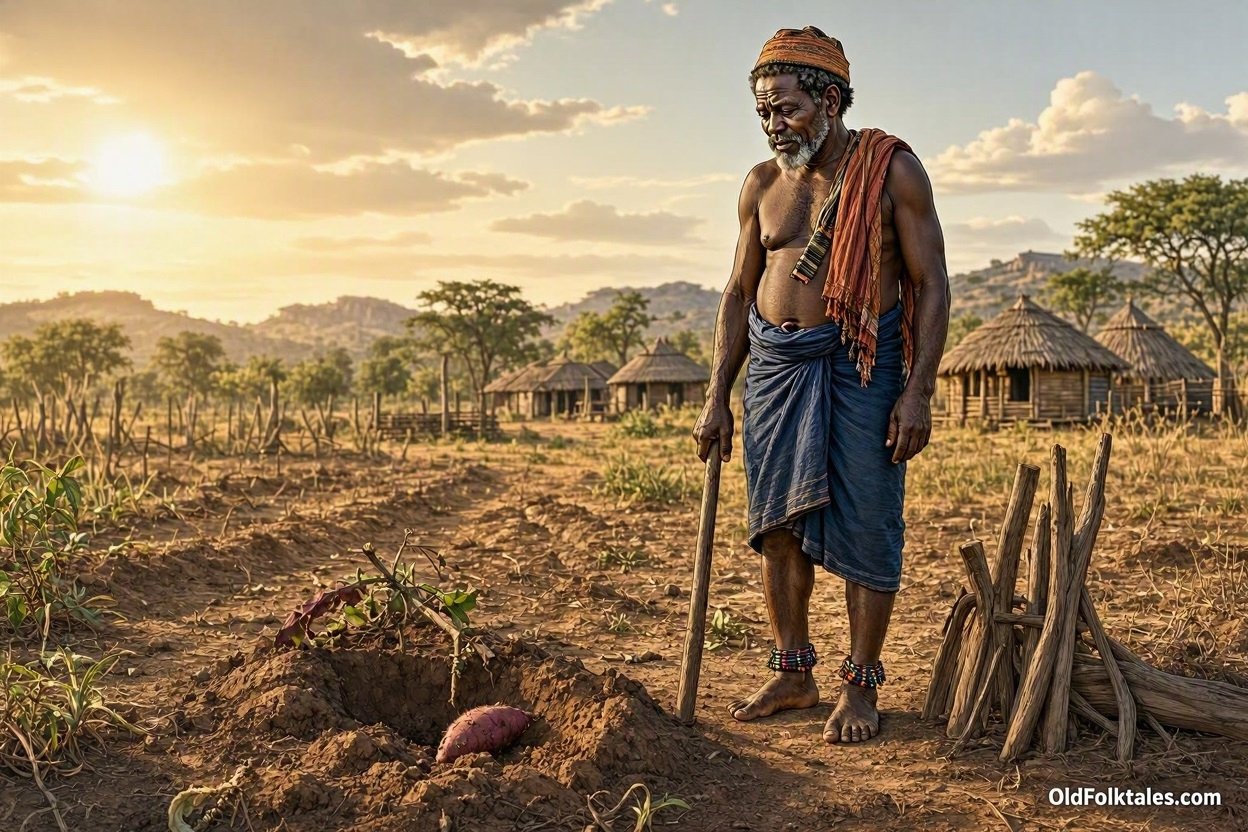
Eventually, only one sweet potato remained.
The farmer looked at it carefully.
It was the final result of his labour.
He could have dug it up immediately and taken it home.
Instead, he decided to use it to discover the truth.
He left the sweet potato in the ground and began paying closer attention to what happened around his field.
He watched during the day.
He listened at night.
He noticed the movements of people passing nearby.
Still, nobody came forward.
The farmer began thinking about the person who had been taking his crops.
Was it someone hungry?
Was it someone who simply wanted free food?
Was it a neighbour who considered the farmer’s harvest partly his own?
Or was it someone who believed that because the farmer was generous, he could take whatever he wanted?
These questions troubled him.
The farmer believed strongly in sharing.
If someone came to him and asked for food because they were hungry, he would not normally turn them away.
But taking something secretly was different.
Sharing required willingness.
Taking without asking was another matter.
The farmer therefore wanted to understand the difference.
The final sweet potato became his opportunity.
He waited.
Days passed.
The sweet potato remained in the soil.
The farmer continued pretending that everything was normal.
Then one day, the final sweet potato disappeared.
The farmer immediately knew that whoever had been taking his crops had returned.
But instead of becoming furious, he stopped and thought.
He had finally learned something important.
The person had not come to him to ask for food.
The person had taken it secretly.
Yet the farmer’s response was not what anyone might have expected.
He did not rush through the village accusing people.
He did not gather his neighbours and demand that the thief be punished.
Instead, he considered what the missing sweet potato had revealed about the relationships within his community.
He understood that food could bring people together.
A farmer who had enough could feed someone who had little.
A neighbour could visit another neighbour and share a meal.
Friends could sit together and divide what was available.
In such moments, the quantity of food mattered less than the willingness to share it.
But there was also another side to generosity.
A generous person could become vulnerable if others treated kindness as permission to take advantage of him.
The farmer thought about the people who might have eaten his crops.
Perhaps some had been hungry.
Perhaps others had simply become accustomed to taking what did not belong to them.
The difference mattered.
True friendship was not built on taking everything from someone who was willing to give.
True friendship involved consideration.
A friend might accept food offered freely, but a true friend would also care about the person who had produced it.
A friend would understand the effort behind every crop.
A friend would not quietly take the last piece without considering whether the owner had anything left.
The farmer began to see the missing crops in a different way.
The problem was not simply that his sweet potatoes had disappeared.
The deeper issue was trust.
When people share with one another, they create a relationship based on trust.
One person gives because they believe the other person will appreciate the gift.
But when someone secretly takes what has not been offered, that trust is damaged.
The farmer also recognised the importance of hospitality.
Hospitality was valuable because it allowed people to feel welcome.
A visitor could enter a neighbour’s home and receive food without embarrassment.
But hospitality worked best when it was mutual.
The person receiving kindness should not turn hospitality into an excuse for selfishness.
The farmer’s experience taught him that community could only remain strong when generosity was respected.
He thought about what he would do if the person responsible eventually came to him.
Would he refuse to share?
No.
The farmer was still willing to share.
But he wanted people to understand that sharing and stealing were not the same thing.
If someone asked him for a sweet potato, he could decide whether to give one.
If someone secretly dug up his crops, the decision had been taken away from him.
That difference was important.
The farmer eventually shared his thoughts with people around him.
He did not need to reveal every detail of his plan.
Instead, he spoke about friendship and the responsibilities that came with living among others.
He explained that a person’s generosity should never be mistaken for weakness.
He said that when someone shares food, the gift should be appreciated.
When someone offers hospitality, it should be respected.
And when people call one another friends, they should be able to trust each other.
His words made some people think carefully.
Everyone knew how difficult farming could be.
They knew that a crop did not simply appear in the ground.
Someone had to prepare the soil.
Someone had to plant the seeds.
Someone had to weed the field.
Someone had to protect the plants.
Someone had to wait patiently for the harvest.
Taking food from a farmer without asking meant taking the result of all that work without acknowledging the labour behind it.
The farmer did not want his community to become a place where people were afraid to be generous.
He wanted people to continue helping one another.
But he also wanted generosity to be respected.
His experience with the last sweet potato showed him that friendship was not measured by how much one person could take from another.
It was measured by how people treated one another when there was little to go around.
A person who shared half of what they had could show greater friendship than someone who demanded everything.
A person who asked before taking could show greater respect than someone who quietly helped themselves.
And someone who cared about a friend’s wellbeing would understand that kindness came with responsibility.
The farmer looked back at the season.
His field had produced food.
Some of it had fed his household.
Some had disappeared without permission.
But the final sweet potato had taught him something more valuable than the crop itself.
It had shown him that sharing was not merely about giving away food.
It was about building relationships.
It was about trust.
It was about understanding that another person’s labour had value.
It was about knowing when to accept kindness and when to offer it.
Most importantly, it was about recognising the difference between a person who receives generosity with gratitude and one who begins to expect generosity as an entitlement.
The farmer did not allow the experience to make him bitter.
He continued to believe in helping others.
He continued to welcome people into his home.
He continued to share when he had enough.
But he became wiser about the people around him.
He learned that kindness needed wisdom alongside it.
Generosity could bring people together, but it could also be abused when it was not respected.
True friendship therefore required more than eating together or receiving gifts.
It required consideration.
It required trust.
It required the willingness to give as well as the willingness to receive.
And sometimes, the smallest thing could reveal the greatest truth.
For this farmer, that thing was his last sweet potato.
Someone had taken it.
But in losing that final crop, the farmer gained a deeper understanding of what it meant to share, what it meant to trust and what it truly meant to be a friend.
Don’t miss out: Read more Southern African folktales
Moral Lesson
True friendship is built on trust, respect and mutual generosity. Sharing should come from willingness, not from taking advantage of another person’s kindness.
Knowledge Check
1. Why did the farmer become suspicious?
His crops repeatedly disappeared from his field.
2. Why did the farmer avoid immediately accusing his neighbours?
He did not want to accuse innocent people without evidence or damage relationships.
3. What did the farmer use to help him discover what was happening?
He used the last sweet potato as an opportunity to observe who would take it.
4. What difference did the farmer recognise between sharing and taking?
Sharing happens when food or possessions are willingly offered, while taking without permission ignores the owner’s choice.
5. What does true friendship require according to the lesson of the story?
It requires trust, respect, consideration and mutual generosity.
6. What did the farmer learn from losing his last sweet potato?
He learned that kindness should be respected and that true friendship is not about taking advantage of someone’s generosity.
Source
Adapted from “Lunda Storytelling 9,” told by Emeliya Muleya and documented by Robert Cancel in Storytelling in Northern Zambia: Theory, Method, Practice and Other Necessary Fictions (Open Book Publishers, 2013), pp. 194–196.