For many years, the woman had watched other families celebrate the arrival of children while her own home remained quiet. She had no child to call her own, and the absence weighed heavily on her.
People in the community knew of her longing. Some offered words of encouragement. Others suggested remedies, prayers or traditional explanations for her situation. She listened to them all, but nothing changed.
Then one day, several people returned from gathering honey.
Among the things they carried was a quantity of beeswax. When they saw the woman, they decided to give some to her.
She accepted the wax gratefully.
At first, she had no idea what to do with it. She simply regarded it as a useful substance that might one day serve a purpose. Yet because she had spent so long hoping for a child, even an ordinary gift seemed capable of carrying a little hope.
She took the beeswax home.
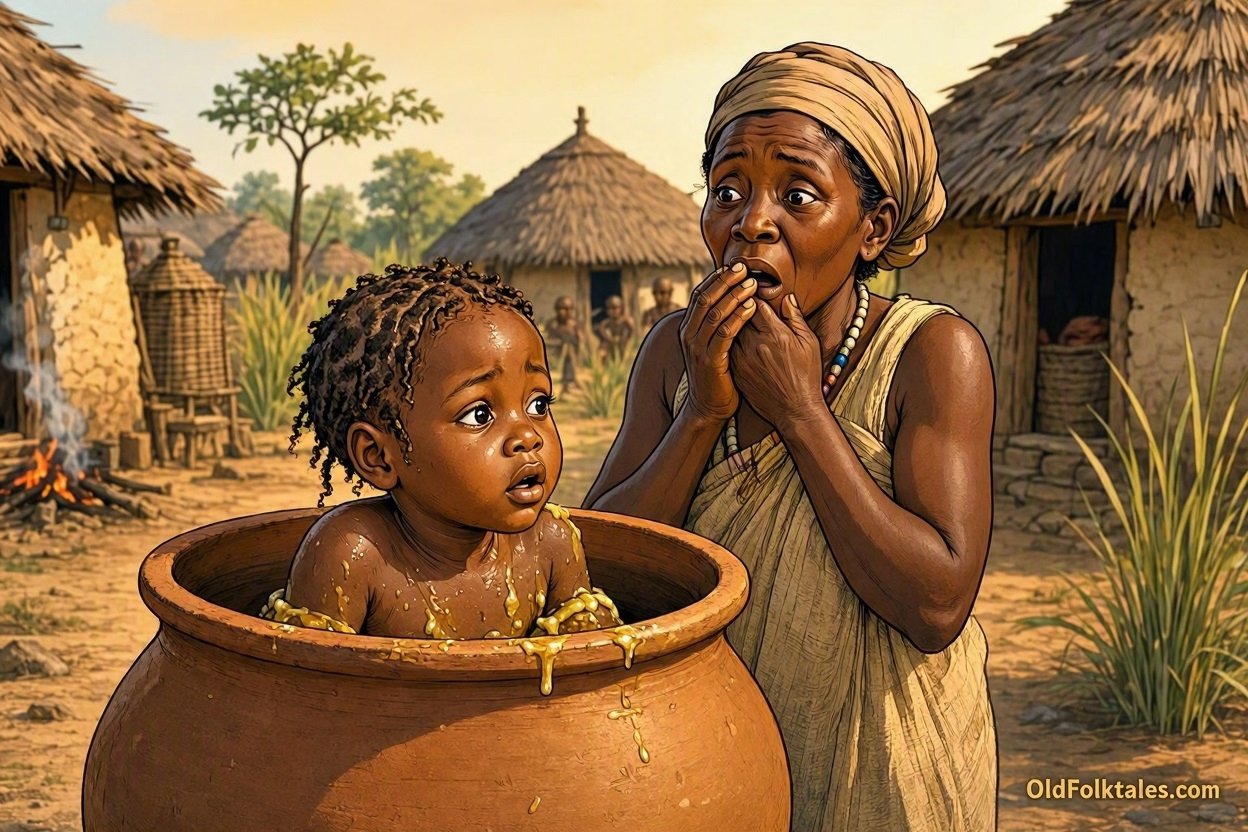
There, she placed it carefully inside a clay pot.
She did not know that the simple act would change her life.
Something extraordinary happened inside the pot.
If you enjoyed this story, explore our full West African folktales collection
When the woman eventually looked again, she discovered that the wax had become something she could never have imagined.
There was a child.
A girl.
The woman could hardly believe what she was seeing.
For years she had wished for a daughter, and now a little girl had appeared through circumstances that no ordinary explanation could account for.
She welcomed the child as a blessing.
She cared for her.
She watched her grow.
The girl was different from other children in ways that were difficult to explain, but her mother did not allow those differences to diminish her love.
As the years passed, the girl became increasingly beautiful.
She also became known for her unusual beginning.
People wondered about her.
Some were fascinated by the story of the child who had come from beeswax. Others simply accepted that the world contained mysteries that could not always be explained.
Her mother, however, became increasingly protective.
She had waited too long for a child to allow anything to happen to her daughter.
She wanted to decide what was best for her.
She wanted to protect her from disappointment.
Most of all, she wanted to ensure that her daughter married well.
As the girl grew into a young woman, people began to notice her.
Suitors appeared.
Some came with respectable families.
Others offered promises of wealth or security.
The girl’s mother considered them carefully.
She believed that because her daughter had been given to her through such extraordinary circumstances, an ordinary marriage would not be enough.
Her daughter deserved something special.
But the young woman had thoughts of her own.
She wanted to choose the person with whom she would spend her life.
Her mother’s expectations gradually became a source of tension between them.
The girl respected her mother, but she did not understand why every decision concerning her future had to be made for her.
Then an unusual young man entered their lives.
There was something mysterious about him.
He did not behave like the other young men who had come to seek the girl’s hand.
He spoke carefully.
He seemed to know more about the family than a stranger should.
Yet there was also something reassuring about him.
The girl was drawn to him.
Her mother was not convinced.
She questioned him about his family and his background.
Some of his answers were satisfying.
Others only created more questions.
Still, circumstances brought the young man and the girl closer.
Eventually, a marriage became possible.
The girl’s mother agreed, but she remained watchful.
She believed that there was something about the marriage that had not yet been revealed.
She was right.
The young man’s identity was connected to a secret.
It was not the kind of secret that could easily be explained to neighbours or relatives.
The girl gradually realised that the life she had entered was not as ordinary as it first appeared.
Her husband had warned her about certain things.
There were matters she was not supposed to investigate.
There were questions she was not supposed to ask.
There were boundaries she was expected to respect.
At first, she accepted them.
After all, marriage required trust.
But secrets have a way of creating curiosity.
The more someone is told not to look, the more tempting the hidden thing can become.
The young woman began wondering what her husband was concealing.
She remembered the strange circumstances of her own birth.
She wondered whether her unusual beginning was somehow connected to the unusual man she had married.
Her questions grew stronger.
Meanwhile, her mother remained concerned.
She had always believed that she needed to protect her daughter.
But protection had gradually become control.
She wanted to know everything happening in her daughter’s marriage.
She asked questions.
The daughter tried to reassure her.
But eventually, the secret became impossible to keep completely hidden.
A decision had to be made.
The young woman had to choose between respecting the boundary her husband had established and satisfying the curiosity that had been growing inside her.
She knew that breaking a promise could have consequences.
Yet she also believed that she deserved to understand the truth about her own life.
She began looking for answers.
What she discovered changed her understanding of her husband.
The mysterious marriage was not simply the ordinary union she had imagined.
There were supernatural elements surrounding the man and the circumstances that had brought them together.
The girl finally understood that her extraordinary birth had not been the only unusual event in her life.
From the moment she emerged from the beeswax, her existence had been connected to a world beyond ordinary explanation.
Her husband had known this.
Her mother had known that there was something extraordinary about her.
But neither had given her the full truth.
She felt betrayed.
Her mother had spent her entire life protecting her, yet that protection had included keeping important truths from her.
Her husband had asked for her trust, yet he had also surrounded their marriage with secrecy.
The young woman now understood that love without honesty could become another form of imprisonment.
The discovery also forced her to reconsider her mother’s behaviour.
Her mother had not acted from hatred.
She had acted from fear.
After waiting so many years for a child, she had become terrified of losing the daughter she had received through such a miracle.
That fear had made her controlling.
She had confused protecting her daughter with deciding everything for her.
The young woman finally confronted her mother.
She explained that she appreciated everything her mother had done, but she could no longer allow fear to determine her life.
Her mother struggled to accept this.
For the first time, she had to recognise that the child she had once held in her arms was now an adult capable of making her own decisions.
The events surrounding the marriage eventually revealed an important truth.
Extraordinary beginnings do not guarantee simple lives.
The girl had been born through a miracle, but the miracle did not protect her from difficult choices.
Instead, it placed her on a path filled with mystery, love, secrecy and uncertainty.
She had to learn that a person’s origins do not determine every decision they make.
She could not control the mysterious circumstances of her birth.
She could not control the secrets surrounding her husband.
But she could decide how she would respond to them.
The experience changed her relationship with her mother.
They were no longer simply mother and daughter in the way they had been before.
The mother had to learn to trust the woman her daughter had become.
The daughter had to learn that her mother’s fear came from love, even when that love became too controlling.
And both had to accept that trust could not survive without honesty.
The story of the girl born from beeswax continued to be remembered because her life had begun in such an extraordinary way.
She had entered the world through a clay pot instead of an ordinary birth.
She had grown into a young woman whose marriage was surrounded by mystery.
But the most important transformation was not the miracle that brought her into existence.
It was the transformation that took place within her.
She began as a child whose future was controlled by others.
She became a woman who understood the importance of making her own choices.
Her story reminded those who heard it that miracles can bring people unexpected blessings, but blessings also come with responsibilities.
A parent may want to protect a child from every danger, but no parent can live a child’s life forever.
A husband may ask for trust, but trust must be supported by honesty.
And a person may be born under extraordinary circumstances without being destined to remain powerless.
The girl born from beeswax had entered the world as a mystery.
She left her childhood behind as someone determined to understand her own place in that mysterious world.
Her life proved that sometimes the greatest transformation is not becoming something different.
It is discovering who you have the courage to become.
Love this story? Discover our full Southern African folktales collection
Moral Lesson
Love should protect without controlling, and trust must be built on honesty. Extraordinary circumstances may shape our lives, but our choices determine the people we become.
Knowledge Check
1. What unusual material was connected to the girl’s birth?
Beeswax.
2. Why was the girl’s mother especially protective of her?
She had waited many years for a child and feared losing the daughter she had received through extraordinary circumstances.
3. What made the girl’s marriage unusual?
Her husband had a mysterious identity and the marriage was connected to supernatural circumstances.
4. What created tension between the girl and her mother?
Her mother’s desire to control decisions about her daughter’s future.
5. What did the girl learn about trust?
She learned that trust requires honesty and that keeping important secrets can damage relationships.
6. What is one major lesson from the girl’s transformation?
A person’s unusual origins do not determine their future; they must eventually learn to make their own choices.
Source
Adapted from “Bwile Storytelling 5,” told by Timothy Kachela and documented by Robert Cancel in Storytelling in Northern Zambia: Theory, Method, Practice and Other Necessary Fictions (Open Book Publishers, 2013), pp. 228–233.