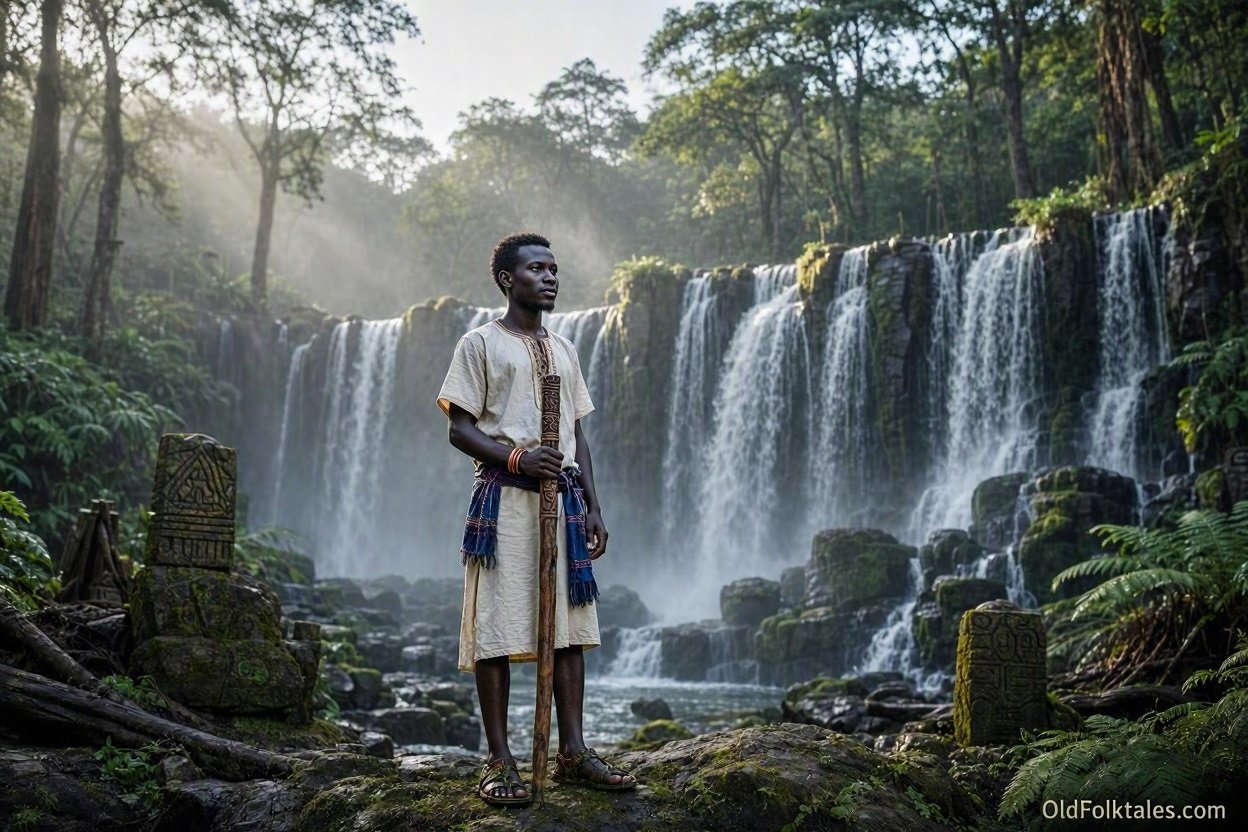
The sound of falling water could be heard long before the waterfall came into view. Deep in Northern Zambia, the rushing waters of Chishimba Falls thundered over the rocks, sending cool mist into the surrounding forest. To visitors, the waterfall was beautiful. To the Bemba people, however, it was much more than a beautiful place. It was a sacred place of power, a place where the visible world and the unseen world were believed to meet.
For generations, elders had warned younger people to behave carefully whenever they approached the falls. They were told not to insult one another, quarrel, curse, speak words of hatred or vengeance, or behave arrogantly within the sacred grounds. The elders believed that the spirit of the falls was present and that anyone who entered the place had to show respect.
Among the young men of a nearby village was a man named Mumba. He was strong, confident and adventurous. He had heard many stories about Chishimba Falls, but he had never taken the warnings seriously.
Whenever the elders spoke about the sacredness of the waterfall, Mumba laughed.
Don’t stop yet! See our complete East African folktales collection
“Water is water,” he would say. “Why should anyone be afraid of a waterfall?”
His friends often warned him not to speak carelessly.
“You should listen to the elders,” they told him. “They know the history of that place.”
But Mumba believed that the elders were simply trying to frighten young people.
One morning, he decided that he would go to the waterfall alone.
He wanted to prove that there was nothing mysterious about the place. He wanted to walk close to the water, explore the rocks and perhaps swim in one of the pools beneath the falls.
Before leaving the village, an elderly man saw him preparing.
“Where are you going?” the elder asked.
“To Chishimba Falls,” Mumba replied.
The old man looked at him carefully.
“Then remember what you have been taught. Do not quarrel there. Do not insult anyone. Do not curse. Do not speak words of hatred. Above all, do not behave as though you are greater than the place.”
Mumba smiled.
“I am only going to see water.”
The elder shook his head.
“Some places are not approached in the same way as ordinary places.”
Mumba did not answer. He picked up his belongings and continued toward the falls.
As he walked through the forest, the sound of the water grew louder. Soon, he began seeing mist rising above the trees. When he finally reached the waterfall, he stopped.
Even Mumba was impressed.
The water rushed over the rocks with tremendous force. Mist floated through the air, and the forest around the falls seemed unusually quiet. The rocks were wet and slippery, while the pools below reflected the movement of the water.
For a moment, Mumba understood why the elders respected the place.
Then his pride returned.
“This is what everyone is afraid of?” he muttered.
He walked closer.
He noticed a narrow path leading toward a cave behind the falling water. He had heard that the cave was connected with the spirit of Chishimba.
Instead of turning back, Mumba decided to explore it.
He stepped carefully across the rocks.
The closer he moved toward the cave, the colder the air became. The sound of the waterfall surrounded him until he could barely hear anything else.
Mumba entered the cave.
Inside, everything was dark and damp.
He looked around.
“There is nothing here,” he said aloud.
His voice echoed through the cave.
He laughed.
“Maybe the spirit is sleeping.”
The laughter disappeared into the sound of the waterfall.
Then Mumba heard something.
A faint sound.
At first, he thought it was only the echo of the water.
Then he heard it again.
Someone was calling his name.
“Mumba.”
He froze.
He turned around.
Nobody was there.
He looked toward the entrance of the cave.
Nothing.
He told himself that he had imagined it.
Then the voice came again.
“Mumba.”
This time, it sounded closer.
He stepped backward.
“Who is there?”
No answer came.
The waterfall continued roaring.
Mumba suddenly remembered the elder’s warning.
Do not insult anyone.
Do not curse.
Do not speak words of hatred.
Do not behave arrogantly.
He began feeling uncomfortable.
“I should leave,” he whispered.
He turned toward the entrance.
Before he could take another step, the wind inside the cave changed.
The mist around him thickened.
For a moment, Mumba thought he saw a human figure standing beyond the curtain of water.
He blinked.
The figure disappeared.
Then another shape seemed to emerge from the mist.
Mumba could not tell whether he was seeing a person, a shadow or something belonging to the unseen world.
He wanted to run.
But his feet refused to move.
A deep voice spoke.
“Why have you come?”
Mumba’s heart pounded.
“I came to see the waterfall,” he answered.
“Did you come with respect?”
Mumba remembered how he had laughed at the elders.
He said nothing.
The voice continued.
“You were warned before you came.”
Mumba lowered his head.
“Yes.”
“Yet you entered believing that this place was no different from any other.”
Mumba could not deny it.
He had thought the elders were foolish.
He had believed that courage meant ignoring their warnings.
Now, standing inside the dark cave, he realized that courage and arrogance were not the same thing.
“I am sorry,” he said.
The voice became silent.
Mumba waited.
Then he heard another sound.
This time, it was not a voice.
It was the sound of rushing water.
The mist slowly cleared.
The figure was gone.
Mumba finally felt his legs loosen.
He hurried toward the entrance of the cave.
When he stepped outside, the sunlight seemed brighter than before.
He stood beside the waterfall for a long time without speaking.
The place suddenly looked different to him.
The rocks were still rocks.
The water was still water.
The trees were still trees.
But now he understood why the people of his community treated the place differently.
Sacredness was not always something that could be seen.
Sometimes it existed in the stories people carried, the traditions they preserved and the respect they showed toward places that held deep meaning for their community.
Mumba began his journey home.
This time, he walked slowly.
When he reached the village, the elder who had warned him was sitting beneath a tree.
The old man looked at him.
“You have returned.”
“Yes,” Mumba replied.
“What did you see?”
Mumba remained silent for a moment.
“I saw a waterfall.”
The elder smiled.
“And what did you learn?”
Mumba looked toward the forest.
“I learned that not every place should be treated as ordinary.”
The elder nodded.
“Now you understand.”
From that day, Mumba stopped laughing whenever the elders spoke about Chishimba Falls. He began warning younger people about the importance of respecting the sacred site.
He told them that they should never insult one another there, never quarrel, never curse and never behave arrogantly.
Some young people laughed at him.
Others asked whether he had truly seen the spirit.
Mumba never gave them a definite answer.
He simply told them that there were some mysteries that a person did not need to solve before choosing to show respect.
The elders were pleased with the change in him.
They understood that Mumba had learned an important lesson.
The secret of the sacred waterfall was not simply the existence of an unseen spirit.
It was also the knowledge that had been preserved by generations of people.
The waterfall reminded them that nature could hold cultural and spiritual meaning. The forest, the rocks, the rushing water and the caves were not merely things to be used or conquered. They were part of a landscape surrounded by stories, beliefs and traditions.
Years later, when Mumba became an elder himself, he continued telling young people about the day he visited Chishimba Falls.
Whenever they laughed at the old warnings, he would smile.
“You may not believe everything your elders believe,” he would tell them, “but that does not give you permission to disrespect what is sacred to others.”
Then he would remind them of the rules.
No insults.
No curses.
No hatred.
No quarrelling.
No arrogance.
And no careless behaviour in a place that generations before them had learned to respect.
The waterfall continued to thunder through the forest.
Its waters continued their endless journey over the rocks.
And the people continued to pass down the belief that something powerful lived within the sacred landscape.
Whether a visitor believed in the spirit or not, the lesson remained.
A sacred place is not respected because everyone understands its mystery.
It is respected because it carries the memory, beliefs and traditions of the people who have cared for it.
That was the secret Mumba finally understood.
And once he understood it, he never looked at Chishimba Falls in quite the same way again.
Love this story? Discover our full Southern African folktales collection
Moral Lesson
Respect the sacred places, beliefs and traditions of other people. Even when we do not share the same beliefs, we should approach culturally important places with humility and care. Nature can hold deep spiritual, historical and cultural meaning for communities.
Knowledge Check
1. Why was Chishimba Falls considered special by the Bemba people?
Answer: It was regarded as a sacred place of power where the spirit Chishimba was believed to reside.
2. What did the elders warn people not to do at the waterfall?
Answer: They warned people not to insult, curse, quarrel, speak words of hatred or vengeance, or behave arrogantly.
3. Why did Mumba decide to visit the waterfall?
Answer: He wanted to prove that there was nothing mysterious about the waterfall and that the elders’ warnings were unnecessary.
4. What happened when Mumba entered the cave?
Answer: He heard a mysterious voice calling his name and encountered an unexplained supernatural presence.
5. What did Mumba learn from his experience?
Answer: He learned that sacred places should not be treated like ordinary places and that traditions and beliefs deserve respect.
6. What did Mumba do after returning to the village?
Answer: He stopped mocking the elders and began teaching younger people to respect Chishimba Falls and its traditions.
Source
This is an original adaptation inspired by documented Northern Zambian traditions surrounding Chishimba Falls, rather than a verbatim retelling of a story titled “The Secret of the Sacred Waterfall.”