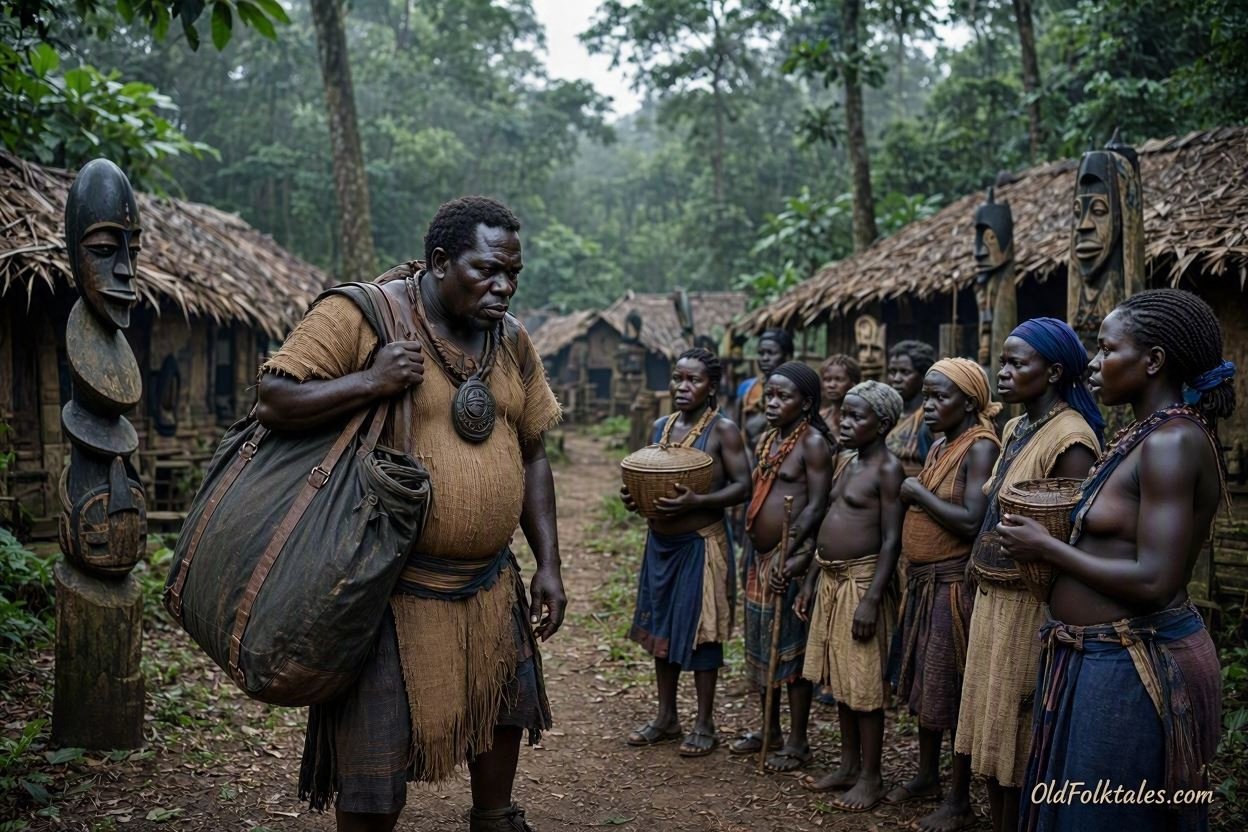
By the time the people of the forest village began whispering about Akhoulenzame, nobody could remember exactly when he had first appeared. Some said he came at the beginning of the rainy season, when the forest became dark beneath heavy clouds. Others insisted that he had arrived one evening just before the last drumbeat announcing that the village gates were closing. What everyone agreed upon was that he never travelled without the same old bag hanging from his shoulder.
The bag was unlike anything the villagers had seen. It was large, dark and strangely heavy, although Akhoulenzame never appeared tired from carrying it. He kept it close to his body wherever he went. When he sat, the bag sat beside him. When he slept, he placed it beneath his head. When he walked into the forest, he carried it with him.
Nobody knew what was inside.
That was what frightened them.
Akhoulenzame was not an ugly man, nor did he behave like someone who wanted to frighten people. He greeted elders respectfully, answered questions politely and never caused trouble in the village. Yet there was something about him that made people uncomfortable. He spoke very little about himself, and whenever anyone asked about the bag, his face became serious.
“What do you carry in there?” one young man once asked.
Want more? Read more West African folktales now
Akhoulenzame looked at him for a long moment.
“Something that belongs to me,” he answered.
“Is it food?”
“No.”
“Clothes?”
“No.”
“Then what is it?”
Akhoulenzame lifted the bag onto his shoulder.
“That is not a question you should ask.”
The young man laughed, pretending not to be afraid, but he never asked again.
As the seasons passed, strange things began happening around the village. People who had been healthy suddenly became weak. A hunter would leave in the morning full of strength and return before sunset looking exhausted. A woman who had spent the day working in her plantation would sometimes wake during the night feeling as though someone had been calling her name from the forest.
Then people began disappearing.
The first was a young hunter.
He left the village with his knife and hunting equipment and never returned. His family searched along the forest paths. They followed footprints, examined the riverbanks and called his name until their voices became hoarse. They found nothing.
A few weeks later, another man disappeared.
Then a young woman.
Fear spread through the village.
People began closing their doors earlier. Mothers warned their children not to wander beyond the houses. Hunters travelled in groups. Nobody wanted to enter the forest alone.
And then someone remembered Akhoulenzame.
“Since that man arrived, strange things have happened,” an elder said.
Another replied, “But he has done nothing openly.”
“Perhaps that is why we should be more afraid.”
The rumours grew.
Some villagers claimed they had seen Akhoulenzame walking toward the forest after midnight. Others said that they had heard strange sounds coming from his house. One woman insisted that she had seen him open his bag near the river.
“What was inside?” someone asked.
“I do not know,” she replied. “I ran before I could see.”
Soon, the bag became the centre of every conversation.
One evening, several young men decided that they would discover the truth.
They waited until Akhoulenzame left the village. When they saw him disappear along the forest path, they entered his house.
The room was empty.
In one corner lay the bag.
The young men stared at it.
Nobody moved.
Finally, one of them whispered, “Open it.”
Another shook his head.
“We came here to discover what is inside.”
“And what if we discover something we cannot escape from?”
The first man laughed nervously and reached for the bag.
Before he could touch it, the bag moved.
Everyone froze.
It moved again.
Something inside had shifted.
The young men ran from the house.
That night, nobody slept properly.
The next morning, Akhoulenzame returned as though nothing had happened. He entered his house, looked at the place where the bag had been left and immediately understood what had occurred.
He walked to the village square.
“You entered my house,” he said.
Nobody answered.
“You touched what did not belong to you.”
Still nobody spoke.
Then an old man stepped forward.
“People are disappearing,” he said. “We are afraid. If you know something, tell us.”
Akhoulenzame looked around at the frightened faces.
“You are afraid of my bag because you do not understand it,” he said.
“Then explain it.”
He lowered his voice.
“The forest has things that belong to the forest. The village has things that belong to the village. There are boundaries between the living and what should remain hidden. A person who crosses those boundaries without wisdom may not return.”
The villagers listened silently.
“But what is inside the bag?” a woman asked.
Akhoulenzame did not answer.
Instead, he lifted it and walked away.
That answer frightened them more than anything else.
Days later, another person disappeared.
This time, the villagers refused to remain silent.
They gathered together and demanded that Akhoulenzame leave.
“You have brought danger here,” the village chief told him.
Akhoulenzame looked at the chief.
“I came carrying the bag,” he replied. “I did not bring the danger. You have been living beside the forest without understanding what surrounds you.”
The chief became angry.
“You speak in riddles.”
“Because some truths cannot be spoken carelessly.”
The chief ordered the villagers to search Akhoulenzame’s house.
This time they found him waiting.
He placed the bag on the ground.
“Since you want to know,” he said, “look.”
Nobody moved.
Akhoulenzame opened it.
Inside was not gold.
It was not food.
It was not clothing.
The villagers saw strange objects wrapped in old material, pieces of things that seemed to belong to people who were no longer among them. There were objects connected to the missing villagers, things their families immediately recognized.
A knife belonging to the first hunter.
A necklace belonging to the missing woman.
A small wooden object carried by another man.
A terrible silence fell over the square.
The families cried out.
“You took them!”
Akhoulenzame shook his head.
“No.”
“Then where are they?”
He closed the bag.
“The forest took what was offered to it.”
The villagers did not understand.
Akhoulenzame explained that the missing people had not all vanished in the same way. Some had ignored warnings. Some had entered places they had been told not to enter. Some had followed mysterious sounds into the forest. Others had searched for things they believed would make them powerful.
The bag, he explained, held objects left behind after encounters with forces that ordinary people did not understand.
But one object remained.
Akhoulenzame reached into the bag and removed a small item.
The village elder recognized it immediately.
It belonged to a young man who had disappeared many months earlier.
“Where did you find that?” the elder asked.
Akhoulenzame pointed toward the forest.
The elder understood.
The young man might still be alive.
The villagers organized a search party. They entered the forest carefully, following the signs Akhoulenzame gave them. They travelled beyond the familiar hunting paths until they reached a place none of them had seen before.
There, beneath a great tree, they found the missing young man.
He was weak but alive.
When they brought him home, the village celebrated.
But Akhoulenzame did not celebrate with them.
The next morning, he disappeared.
His house was empty.
The mysterious bag was gone.
Nobody knew where he had gone or whether he would ever return.
For many years afterward, travellers passing through the village were told the same warning.
If they ever saw a stranger carrying a dark bag through the forest, they should not follow him out of curiosity.
They should greet him respectfully.
They should mind the boundaries between what is known and what is hidden.
And above all, they should never open what they had not been given permission to open.
For the people of that village had learned a lesson they never forgot.
A mysterious thing does not become harmless simply because curiosity demands that it be revealed.
Sometimes wisdom means knowing what to ask.
Sometimes courage means facing what frightens you.
And sometimes the greatest wisdom of all is knowing when to leave a mystery alone.
Click here to explore more Central African folktales
Moral Lesson
Curiosity can lead us toward knowledge, but curiosity without wisdom can also lead us into danger. The story reminds us to respect boundaries, listen to warnings and avoid interfering with things we do not understand.
Knowledge Check
1. Why did the villagers become suspicious of Akhoulenzame?
Answer: They were frightened by his mysterious bag and began connecting his presence with the strange disappearances in the village.
2. What made Akhoulenzame’s bag unusual?
Answer: He carried it everywhere, kept its contents secret and refused to explain what was inside.
3. Why did the young men enter Akhoulenzame’s house?
Answer: They wanted to discover the secret of the mysterious bag.
4. What did the villagers discover inside the bag?
Answer: They found strange objects connected to people who had disappeared.
5. What did the story teach the villagers about the forest?
Answer: They learned that the forest contained mysteries and dangers that should not be approached carelessly.
6. What is the main lesson of the story?
Answer: We should respect boundaries and use wisdom instead of allowing curiosity to lead us into danger.
Source
Original documented source: Henri Trilles, Contes et légendes fang du Gabon (1905), “Akhoulenzame, l’homme au sac,” p. 108.