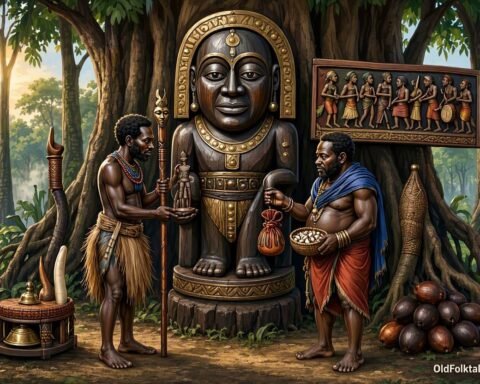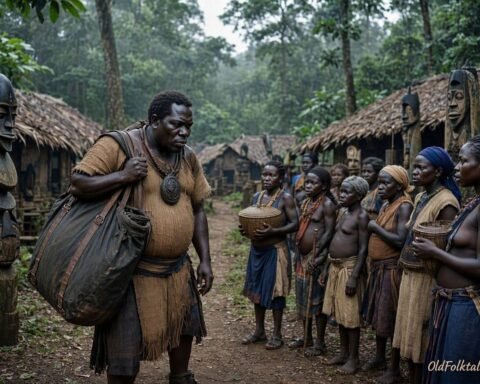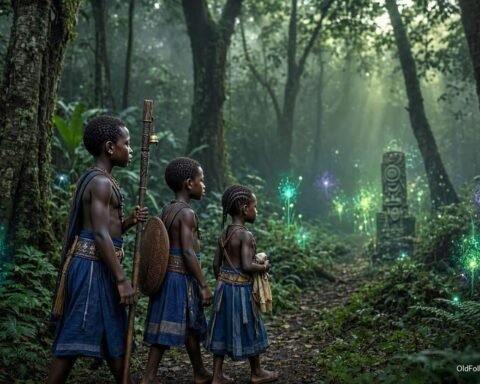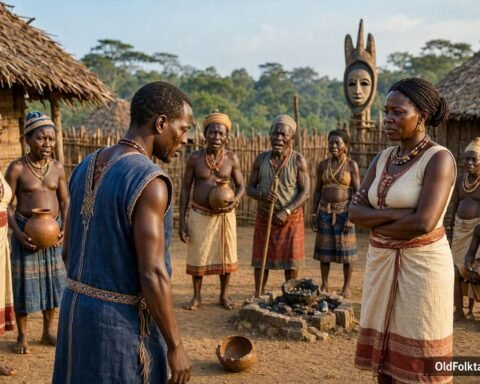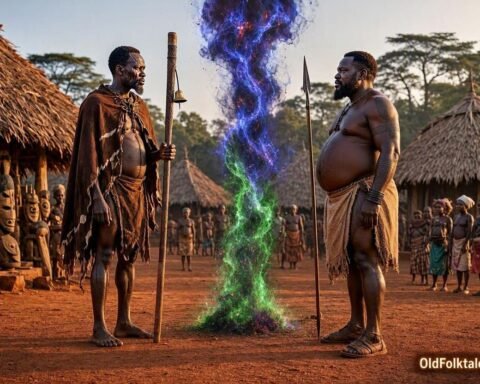
The people of the forest knew that some lives were tied together by bonds that could not easily be explained. Among the Fang people of Gabon, stories were told of powerful men, mysterious beings and forces that lived beyond the ordinary world. One of the most striking of these traditions was the legend of Ngourangourane, a man whose name became closely connected with a crocodile.
Ngourangourane was not an ordinary man. His presence carried weight, and people spoke of him with a mixture of respect and caution. He possessed a strength and authority that made others listen when he spoke. Yet the most unusual part of his story was not his power among people. It was the strange relationship that connected his fate with that of a great crocodile.
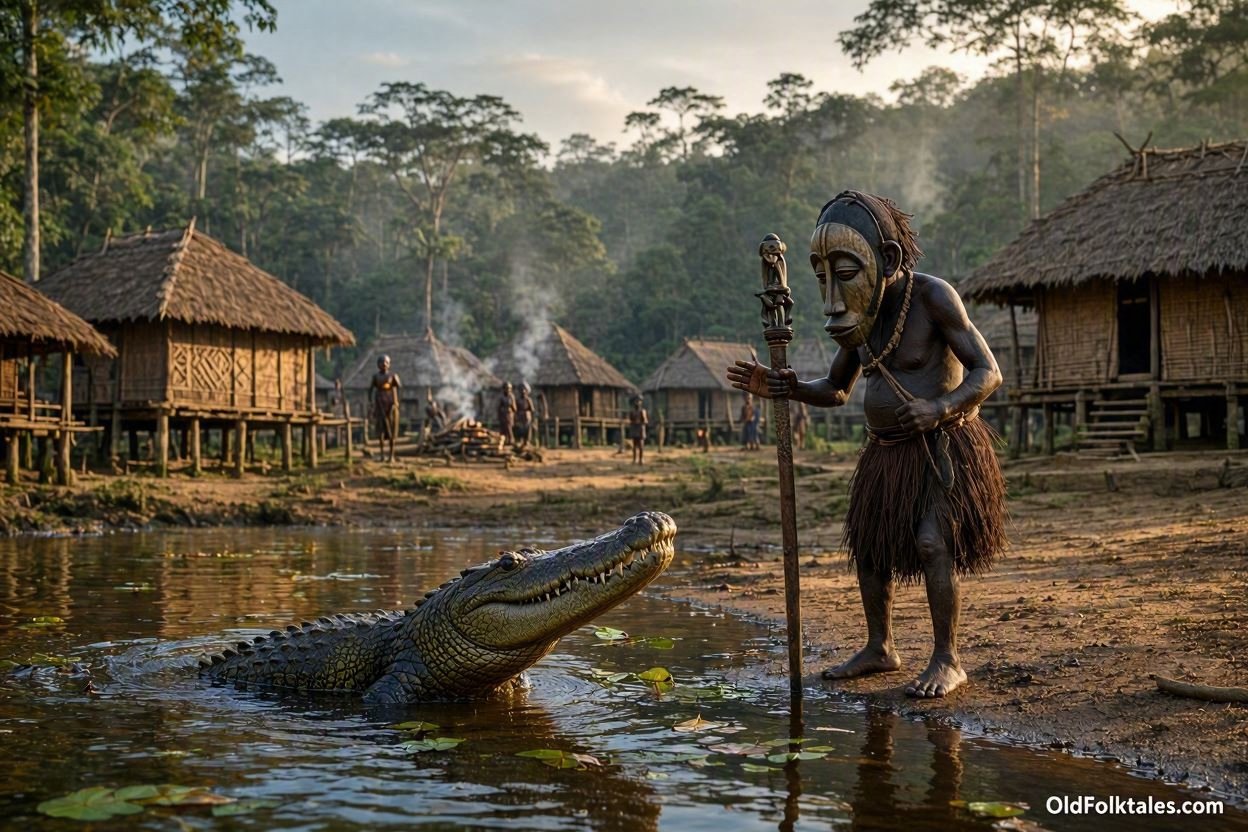
The crocodile belonged to the world of rivers and hidden waters. In the forest country, rivers were essential to life. People depended on them for water, fishing and travel, but they also understood that the river was not a place to approach carelessly. Beneath its surface lived creatures that could not be controlled by human strength.
The crocodile was one of them.
Want more? Read more West African folktales now
People watched the water carefully whenever they approached the river. They knew that a crocodile could remain almost invisible beneath the surface, waiting silently before striking with frightening speed. Children were warned not to wander too close to dangerous waters, and adults treated the creature with caution.
Yet the story of Ngourangourane was different.
The crocodile was not simply remembered as a dangerous animal in his story. It became part of his legend, and the relationship between the man and the creature acquired a deeper meaning for those who preserved the tale.
As the story was passed from one generation to another, Ngourangourane and the crocodile became inseparable in memory. People came to understand that the fate of one could not be considered without thinking about the other.
This was not a simple friendship between a man and an animal. It belonged to a world where the boundary between human life and the mysterious forces of nature could become very thin.
Ngourangourane’s connection with the crocodile also made people aware of the limits of human power. A man might be strong, respected and feared, but there were forces around him that were older and more mysterious than anything he could command.
The river did not belong to Ngourangourane.
The forest did not belong to him either.
And the creatures within them could not simply be treated as ordinary possessions.
The crocodile continued to hold its place in the story, and with time its presence became deeply associated with Ngourangourane himself. The people who remembered the legend did not speak of the creature as though it were unrelated to the man’s destiny. Instead, the crocodile became part of the story that explained his life and his eventual fate.
Then came the death of the crocodile.
Its death was not treated as an ordinary event. Because the creature had become connected to Ngourangourane’s story, its passing carried significance. The crocodile had occupied a special place in the legend, and its death marked a turning point.
People remembered what had happened and preserved the memory of the creature. What had once been feared in the waters was now remembered with reverence.
The relationship between the crocodile and the people consequently changed. Fear gave way to ritual remembrance, and the creature became associated with a form of reverence that continued beyond its death.
This part of the tradition is important because it shows how traditional societies could understand animals not only as creatures of the physical world but also as beings connected to stories, ancestors, power and sacred meaning.
The crocodile’s death did not end its place in the community’s memory.
Instead, its story continued.
People remembered its connection with Ngourangourane and treated the crocodile with a respect that went beyond the ordinary fear inspired by a dangerous creature. The legend therefore became more than a story about a man and a crocodile. It became a story about power, destiny, nature and the mysterious connections that people believed could exist between different forms of life.
Ngourangourane himself eventually faced death.
His death brought another powerful moment to the legend. The man whose life had been connected so closely with the crocodile could no longer remain untouched by the same mystery that had surrounded him.
His death completed the cycle of the story.
The crocodile had died before him, but its memory remained tied to his name. When people remembered Ngourangourane, they remembered the crocodile too. The two became connected through the story in a way that ordinary explanations could not fully capture.
That is how legends survive.
They do not always give people simple answers. Sometimes they preserve questions. They invite listeners to think about the relationship between human beings and the natural world, about powers that cannot be easily understood and about the consequences of crossing boundaries that people consider sacred.
For the Fang people of Gabon, such traditions formed part of a wider oral world in which stories carried knowledge about life, society, nature and the unseen. A legend could entertain listeners while also teaching them to respect the forces around them.
The story of Ngourangourane reminds us that strength does not make a person master of everything. Even the most powerful person remains connected to a world larger than himself.
The forest has its secrets.
The river has its secrets.
And the creatures that live within them may become symbols through which people try to understand life itself.
Ngourangourane’s name endured because his story was unusual. His fate became connected with that of a crocodile, and the memory of their connection survived generations of storytelling.
The crocodile died.
Ngourangourane also died.
But the legend did not die with them.
It remained among the stories told about the old world of the Fang people, carrying with it the image of a powerful man whose destiny became mysteriously linked with a creature from the river.
For those who listened carefully, the legend offered a quiet warning. Human beings may build villages, gain authority and become powerful among their people, but they should never forget that they live within a world filled with forces beyond their control.
Nature deserves respect.
Tradition deserves memory.
And some stories are preserved precisely because their mysteries are greater than the answers people can give.
That is the enduring power of the legend of Ngourangourane.
Click here to explore more Central African folktales
Moral Lesson
Human strength and authority have limits. The story encourages respect for nature, cultural traditions and the mysterious forces that exist beyond human control. It also shows how powerful stories can preserve the memory of people, creatures and beliefs across generations.
Knowledge Check
1. Who is Ngourangourane?
Answer: Ngourangourane is the central human figure in a traditional Fang legend from Gabon whose story is closely connected with a crocodile.
2. What creature is strongly connected with Ngourangourane’s legend?
Answer: A crocodile is the creature closely connected with Ngourangourane’s story.
3. Why is the crocodile important in the legend?
Answer: The crocodile becomes closely connected with Ngourangourane’s fate and later acquires a place of remembrance and reverence.
4. What happens to the crocodile in the legend?
Answer: The crocodile eventually dies, marking an important stage in the legend.
5. What does the legend teach about human power?
Answer: It suggests that human strength and authority have limits because people remain subject to forces greater than themselves.
6. What is the cultural origin of the legend of Ngourangourane?
Answer: The legend belongs to the oral tradition of the Fang people of Gabon.
Source
Adapted from “La Légende de Ngourangourane, l’homme du Crocodile” in Henri Trilles’s Contes et légendes fang du Gabon, first published in 1905.