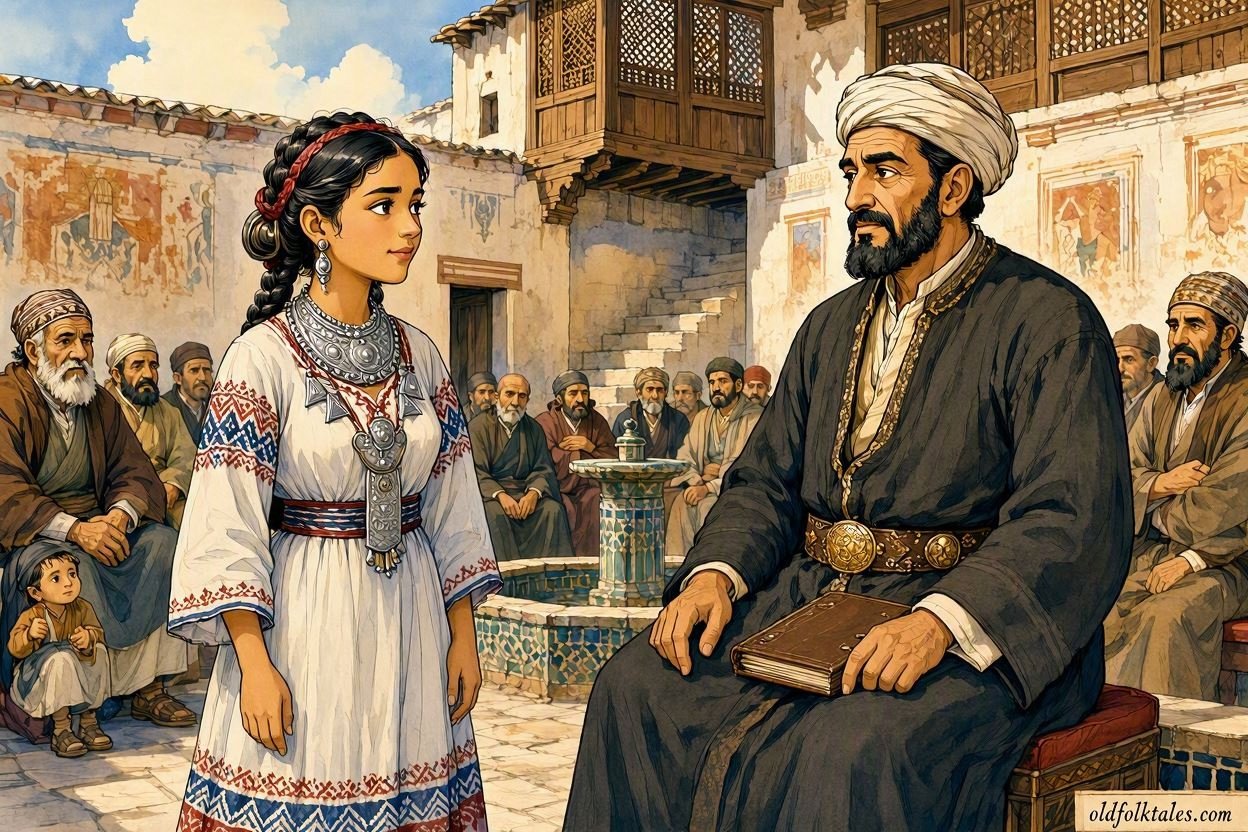
A cadi once gathered the people of his town and presented them with a difficult riddle. He declared that anyone who could not solve it would face a terrible punishment. The cadi described a very tall tree with twelve branches. Each branch had thirty leaves, and each leaf had five fruits. The people listened carefully, but nobody could explain what the strange tree represented.
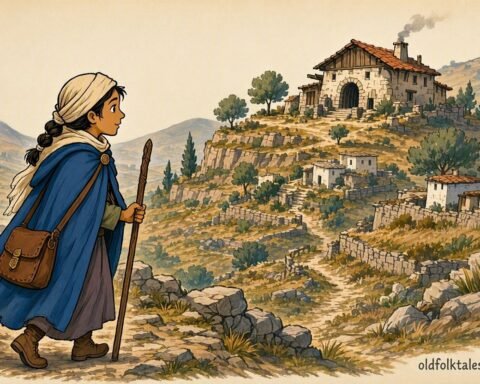
Among those who heard the riddle was a merchant who sold soap. He returned home troubled by the challenge. His daughter noticed his worry and asked what had happened. The merchant told her about the cadi’s riddle and the punishment awaiting anyone who failed to solve it.
The young woman listened carefully and soon gave her father an answer. “The tree represents the world. Its twelve branches are the twelve months. Its thirty leaves are the days, and its five fruits represent the five daily prayers.”
Looking for more? Explore the magic of East African folktales here
The merchant was amazed by his daughter’s explanation. The following day, he went before the cadi and gave the answer exactly as she had explained it. The cadi was surprised that the merchant had solved the difficult riddle and immediately asked who had given him the answer. The merchant admitted that it was his daughter.
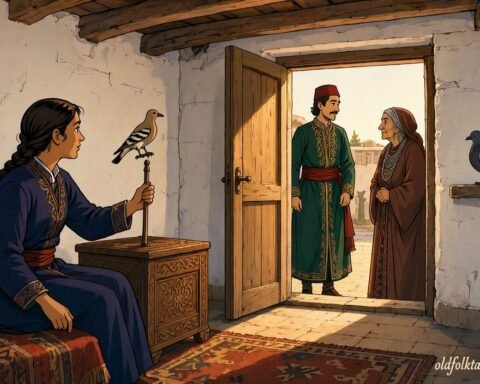
The cadi was impressed by the young woman’s intelligence and declared that he would marry her. Soon, his messengers were sent to bring the merchant’s daughter to him. When they arrived, the young woman welcomed them, but instead of simply answering their questions, she gave them strange replies that left them confused.
They asked where her brother was. She replied, “He has gone to strike and be struck.” They asked about her mother, and she answered, “She has gone to see what has never been seen.” When they asked about her father, she said, “He has gone to put water where there is already water.”
The messengers could not understand any of these answers. Before they left, the young woman gave them another message for the cadi. “Tell him that the earth has decreased by a hand, the waters have decreased in the sea, and the stars have decreased in the sky.”
When the messengers returned, they told the cadi that the merchant’s daughter must be mad. The cadi, however, thought carefully about her words. He understood that she had not spoken foolishly. Her brother had gone to play a game, where he would strike and be struck. Her mother had gone to see a newborn child, something that had never been seen before. Her father had gone to the mill, where water was already present.
The cadi realized that the young woman possessed unusual intelligence. He brought her into his household and eventually married her. She soon became part of his life, but another matter would reveal just how much wiser she could be than the man who held the position of judge.
One day, a man brought his mare to stay with a friend who owned a mule. During the night, the mare gave birth. When morning came, the young animal followed the mule. The two men began arguing because each claimed that the young animal belonged to him. Unable to settle the matter themselves, they brought their dispute before the cadi.
The cadi examined the animals and watched which one the young animal followed. Since it followed the mule, he decided that the young animal belonged to the mule’s owner. The true owner of the mare was heartbroken. He went downstairs in the cadi’s house and began to cry over the judgment.
The cadi’s wife heard him and asked what had happened. The man explained that his mare had given birth, but the cadi had awarded the young animal to the owner of the mule. The woman listened carefully and then gave him some advice.
“Go back to the cadi and tell him that when your mule gives birth, the whole world will be destroyed.”
The man followed her instructions. He returned to the cadi and repeated the strange statement. The cadi immediately understood the weakness in his own judgment. A mule could not give birth. He asked the man who had given him such a clever answer.
The man explained that the cadi’s wife had spoken to him while he was crying downstairs. The cadi realized that she had once again seen what he had failed to see. He corrected his judgment and returned the young animal to its rightful owner.
The cadi knew that his wife was exceptionally clever, but he still remembered the promise he had once made to her. He had told her that she could take whatever she valued most from his house.
One day, the woman prepared a special biscuit for him. The cadi ate it without suspicion, unaware that it contained opium. Before long, he fell into a deep sleep.
The woman then placed him inside a chest. She called the household workers and instructed them to carry the chest to her parents’ house. They obeyed, believing that the cadi himself had ordered them to do so.
When they reached her parents’ home, the woman opened the chest and woke her husband. The cadi looked around in confusion and asked why he had been brought there.
His wife reminded him of the promise he had made. He had told her that she could take whatever she valued most from his house. She had chosen him because he was what she valued most.
The cadi understood what she had done. His own words had been turned against him. He could have become angry, but instead he recognized the cleverness behind her actions.
The merchant’s daughter had solved his riddle when others were afraid to attempt it. She had understood meanings hidden inside ordinary words, corrected an unjust judgment, and used the cadi’s own promise in a way he had never expected.
The cadi had authority because of his position, but his wife had shown that wisdom does not always belong to the person holding the highest office. Her intelligence had earned his respect, and her cleverness had taught him that even a powerful judge must be willing to recognize when someone else sees the truth more clearly.
Fascinated by this tale? Discover more North African folktales
Moral Lesson
Wisdom is not determined by wealth, position, or authority. The merchant’s daughter proves that careful thinking and intelligence can solve problems that even powerful people cannot. The tale also reminds us that those in positions of authority must be humble enough to recognize their mistakes.
Knowledge Check
1. What was the cadi’s first riddle about?
It was about a tall tree with twelve branches, thirty leaves on each branch, and five fruits on each leaf.
2. How did the merchant’s daughter solve the cadi’s riddle?
She explained that the tree represented the world, the twelve branches represented the months, the leaves represented the days, and the five fruits represented the five daily prayers.
3. What did the daughter mean when she said her brother had gone to strike and be struck?
She meant that her brother had gone to play a game.
4. How did the merchant’s daughter expose the cadi’s mistake about the young animal?
She told the animal’s true owner to say that the whole world would be destroyed when the mule gave birth, reminding the cadi that a mule could not give birth.
5. How did the woman take the cadi to her parents’ home?
She gave him a biscuit containing opium, and after he fell asleep, she placed him in a chest and had it carried to her parents’ home.
6. What lesson did the cadi learn from his wife?
He learned that wisdom and intelligence can belong to someone without power or authority and that even a cadi can make mistakes.
Source
Adapted from Joseph Rivière, Recueil de contes populaires de la Kabylie du Djurdjura, 1882, “Le Cadi et la fille du marchand de savon,”