Two thieves spent their days making a living through stealing. Their lives followed the same path for a long time, but eventually one of them married while the other continued with his old profession.
After the two friends had been separated for some time, the unmarried thief decided to visit his companion. The two men welcomed each other as old friends and spoke about their lives.
During their conversation, the unmarried thief made an unusual request.
“If your wife gives birth to a daughter, promise that you will give her to me.”
His married friend agreed.
“If my wife has a daughter, I will give her to you on the seventh day after she is born.”
The promise was made between the two men, and the unmarried thief left.
Before long, the married man’s wife gave birth to a daughter. The news was carried to the other thief, who remembered the promise immediately. Seven days after the child was born, he came to collect her.
Don’t stop yet! See our complete East African folktales collection
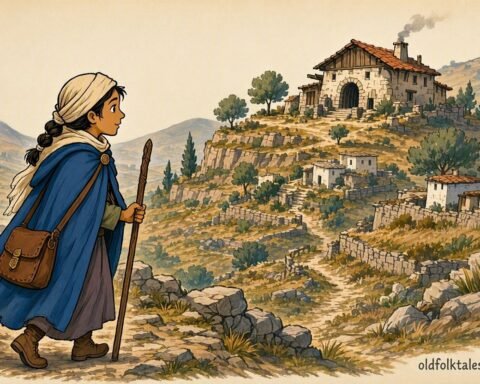
He took the little girl with him to the countryside. Away from the village, he built a house and bought herds of animals. He took responsibility for the animals himself and remained there with the girl as she grew.
The years passed, and the countryside became the place where the thief lived. His house stood among the land where he kept his animals, far from the noise of the village. Although his life had begun with stealing, he had now created a household and a place of his own.
One day, a group of pilgrims arrived at his house.
The thief welcomed them as guests. He did not send them away or make them search for food elsewhere. Instead, he killed a cow and prepared a feast for them. The pilgrims ate at his house and rested there.
Their visit changed the course of the story.
The following day, the thief decided to accompany the pilgrims on their journey. Before leaving, he was concerned about the woman who remained at the countryside house. He did not want her to be left without protection while he travelled.
The pilgrims reassured him.
“If you come with us,” they told him, “two birds will remain with your wife.”
The thief accepted their assurance and left with the pilgrims.
The woman stayed behind at the countryside house, while the two birds remained nearby to watch over her.
For a time, nothing happened. The house was quiet, and the woman continued with her daily life. The birds stayed close, keeping watch over the place.
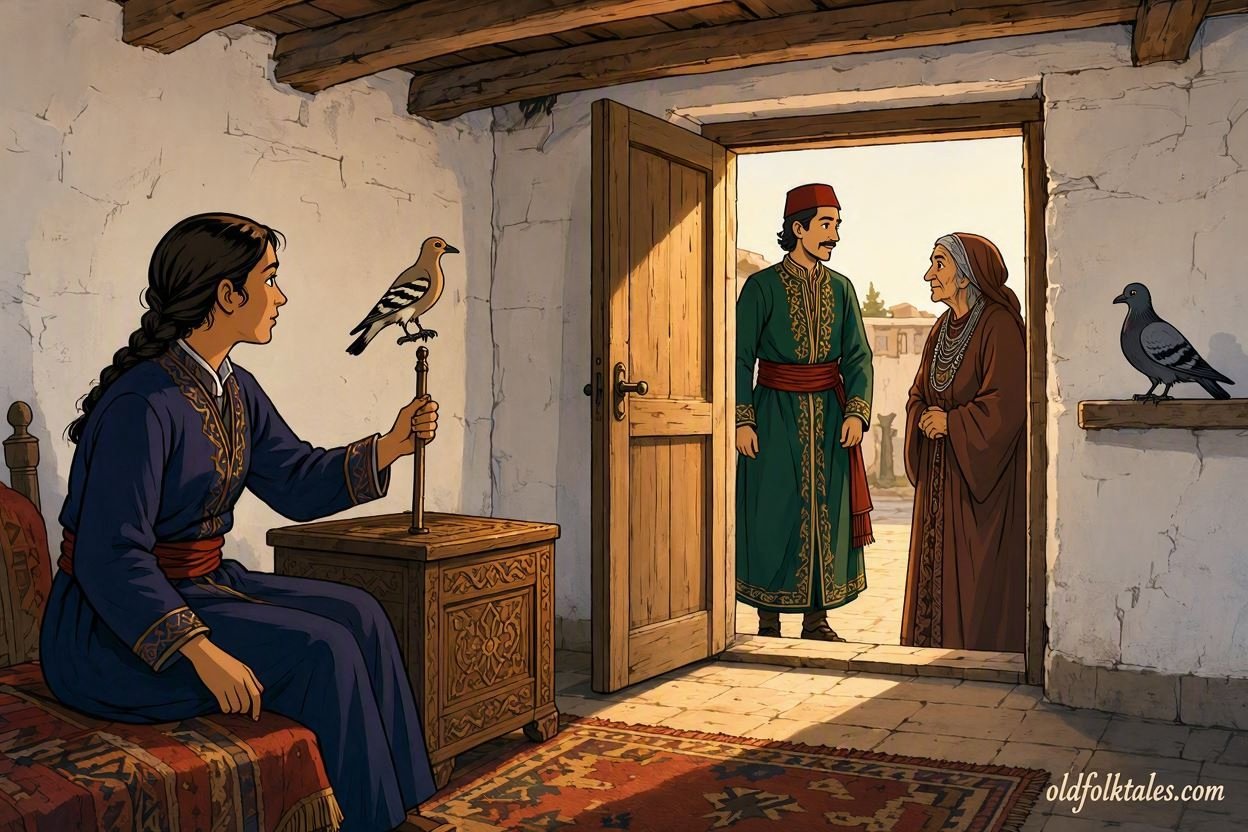
Then one day, the son of the sultan came hunting in that part of the countryside.
As the prince approached the house, one of the birds saw him. The bird immediately warned the woman.
“Do not open the door.”
The prince heard the bird speaking.
The strange sight and the strange warning caught his attention. He returned to the palace without saying anything about what he had seen. His silence, however, did not go unnoticed.
The people around him became concerned because he had returned from his journey without speaking about the matter. An old woman was brought before him. She was asked to discover what had happened to the prince.
The old woman told the king that the prince must have seen a woman whom he had never seen before.
The prince finally spoke.
“You will come with me. I will take you to her.”
So the prince and the old woman returned to the countryside house.
When they arrived, the old woman called out to the woman inside.
“Come outside so that we may see you.”
The woman heard the request, but she did not immediately obey. She turned to the bird.
“I am going to open the door,” she said.
The bird warned her again.
“If you open the door, you will suffer the same fate as Si el Ahçen.”
The woman did not understand why the bird had mentioned this man, so the bird told her his story.
Si el Ahçen had once been studying with several other people in a mosque. One day, while he was there, he found an amulet. That object became connected with the fate that later overtook him.
Si el Ahçen had a fiancée. When she became old enough, he took her to his house. A few days later, he had to travel, so he entrusted his wife to the care of his father.
“Watch over my wife,” he told his father.
“Do not worry,” his father replied. “I will watch over her.”
Si el Ahçen began his journey, but after travelling some distance, he turned back. He repeated his instruction to his father.
“Watch over my wife.”
Again, his father assured him that nothing would happen to her.
Eventually, Si el Ahçen left for his journey.
While he was away, his wife went to the market with his father. When the father returned, he told her that he had seen beautiful women at the market.
The woman replied that she was more beautiful than all of them.
“Take me to the market,” she said.
Her father in law took her there. A man saw her and offered one thousand francs for her. The father refused the offer.
He then told his daughter in law to sit on a mat.
“Whoever covers you with money will take you,” he said.
Another man approached and asked how much he should pay.
“If you desire her,” the father replied, “cover her with money and she is yours.”
The woman was taken away.
When Si el Ahçen returned from his journey, he asked his father whether his wife was still alive.
“Your wife is dead,” the father replied. “She fell from a mule.”
The news devastated Si el Ahçen. He threw himself to the ground, and those around him tried to raise him. Their efforts were useless. He remained there in grief.
Later, a merchant came to the village and brought him news that changed everything.
“It is the sultan who has married your wife,” the merchant told him.
Before the woman had been taken away, she had given the merchant a message to deliver to her husband. She wrote a letter and promised the merchant a flock of sheep if he succeeded in delivering it.
When Si el Ahçen received the letter, he read it and learned that his wife was alive. His grief disappeared. He hurried home and confronted his father.
“My wife has been remarried. She is not dead.”
He took the money he had brought and travelled to the city where his wife now lived.
At the city gates, he gave five francs to the first person he met and another five francs to the next person. They asked him what he wanted.
“If you wish to see the sultan,” they told him, “we will introduce you.”
They took him before the sultan.
“Give this man justice,” they said.
The sultan asked what he wanted.
Si el Ahçen answered that the woman the sultan had married belonged to him.
The sultan became angry and ordered that he be killed.
But the witnesses intervened.
“No. Give him justice.”
The sultan then asked Si el Ahçen whether the woman carried any object that could prove his claim.
Si el Ahçen answered that the woman had been promised to him before she was born and that an amulet was hidden in her hair.
The answer convinced the sultan. Si el Ahçen took his wife back to the village and prepared a feast.
The bird finished the warning.
“If you open the door, you will have the same fate as Fatima or Imelh.”
The woman listened carefully as the bird told another story.
H’amed ou Imelh had married Fatima. Fatima later asked her father in law to take her to her uncle. When she arrived there, she took another husband.
H’amed ou Imelh heard what had happened and hurried to find her. He arrived just as she was preparing to leave for the house of her new husband. He entered her room and threw himself from the window.
The story ended in tragedy, with both of them dying.
Their families returned to their homes and were asked what had caused the disaster.
“It was the woman who caused it,” they answered.
The father of H’amed ou Imelh then went to Fatima’s parents.
“Pay us for the loss of my son,” he demanded.
Fatima’s family answered that they should instead be paid for the loss of their daughter.
Neither side would agree with the other, so they decided to seek justice.
As they travelled, they passed through the village where the two young people had died. They met an old man and asked him to settle the dispute.
“I cannot,” the old man replied.
Farther along, they met a sheep striking its horns against a rock.
“Settle our dispute,” they asked.
“I cannot,” answered the sheep.
They continued and met a serpent.
“Settle our dispute.”
“I cannot,” said the serpent.
They went farther and came to a river.
“Settle our dispute.”
“I cannot,” replied the river.
At last they met a chacal.
“Settle our dispute,” they pleaded.
The chacal gave them an answer.
“Return to the village where your children died.”
They followed the advice and went back to the village. Eventually, they brought their dispute before the sultan, who ordered all of them to be killed.
The bird had told these stories for a reason.
The woman stood inside the house, listening to the warnings. Outside, the prince and the old woman were still waiting for her to open the door. She now understood that the birds were not speaking without reason. Their warnings carried memories of people whose lives had been changed by choices made without sufficient caution.
She remained inside.
The door stayed closed.
The prince did not enter.
Before long, the pilgrims returned from their journey. The old woman saw them approaching and fled. When the thief saw the pilgrims returning, he prepared another feast for them.
The guests who had once been welcomed into his house were welcomed again.
The journey had ended, and the countryside house once more became a place of hospitality. The two birds had remained faithful to their duty, guarding the woman while the thief was away and warning her when danger came to the door.
The story leaves behind a simple lesson. A person who is protected should not ignore a trustworthy warning, especially when the consequences of opening the wrong door may be impossible to reverse.
Want to dive deeper? Read more North African folktales today
Moral Lesson
Trust should be accompanied by wisdom and caution. The woman survives the danger because she listens to the birds and does not act hastily. The stories they tell remind her that careless decisions can bring serious consequences.
Knowledge Check
1. What did the unmarried thief ask his married friend to promise?
He asked him to give him a daughter if his wife gave birth to one.
2. Where did the thief take the girl after receiving her?
He took her to the countryside, where he built a house and kept herds of animals.
3. What did the thief do when the pilgrims arrived at his house?
He welcomed them, killed a cow and prepared a feast for them.
4. Who protected the thief’s wife while he travelled with the pilgrims?
Two birds remained with her and watched over her.
5. Why did the bird tell the woman not to open the door?
The bird warned her because the prince and the old woman were outside, and it used the stories of Si el Ahçen and Fatima to show the danger of acting carelessly.
6. What does the story teach about listening to warnings?
It teaches that careful listening and good judgment can protect a person from serious consequences.
Source
Adapted from Joseph Rivière, Recueil de contes populaires de la Kabylie du Djurdjura, 1882, “Le voleur et les pèlerins,” beginning on page 125 in the section “Le mariage.”