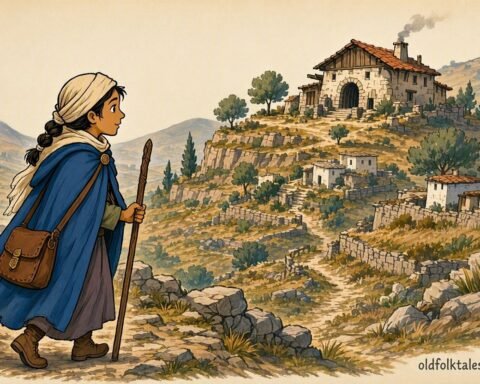
A severe famine had struck the land where Ama lived. Food had become so scarce that people struggled to find enough to eat. Each day, they went into the bush searching for palm nuts because there was little else available.
Ama was one of those who went out in search of food. One day, while walking through the bush, he found a small tree and climbed it. From the top, he saw a huge baobab tree standing some distance away.
Ama climbed down and walked towards the great tree.
When he reached it, a voice called his name.
“Ama! Ama!”
He stopped and looked around.
Who could be calling him in such a lonely place?
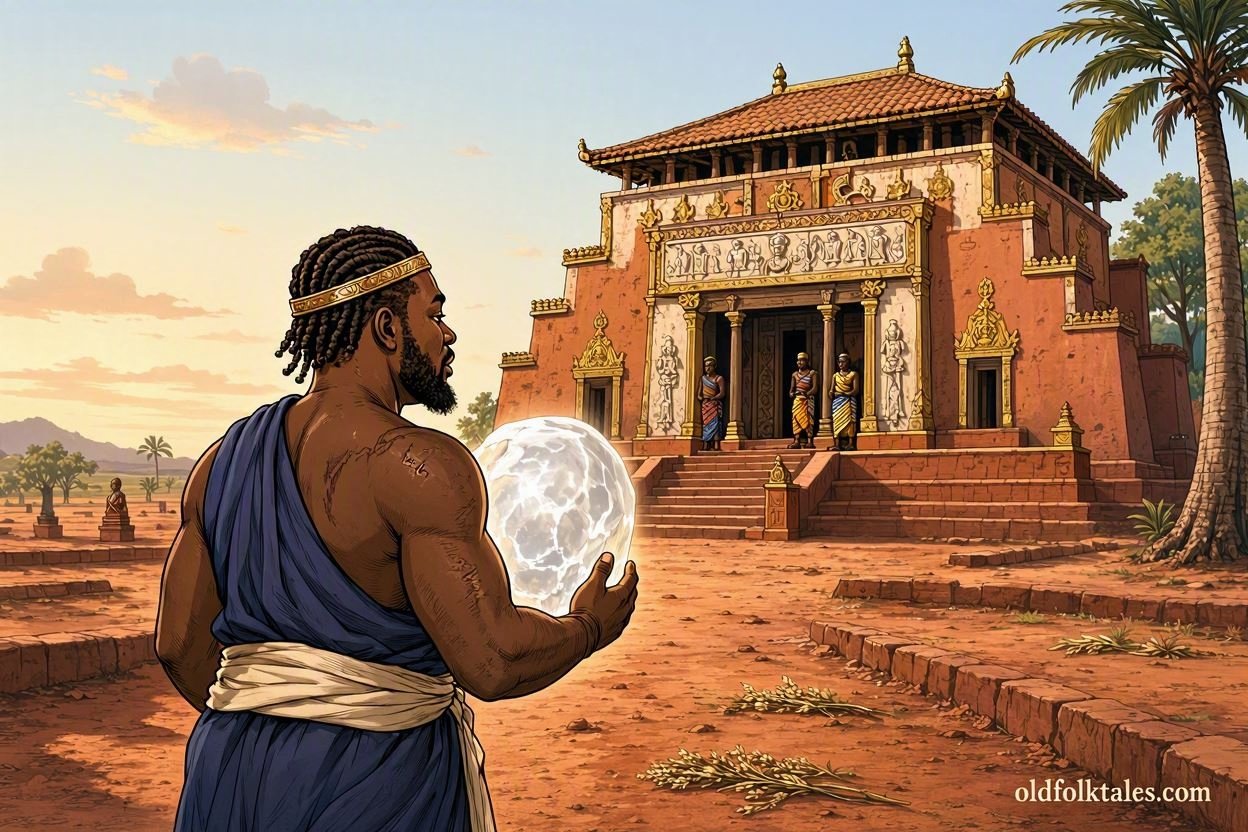
Ama followed the voice until he reached its source. There, he saw a dazzling white calabash with a lid.
Ama was surprised.
“So it was a calabash that called me?” he wondered.
The calabash answered him. It told Ama that it was not an ordinary calabash. It was a magical calabash and asked him to take it home.
Ama wanted to know what the calabash could do.
“What can you do for me at home?” he asked.
The calabash explained that it could produce food for people to eat.
Ama asked it to show him.
At once, the magical calabash produced maize porridge, sauce and beans. Ama ate until he was satisfied.
He was amazed.
After his meal, Ama carried the calabash home.
When he reached his house and called the calabash, it produced food again. His wife and children ate until they were satisfied. As the days passed, the calabash continued to provide them with food.
Click here to discover more legendary tales from West Africa
Ama and his family grew well fed while the famine continued to affect the rest of the people. Many others had become thin because they had so little to eat.
The magical calabash became a blessing to Ama’s household.
But such a remarkable secret could not remain hidden forever.
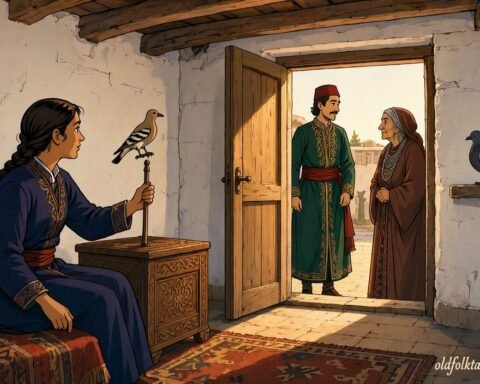
A famous man named Adonoyogbo eventually heard about Ama’s strange calabash. Ama invited him to come and see it for himself.
When Adonoyogbo arrived, Ama showed him the calabash.
Adonoyogbo asked the calabash what it could produce. Immediately, it brought out various kinds of food.
Adonoyogbo ate greedily until he was completely satisfied. He even wrapped some of the food in a cloth and carried it home.
But Adonoyogbo was not content to enjoy what he had seen. He went straight to the king.
He told the king about Ama and his magical calabash.
“There is a man called Ama,” Adonoyogbo told him. “He has a calabash that provides enough food for him and his family. They eat whatever they want while the famine continues to trouble everyone else.”
Then he urged the king to take the calabash from Ama.
The king listened.
He ordered his messengers to summon Ama.
The messengers brought Ama and the magical calabash before the king. Without giving Ama a choice, the king seized the calabash and kept it in his bathroom.
The object that had once provided food for Ama and his family now belonged to the king.
But the king soon discovered that the calabash was capable of producing much more than food.
Whenever he used it, it produced gold, beads and other valuable things. The king became extremely wealthy. His palace became filled with gold.
While the king enjoyed his new wealth, Ama returned home without the calabash.
The famine had not ended. In fact, it had become even worse.
Ama had to return to the bush and search for palm nuts just as he had done before finding the magical calabash.
One day, while searching for food, Ama climbed a tree and looked into the distance. He saw a huge Irokobaum.
Ama climbed down and walked towards it. He wanted to find out whether anyone was beneath the enormous tree.
The journey took him some time.
When he finally reached the tree, a sharp voice called his name.
“Ama! Ama!”
Ama followed the voice.
At its source, he found a brilliant white stone lying on the ground. The stone was about the size of a child’s head.
Ama stared at it.
“How can an ordinary pebble call my name?” he wondered.
As soon as he said this, the stone sprang towards him.
It struck Ama repeatedly, slapping him so hard that his head became swollen.
Ama quickly realised that the stone was no ordinary pebble.
The stone then spoke.
“I am not a pebble. I am a great stone. Take me directly to the person who took your calabash from you.”
Ama understood what the stone meant.
He picked it up and carried it home.
When Ama’s wife and children saw him returning, they hoped that he had brought food. Hunger had continued to trouble the household since the king took the magical calabash.
Ama opened the cloth in which he had wrapped the stone.
His family looked inside.
“Only a pebble has our father brought home,” they said.
The stone heard them.
Immediately, it sprang towards Ama’s wife and children and struck them until their heads became swollen.
Ama quickly warned them.
“You must not call it a pebble. It is a great stone.”
His family understood.
Ama then carried the great stone to the king.
When the king saw him approaching, he asked what Ama had brought him this time.
Ama placed the stone before him.
The king looked at it.
Then he called it a pebble.
The moment the king said the word, the great stone sprang towards him.
It began striking the king and the servants around him. The people in the palace were beaten so severely that their heads became swollen.
The palace descended into confusion.
While the king and his servants were distracted by the stone, Ama entered the king’s bathroom.
There he found the magical calabash.
Ama took back the calabash that had been taken from him and hurried home with it.
The king had used his power to take something valuable from a man who was already suffering from hunger. He had turned the magical calabash into a source of wealth for himself while Ama and his family continued to struggle.
But the strange stone gave Ama the opportunity to recover what belonged to him.
The story closes with a clear warning. No one should use violence or power to exploit another person. Even someone who appears powerful can eventually face the consequences of injustice.
Ama had lost his magical calabash because the king had taken it from him. Yet the king’s own actions eventually created the opportunity for Ama to reclaim it.
The magical stone became an unexpected instrument of justice.
Ama returned home with his calabash, while the king was left to face the consequences of what he had done.
The story reminds listeners that power does not give anyone the right to exploit another person. Wealth obtained through injustice cannot guarantee safety, and those who abuse their position may eventually find that justice comes from an unexpected direction.
Fascinated by this tale? Discover more North African folktales
Moral Lesson
Power should never be used to exploit another person. The king used his authority to take Ama’s magical calabash, but his abuse of power eventually allowed Ama to recover what belonged to him.
Knowledge Check
1. Why did Ama go into the bush at the beginning of the story?
Ama went into the bush to search for palm nuts because a severe famine had made food scarce.
2. What did Ama discover beneath the great baobab tree?
He discovered a magical white calabash that could produce food.
3. Who told the king about Ama’s magical calabash?
Adonoyogbo told the king about the calabash.
4. What did the king discover after taking Ama’s calabash?
He discovered that it could produce gold, beads and other valuable things in addition to food.
5. What happened when Ama called the white stone a pebble?
The stone attacked Ama and later attacked his family and the people in the king’s palace when they also called it a pebble.
6. How did Ama recover his magical calabash?
The great stone attacked the king and his servants, giving Ama the opportunity to enter the king’s bathroom and take back his calabash.
Source
Adapted from Mensah Wekenon Tokponto, Deutsch beninische Märchenforschung am Beispiel von Märchen in der Fon Sprache, Märchen Nr. 11, “Der König und der magische Stein.”