Once, in a distant land, there lived a young girl who had lost both her parents. Before her father died, he had married another woman, and that woman had a daughter of her own. After the orphan girl lost her parents, she had no choice but to live with her stepmother and her stepsister.
Life in the new household was difficult from the beginning. The stepmother treated her own daughter with care and protected her from every difficult task, while the orphan girl was expected to do almost everything in the house. She washed the dishes, went to the market, cleaned the rooms, swept the house, cooked the food, and fetched water from the well. Whatever work needed to be done was placed on her shoulders, yet the stepmother rarely praised her or showed appreciation for her efforts.
The girl endured the treatment quietly. She continued to do what she was told, even though she knew that her stepsister was allowed to rest while she worked from morning until evening. The unfairness continued for a long time until the stepmother began to think that the orphan girl was no longer useful to her. She even wished that the girl would die.
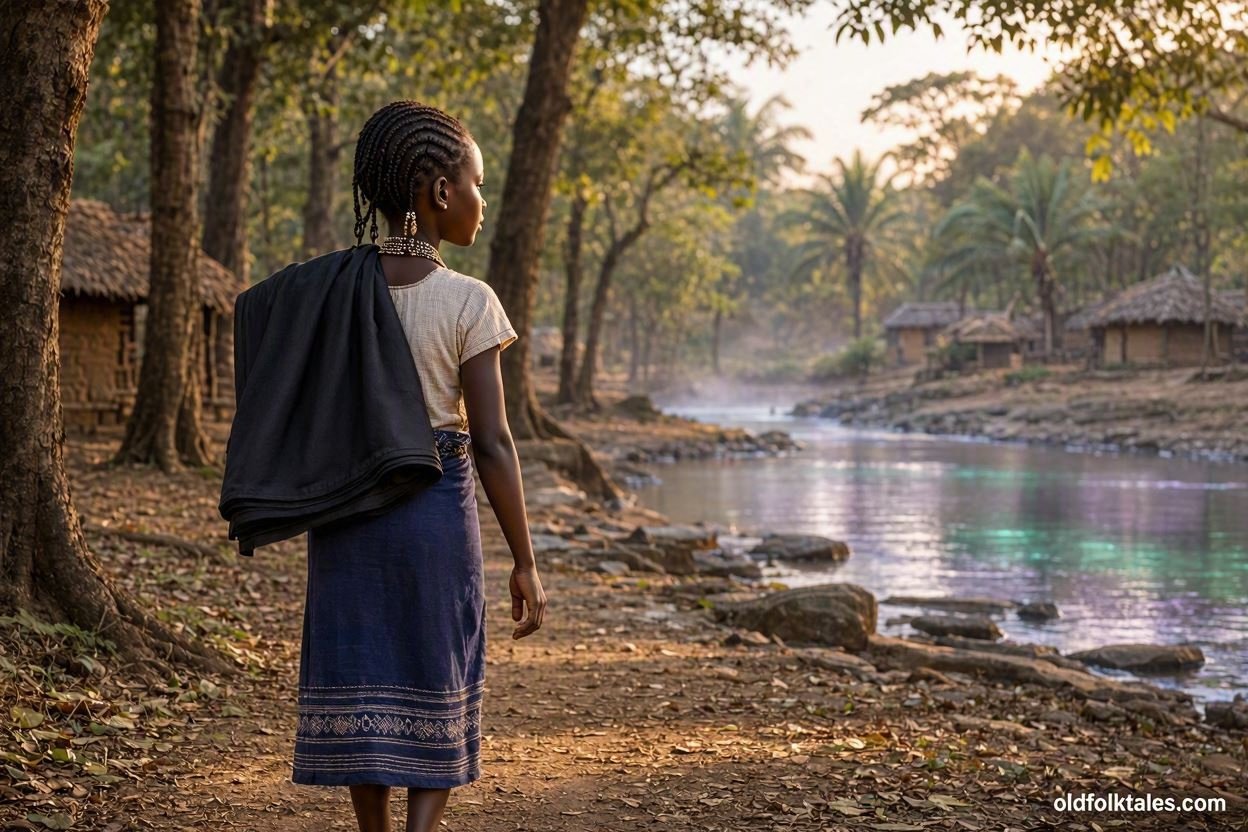
The stepmother then thought of a task that she believed would finally get rid of the child. She took a piece of deep black indigo cloth and gave it to the orphan girl. She ordered her to wash it until it became as white as kaolin. She added one strict instruction. The girl must not wash the cloth at home. She had to travel to a distant river called Nosisitonu and wash it there.
Don’t stop yet! See our complete East African folktales collection
The river was extremely far from their village. The journey had to be made on foot, along a narrow road filled with strange and frightening things. The stepmother knew how difficult the journey would be. She also knew that dangerous creatures lived along the road, and she believed the orphan girl would never return.
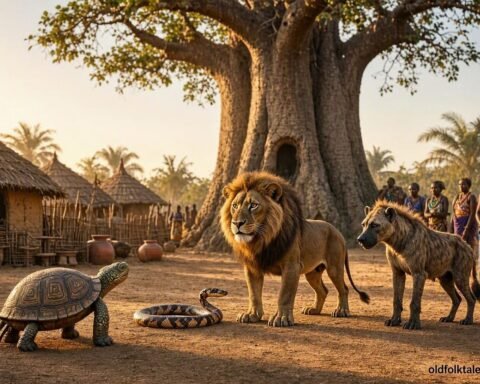
The girl set out carrying the black cloth. She walked for a very long time until she reached a strange place that looked nothing like the world she knew. She found herself in a market where animals behaved like people. A hyena was selling goods, a lion sat among merchandise, and other animals moved about as though the market were an ordinary human marketplace.
The girl was astonished, but she did not insult the animals or cause trouble. As she continued looking around, she saw a little bird carrying flat cakes and calling out to customers. She approached the bird and asked whether it could tell her how to reach Nosisitonu.
The little bird agreed to help her, but only after giving her a task. It asked her to carry its cakes around the strange market and sell them. The girl looked around and wondered how she could possibly sell anything in a place where there seemed to be no human beings. Still, she accepted the task.
She carried the cakes on her head and entered the market. She imitated the little bird’s call and continued walking from place to place until every cake had been sold. When she finished, the bird was pleased with her effort and showed her the way she needed to follow.
The girl continued her journey, but the strange encounters did not end. After walking for some time, she came across two stones that were striking against each other. They were fighting as though they were alive. The girl asked them for directions to Nosisitonu. Instead of simply answering, the stones demanded that she stand between them so they could strike her.
The girl did as they asked. The stones struck her from both sides until she began to bleed. She endured the pain and continued on her way.
Further along the road, she met two chimpanzees fighting one another. They were striking each other with their tails and seemed unable to stop. The girl politely asked them for directions to Nosisitonu.
The chimpanzees told her that they could show her the way, but only if she allowed them to strike her with their tails. The girl accepted. She stood between them while one chimpanzee struck her from one side and the other struck her from the other side. Then another chimpanzee arrived. The animals pulled the girl down, tied her, and beat her until her body was covered with wounds.
Even after all this, the girl continued walking.
Eventually, she came upon a very old woman who had a large and unpleasant wound on her foot. The girl greeted the woman respectfully and asked whether she knew the way to Nosisitonu.
The old woman told her that she knew the way, but before giving her the directions, she asked the girl to lick the wound on her foot until it became clean.
The request was unpleasant, but the girl did not complain. She agreed to help the old woman and carefully cleaned the wound. She continued until the old woman was satisfied.
The old woman then pointed beyond the forest and told the girl that Nosisitonu was nearby. The orphan girl followed the directions and soon saw the magical river.
At last, she washed the black indigo cloth in the river.
She washed it for a long time until the cloth became completely white, as white as kaolin. Her difficult task had been completed.
The old woman had not forgotten the girl’s kindness. Before the orphan girl left, she gave her three mysterious fruits called Atawungwe. She instructed the girl to break them at different points on her journey home. She told her to break the first one after she had walked for a while, the second one later on, and the third when she was close to home.
The orphan girl thanked the old woman and began her journey back.
After walking for some time, she broke the first Atawungwe. Suddenly, the long road became much shorter, and she found herself much closer to her home than she had expected.
She continued walking and then broke the second Atawungwe.
Before her appeared an iron chest.
Inside were gold, money, beautiful shoes, and many valuable pieces of cloth. The girl was amazed by the sight, but she did not forget the black cloth she had been sent to wash. She gathered the treasure and continued her journey.
When she had travelled for about another hour, she broke the third Atawungwe.
A beautiful house suddenly appeared before her.
The house stood close to her stepmother’s home. The orphan girl entered her new home, carrying the wealth she had received and the white cloth she had been ordered to wash.
She then returned to her stepmother and presented the white cloth.
The stepmother could hardly believe what she saw.
The black cloth had become completely white.
The orphan girl explained nothing about the strange things she had experienced. Instead, she simply told her stepmother that she was leaving and would now live in the beautiful house nearby.
When the stepmother later saw the orphan girl living in her new home, she became envious. She returned home and scolded her own daughter for being lazy. She told the girl that she too must take a black cloth to Nosisitonu and wash it until it became white.
The stepsister cried because she had never been accustomed to such difficult work. Her mother had always protected and spoiled her. But the stepmother insisted that she make the journey.
The girl set out carrying the black cloth.
Along the way, she reached the strange animal market. Instead of showing patience and humility, she complained about everything she saw. When she encountered the little bird, she did not behave like the orphan girl had behaved.
Eventually, she reached the old woman with the wounded foot.
The old woman asked her to help clean the wound, but the stepsister did not show the same kindness and willingness to serve. Her behaviour was different from that of the orphan girl.
The old woman nevertheless directed her toward the river and gave her three Atawungwe fruits. She instructed her to break them on her journey home.
The stepsister imagined that she would receive the same fortune as the orphan girl.
She was wrong.
On her journey home, she broke the first Atawungwe and found that her path had become blocked by thick bushes. Unable to find her way through, she broke the second one. The sound of wild animals immediately surrounded her.
Terrified, she continued until she broke the third Atawungwe.
Wild animals suddenly appeared and attacked her. They tore her apart and ate her.
The animals wrapped her bones in the same white cloth she had carried from the river and left the bundle behind. Soon, a vulture came down, picked up the bundle, and carried it away.
The bird eventually dropped the bundle onto the roof of the stepmother’s house.
When the stepmother came outside and saw the bundle, she thought her daughter had returned with some great treasure. She brought it down and eagerly opened the cloth.
But instead of riches, she found her daughter’s bones.
The woman was devastated.
She cried when she realized what had happened. The cruelty she had shown the orphan girl had eventually brought sorrow into her own household.
Meanwhile, the orphan girl lived in the beautiful house she had received after completing the difficult journey. She eventually married and lived happily in her new home.
The story ends with a warning against mistreating vulnerable people. The orphan girl had been treated as though her life had little value, yet her patience, kindness, courage, and willingness to help others opened the way to her happiness. Her stepmother believed that cruelty would destroy her, but the girl survived every hardship placed before her.
The journey to Nosisitonu was more than a journey to wash a piece of cloth. It became a series of tests. At every stage, the girl was given opportunities to show what kind of person she was. She chose patience when she could have complained, kindness when she could have refused, and obedience when the tasks seemed difficult.
Her stepsister followed the same road, but she did not follow the same values.
That difference determined the ending.
Want more? Read more West African folktales now
Moral Lesson
Kindness, patience, humility, and willingness to help others can open doors when hardship seems impossible to overcome. The story also warns against cruelty toward vulnerable people and shows that unfair treatment can eventually bring painful consequences to those who cause it.
Knowledge Check
1. Why did the orphan girl live with her stepmother?
Her parents had died, so she went to live with her father’s other wife and her stepsister.
2. What difficult task did the stepmother give the orphan girl?
She ordered the girl to wash a black indigo cloth until it became white like kaolin at the distant Nosisitonu River.
3. What did the little bird ask the orphan girl to do?
The bird asked her to carry and sell its flat cakes in the strange animal market.
4. How did the old woman help the orphan girl?
The old woman showed her the way to Nosisitonu and later gave her three magical Atawungwe fruits that brought her good fortune.
5. What happened to the orphan girl after she completed her journey?
She received great wealth and a beautiful house and eventually lived happily.
6. What happened to the stepmother’s daughter?
She failed the tests on her journey, and wild animals attacked and killed her after she broke the magical fruits.
Source
Adapted from “Das Waisenmädchen und seine Stiefmutter,” Story 12 in Mensah Wekenon Tokponto’s doctoral dissertation, Deutsch beninische Märchenforschung am Beispiel von Märchen in der Fon Sprache, University of Bielefeld, 2002.