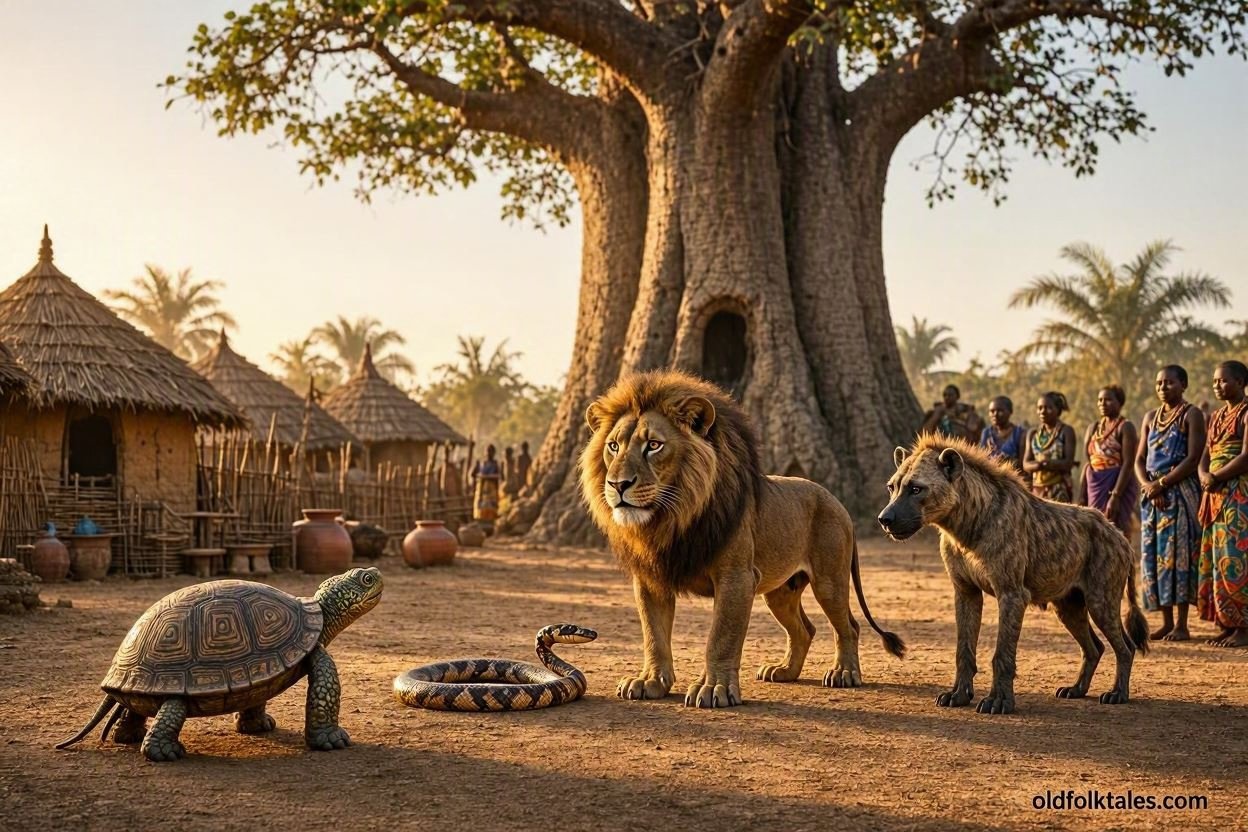
The story begins with four animals who were once close friends: Lion, Hyena, Snake, and Turtle. They visited one another regularly and spent time together as companions. Lion was regarded as the king of the animals, but despite their differences in size and strength, the four appeared to live peacefully.
One day, Lion invited his friends to gather beneath a great baobab tree. When everyone had arrived, Lion explained that their friendship had lasted for a long time, but he wanted it to become even stronger. He believed that if each of them knew what offended the others, they could avoid saying or doing things that might cause anger.
So Lion asked each animal to reveal the thing that annoyed them most.
Lion spoke first. He explained that he could tolerate many things, but he could not stand anyone looking directly into his eyes and claiming to be his equal.
Hyena then explained what she could not tolerate. She said that she could endure many insults, but she became extremely angry when someone threw sand into her fur.
Snake also revealed his weakness. He said that people could joke about his smooth and cold skin, but he could not tolerate anyone stepping on his tail.
Looking for more? Explore the magic of East African folktales here
Finally, it was Turtle’s turn.
Turtle was much smaller and slower than the others. She explained that she moved carefully because she did not want to step on anyone or disturb anyone. She also avoided looking directly into another animal’s eyes. Being called slow or crooked did not trouble her.
But there was one thing she could not tolerate.
Turtle said that she hated being called a particular insulting name, a word known in the Fon language as “Pwìì.” In the context of the story, the word is described as an insult and can also carry the sense of bitter mockery.
The other animals immediately became interested.
They asked Turtle why such a small word could bother her so much. Turtle calmly explained that although she was small and weak compared with them, she still had feelings and deserved respect.
After saying this, Turtle quietly moved into the grass. She did not go far. She remained close enough to hear what her friends would say when they thought she was gone.
As soon as Turtle disappeared from sight, the atmosphere changed.
Lion began to mock her. He wondered why Turtle was so sensitive about a simple word. He boasted that he was powerful enough to crush her with one of his claws.
Hyena joined in. She laughed at Turtle’s small size and slow movement. She repeated the insulting word and joked that Turtle was too weak to do anything about it.
Snake also mocked Turtle. He reminded the others that his venom was powerful and suggested that Turtle could never stand against him.
Turtle heard everything.
She had trusted these animals as friends, but now she understood that they did not respect her. They had asked her to reveal her weakness only to use that information against her.
Turtle did not rush back to argue with them.
She thought carefully.
When she finally returned, she pretended that she had not heard their conversation. She greeted them and asked why they were still gathered together.
The three animals quickly tried to hide what they had been doing.
Turtle then told them that she had heard their insults and was disappointed by the way they had treated her.
Instead of apologizing, Lion became angry.
He told Turtle that if she complained about being insulted, they would simply continue insulting her. He reminded her that he was the ruler of the bush and said that no one could prevent him from saying whatever he wanted.
Hyena agreed.
Snake agreed as well.
Soon, all three began repeating the insulting word at Turtle and laughing at her.
Turtle felt deeply humiliated, but she did not fight them. She did not shout. She did not threaten them.
She simply walked away.
As she moved through the dry grass, Turtle began thinking about the weaknesses each animal had revealed during their meeting.
Lion could not tolerate anyone challenging his pride.
Hyena could not tolerate sand being thrown into her fur.
Snake could not tolerate anyone stepping on his tail.
Turtle understood that she did not need to defeat any of them with strength. She only needed to make their own weaknesses work against them.
She waited for the right moment.
After moving a short distance away, Turtle stopped beneath the dry leaves. She placed her front feet firmly against the ground, gathered some sand, and suddenly threw it onto Hyena’s back.
Then she disappeared into the grass.
The sand entered Hyena’s fur.
Hyena immediately became irritated. She turned around, trying to see who had dared to throw sand at her.
When she looked up, she saw Lion nearby.
Because of what Lion had said earlier, Hyena became convinced that Lion was responsible.
She confronted him.
Lion was surprised by the accusation. He asked Hyena why she was looking at him with such anger.
The disagreement quickly became a quarrel.
Neither animal wanted to back down.
Lion was proud and easily angered, while Hyena was already furious because of the sand in her fur. Their argument became more heated until they attacked each other.
Lion was stronger.
The fight ended with Hyena’s death.
Turtle remained hidden and watched quietly.
But her plan was not finished.
Snake was still nearby.
During the confusion, Lion moved and stepped on Snake’s tail.
Snake reacted immediately.
Remembering what he had said earlier, he could not tolerate anyone stepping on his tail. He struck Lion and bit him.
The snake’s venom entered Lion’s body.
Lion tried to fight back, but the poison weakened him. His strength began to leave him, and eventually he died beneath the same great baobab tree where the animals had once gathered as friends.
Snake had survived the fight, but the story was not yet over.
The venom had taken a toll on him too. In pain, Snake tried to find relief. While struggling with his own body, he accidentally bit his own tail.
The poison entered him again.
Snake moved away desperately, but his condition became worse. Before long, he too died.
Silence returned to the place where the four friends had once gathered.
Turtle slowly came out of hiding.
She looked at the bodies of the animals who had mocked and humiliated her.
She did not celebrate their deaths with loud laughter. Instead, she reflected on what had happened.
Hyena’s foolishness and deceit had led her into the fight with Lion. Lion’s uncontrolled anger and pride had brought about his own downfall. Snake’s deadly nature, which he had proudly boasted about, had eventually turned against him.
Turtle had not defeated them by fighting them directly.
She had simply remembered what each of them had revealed about himself and waited patiently for the right opportunity.
The smallest animal among them had understood something the others had forgotten.
Strength does not always belong to the largest creature.
A small and quiet person can still think, observe, and act wisely.
Turtle turned and continued on her way, proud that she had overcome those who had mocked her.
The story reminds listeners that every creature has a place and deserves respect, regardless of size, strength, or appearance. Those who believe they are too powerful to be challenged may eventually discover that their own weaknesses can become their downfall.
Want more? Read more West African folktales now
Moral Lesson
Never mistake someone’s small size, quiet nature, or weakness for foolishness. Respect others because everyone has strengths and weaknesses. Pride, cruelty, and careless words can create consequences that return to the person who caused them.
Knowledge Check
1. Who were the four animal friends in the story?
The four friends were Lion, Hyena, Snake, and Turtle.
2. What did Lion say he could not tolerate?
Lion said he could not tolerate anyone looking directly into his eyes and claiming to be his equal.
3. What insult did Turtle say she could not tolerate?
Turtle said she could not tolerate being called “Pwìì,” an insulting expression in the Fon language.
4. How did Turtle cause Hyena to fight with Lion?
Turtle secretly threw sand onto Hyena’s back, causing Hyena to believe that Lion had offended her.
5. How did Lion die?
Lion was bitten by Snake after stepping on Snake’s tail, and the snake’s venom eventually killed him.
6. What is the main lesson of Turtle’s revenge?
The story teaches that intelligence and patience can overcome physical strength, while pride and disrespect can lead to destruction.
Source
Adapted from “Die List, die die Schildkröte anwandte, um sich an dem Löwen, der Hyäne und der Natter zu rächen,”