In the vast expanse of the savannah, where the golden grasses sway beneath an endless sky, lived a lion named Bakar—proud, fierce, and feared by all. Bakar ruled the land with his roar alone; his strength was unmatched, but so was his greed. He believed everything in the wild belonged to him.
Not far from Bakar’s den lived a jackal named Kito. Small, wiry, and quick-witted, Kito had learned that brains could win battles that brawn could not. Though often the prey of the lion’s anger, Kito survived by using his sharp mind and cunning words.
One scorching afternoon, Bakar called a meeting of the animals. His voice thundered across the plains. “From now on, all food belongs to me! Whoever brings me the most will be rewarded. Disobey, and face my wrath!”
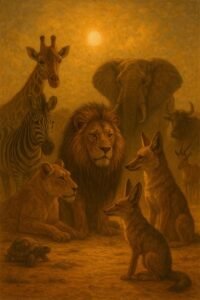
Fear spread like wildfire. The gazelles trembled, the birds hushed their songs, and even the elephants lowered their heads. No one dared to challenge the lion’s decree.
But Kito saw an opportunity.
That very night, beneath the silver glow of the moon, Kito approached Bakar’s den.
“My king,” he said, bowing low, “I bring you news—and a plan.”
Bakar narrowed his eyes. “Speak, jackal.”
“I propose a deal,” Kito said smoothly. “If you allow me to hunt freely, I will bring you a steady supply of food. You won’t have to waste your strength chasing prey.”
Bakar considered this. “Why should I trust you?”
Kito smiled. “Because I am clever and quick. You are strong and mighty. Together, no one will want to challenge your rule.”
Bakar agreed, and from that night on, Kito became the lion’s provider.
Days passed, and true to his word, Kito brought the lion small animals—hares, birds, even fish from the river. Bakar feasted while Kito watched with a smile.
But Kito was not content to be just a food-gatherer. He wanted to teach Bakar a lesson about greed and pride.
One day, Kito brought the lion a large, plump hare and said, “My king, I have found a feast for you beyond the mountains. But it is guarded by a fierce creature. I cannot go alone.”
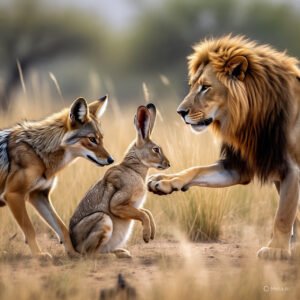
Bakar’s eyes gleamed. “Take me there!”
Kito led the lion to a narrow valley where the wind whispered among the rocks. “The beast lives here,” Kito said nervously.
Suddenly, a deep growl echoed.
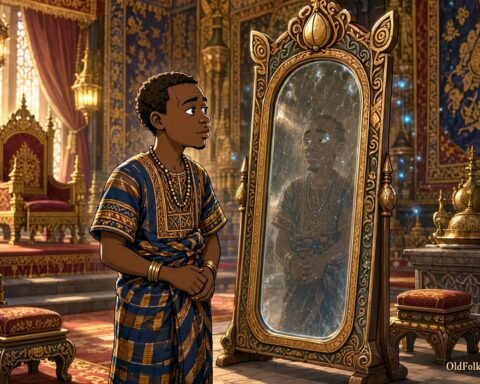
From the shadows emerged another lion—Bakar’s own reflection in a still pool of water.
Bakar roared and charged. He leapt, but his claws struck only cold water.
Kito laughed softly. “See, my king? Sometimes, our own pride is the greatest enemy.”
Bakar, humbled, saw the truth in Kito’s words. From that day, he ruled with wisdom, sharing the land’s bounty rather than hoarding it.
✧ Commentary
This story highlights how intelligence and wit can balance brute strength and pride. The lion’s greed reflects a common theme in many African folktales—how unchecked power often leads to isolation or downfall. Kito’s cleverness shows the value of thinking before acting and using wisdom to influence others. The tale also teaches about humility; even the strongest must recognize their limits and learn from others.
✧ Moral
Greed and pride blind us to reality and can cause our own undoing. Wisdom and cleverness are powerful tools, especially when used to teach and guide rather than trick or harm. True strength lies not just in power but in understanding and cooperation.
✧ Questions & Answers
1. Q: Why did the lion want all the food for himself? A: Because he was greedy and wanted to control everything, believing his strength gave him the right.
2. Q: How did Kito the jackal help the lion? A: By offering to bring him food regularly, using his cleverness to provide and advise.
3. Q: What lesson did the lion learn when he saw his reflection? A: That his pride and anger were his real enemies and that humility is important.
4. Q: Why is it important to balance strength with wisdom? A: Because strength alone can lead to harm or mistakes, but wisdom guides better decisions and harmony.
5. Q: How does this story show the value of teamwork? A: It shows that combining different strengths—lion’s power and jackal’s wit—leads to better outcomes.