Far inland from the coastal rivers and mangrove forests of Guinea-Bissau stretched the wide grasslands of the Gabu Savannah. During the rainy season, the land turned green with grazing fields, scattered trees, and flowing streams that supported farmers, herders, and traders traveling across the region.
But when the dry season arrived, the savannah transformed completely.
Rivers narrowed.
Grass withered beneath the sun.
And survival depended entirely on access to water.
Among the Fula people who traveled seasonally with cattle across the grasslands, knowledge of hidden water sources was treated as sacred wisdom passed carefully between generations. Wells, rivers, and underground springs were not simply natural resources.
They were gifts entrusted to humanity by the ancestors.
Many of these water sources were protected by strict customs designed to preserve balance between people, animals, and the land itself. Travelers were expected to share water fairly, avoid waste, and respect sacred sites connected to earlier generations.
Elders warned that greed around water always brought suffering.
Explore the wisdom and wonder of North African folktales
One particular legend from the Gabu Savannah became famous throughout the region during a period remembered as the Great Drying.
According to oral tradition, the drought lasted longer than anyone could remember.
Seasonal rains failed repeatedly.
Small ponds vanished.
Entire grazing fields turned brown beneath endless heat.
As water disappeared, families abandoned villages searching desperately for survival. Cattle weakened. Trade routes collapsed. And tensions rose between communities competing for the few remaining rivers.
Among the many travelers crossing the savannah during this crisis was a young Fula herder named Samba.
Samba traveled with his older uncle Boubacar and several families guiding a large herd of cattle toward distant grazing territory rumored to contain permanent water sources.
The journey was dangerous.
Each day the heat intensified.
Animals collapsed from exhaustion.
And many travelers carried only enough water to survive another sunrise.
Still, the group continued moving because remaining in place meant certain death.
Boubacar, one of the oldest herders in the caravan, believed ancient wells hidden somewhere within the savannah could still save them.
He remembered hearing stories from his grandfather about sacred underground springs protected by ancestral laws long before modern villages existed.
According to the stories, the wells revealed themselves only to travelers who respected the balance between humanity and nature.
But many dismissed such stories as legends created to comfort desperate people.
Several younger men argued they should raid nearby settlements instead of searching endlessly through dry grasslands for imaginary wells.
Fear and frustration slowly divided the travelers.
Samba listened quietly as arguments spread around the campfires at night.
Though young, he respected his uncle deeply and trusted the wisdom preserved by earlier generations.
One evening, after another day without finding water, the caravan stopped beside a nearly dry riverbed.
The cattle could barely stand.
Children cried from thirst.
And several families prepared to separate from the group by morning to search independently for survival.
That night, while most travelers slept, Boubacar sat alone staring across the empty grasslands beneath the moonlight.
Samba joined him quietly.
“The land is speaking,” the old man whispered.
“But people no longer listen carefully enough to hear it.”
Confused, Samba asked what he meant.
Boubacar explained that in earlier generations, herders studied signs within nature carefully during droughts. Bird movements, wind direction, animal behavior, and even the shape of certain trees helped reveal hidden water beneath the earth.
But fear often blinded desperate people from recognizing these signs.
The following morning, before sunrise, Boubacar led Samba away from the main caravan toward a distant stretch of rocky ground surrounded by scattered baobab trees.
Several travelers mocked them openly as they left.
“There is no water there,” one man shouted angrily.
“Only stones and death.”
Still, Samba followed his uncle without complaint.
As the sun rose higher, the heat became nearly unbearable. Yet Boubacar continued studying the landscape carefully.
Finally, near midday, he stopped beside a cluster of unusual trees growing greener than anything surrounding them.
Birds circled quietly overhead.
And beneath the dry earth, the old man noticed faint cracks in the soil unlike ordinary drought patterns.
“This place remembers water,” he said softly.
Using simple tools, they began digging.
Hours passed beneath the burning sun.
At first, nothing appeared except dry dirt and stone.
Samba’s hope began fading.
But Boubacar continued patiently.
Then suddenly the earth changed texture.
Cooler soil emerged.
Moments later, damp mud appeared beneath their hands.
Samba stared in disbelief.
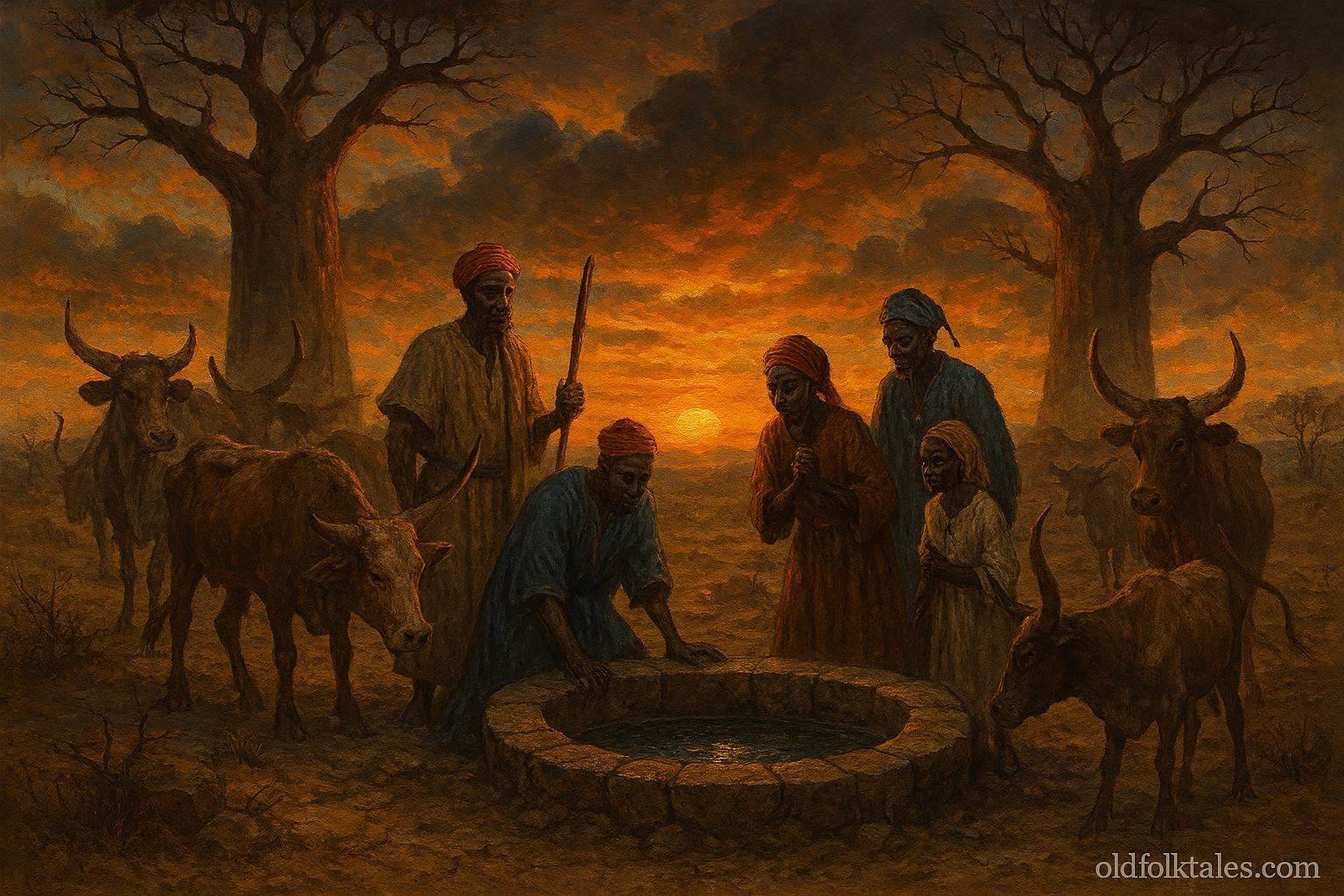
By evening, water slowly filled the shallow pit they had uncovered.
Not much at first.
But enough.
Clear underground water rose steadily from beneath the earth.
The hidden well had been found.
Samba ran back toward the caravan carrying news of the discovery.
Desperate families rushed toward the site immediately with animals and containers.
But as crowds gathered around the well, conflict nearly erupted.
Several men demanded control over the water.
Others tried filling large containers far beyond immediate need.
Fear threatened to turn survival into violence.
Boubacar raised his voice firmly before anyone could act recklessly.
He reminded the travelers of the ancestral laws tied to hidden wells.
Water belonged to everyone.
No family could take more than necessary.
Animals, children, elders, and strangers must all drink equally.
And anyone who wasted water would bring disaster upon the entire group.
At first, some resisted the rules angrily.
But the old man warned them carefully.
“These wells survive only where respect survives.”
Reluctantly, the travelers obeyed.
Over the following days, the group organized themselves peacefully around the sacred well. Water was shared carefully. Guards protected the site from contamination. And every family contributed labor equally to maintain order.
As they recovered, Boubacar taught younger travelers how to recognize the signs that revealed underground water hidden beneath the savannah.
Gradually, additional wells were discovered across nearby regions using the same ancestral knowledge once nearly forgotten.
Entire communities survived because cooperation replaced panic.
Months later, the rains finally returned to the Gabu Savannah.
Grasslands slowly recovered.
Rivers flowed again.
And many families returned home carrying renewed respect for the wisdom preserved by earlier generations.
After the drought ended, the story of the Hidden Wells spread throughout Guinea-Bissau and neighboring regions.
Among the Fula people, the legend became a reminder that survival depends not only on strength, but also on humility, patience, and respect for shared resources.
Even today, elders across the savannah teach younger generations that water must never be treated carelessly.
Because according to tradition, the earth hides its greatest gifts from those who approach with greed instead of wisdom.
Click here to discover more legendary tales from West Africa
Moral Lesson
Communities survive hardship through cooperation, humility, and respect for nature’s resources.
Knowledge Check
- Where is the story set?
It is set in the Gabu Savannah of Guinea-Bissau. - Why were the travelers searching for water?
A severe drought had dried rivers and grazing lands across the savannah. - Who was Boubacar?
He was an elderly Fula herder who remembered ancestral knowledge about hidden wells. - How were the hidden wells discovered?
They were found by carefully reading natural signs within the landscape. - Why were ancestral laws important at the wells?
The laws ensured water was shared fairly and protected from greed. - What lesson does the story teach?
Unity, respect, and cooperation help communities survive difficult times.
Source
West African folklore. Adapted from Fula pastoral traditions preserved in Guinea-Bissauan oral ecology archives and ethnographic folklore studies.