Among the rolling hills, rivers, and dense forests of southern Gabon, the Punu people preserved their history through stories, songs, ceremonies, and the wisdom of elders. Every generation inherited lessons from those who came before, and knowledge was considered one of the community’s greatest treasures. Elders often reminded young people that wisdom was like a flame. If carefully protected, it could illuminate the future. If neglected, it could disappear forever.
In one village surrounded by towering trees and fertile lands lived a young woman named Sela.
Sela was known for her curiosity.
While many people accepted things as they were, she constantly asked questions. She wanted to know why certain traditions existed, how ancient customs began, and what lay beyond the familiar paths surrounding the village. Some elders appreciated her eagerness to learn, while others occasionally worried that her curiosity might lead her into trouble.
Despite these concerns, Sela remained respectful. She listened carefully during storytelling gatherings and often spent hours speaking with elderly villagers about events that had occurred long before she was born.
Looking for more? Explore the magic of East African folktales here
One evening, during the beginning of the rainy season, Sela noticed something unusual.
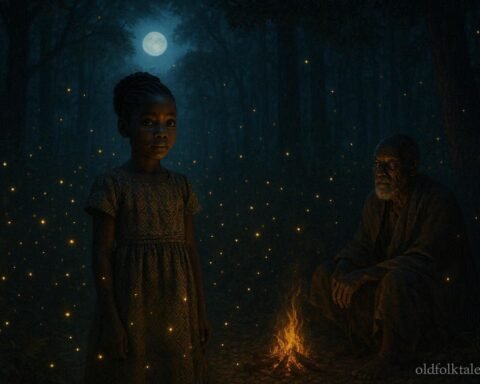
As darkness settled over the village, dozens of fireflies appeared near the edge of the forest.
Fireflies were common in the region, but these seemed different.
Their glow was brighter.
Their movements appeared purposeful.
Instead of scattering randomly through the night, they gathered together in a loose formation before drifting toward the forest.
Sela watched them until they disappeared among the trees.
The following night, the same thing happened.
Again, the fireflies appeared shortly after sunset.
Again, they gathered at the forest’s edge.
Again, they moved away together as though following an invisible path.
Curious, Sela mentioned the phenomenon to several villagers.
Most dismissed it as ordinary insect behavior.
Others paid little attention.
Only an elderly storyteller named Mabika seemed interested.
After listening carefully, he nodded thoughtfully.
“My grandfather once spoke of unusual fireflies,” he said.
Sela leaned forward.
“What did he say?”
“He believed they appeared when forgotten knowledge wished to be found again.”
The answer only deepened her curiosity.
Over the next several evenings, Sela continued observing the fireflies.
Each night, they followed the same route into the forest.
Each night, their glowing lights vanished among the trees.
Eventually, she made a decision.
She would follow them.
Before sunrise the next morning, she informed her family of her plan. Although they worried about her safety, they knew that once Sela became determined to learn something, persuading her otherwise was nearly impossible.
Her mother packed food for the journey.
Her father gave her advice about navigating forest paths.
Mabika offered a final warning.
“Knowledge is valuable,” he said, “but finding it often requires patience.”
Sela promised to be careful.
That evening, as darkness settled across the landscape, she waited near the forest.
Soon the fireflies appeared.
Their lights shimmered among the shadows.
When they began moving deeper into the forest, Sela followed.
The journey was unlike any she had experienced before.
The fireflies guided her along narrow trails she had never seen. They moved through dense groves of trees, across shallow streams, and beneath towering branches woven together high above the forest floor.
Hours passed.
Several times, Sela considered turning back.
Yet the fireflies continued forward, and her curiosity remained stronger than her fear.
Near midnight, the insects led her into a remote section of forest unlike any she had previously encountered.
The air felt calm and unusually still.
Ancient trees rose toward the sky like enormous pillars.
Their roots twisted across the ground in complex patterns.
The fireflies gathered around one particularly massive tree standing at the center of a clearing.
As Sela approached, she noticed something remarkable.
Symbols had been carved into the tree’s trunk.
The markings were old.
Very old.
Some had nearly disappeared beneath layers of bark and moss.
Others remained surprisingly clear.
She examined them closely.
Although she did not recognize many of the symbols, she realized they resembled designs occasionally seen on ancient ceremonial objects preserved by village elders.
The fireflies circled the tree before gradually settling upon its roots.
Then, one by one, their lights faded.
The clearing fell silent.
Sela remained there until dawn.
When daylight finally arrived, she explored the area more carefully.
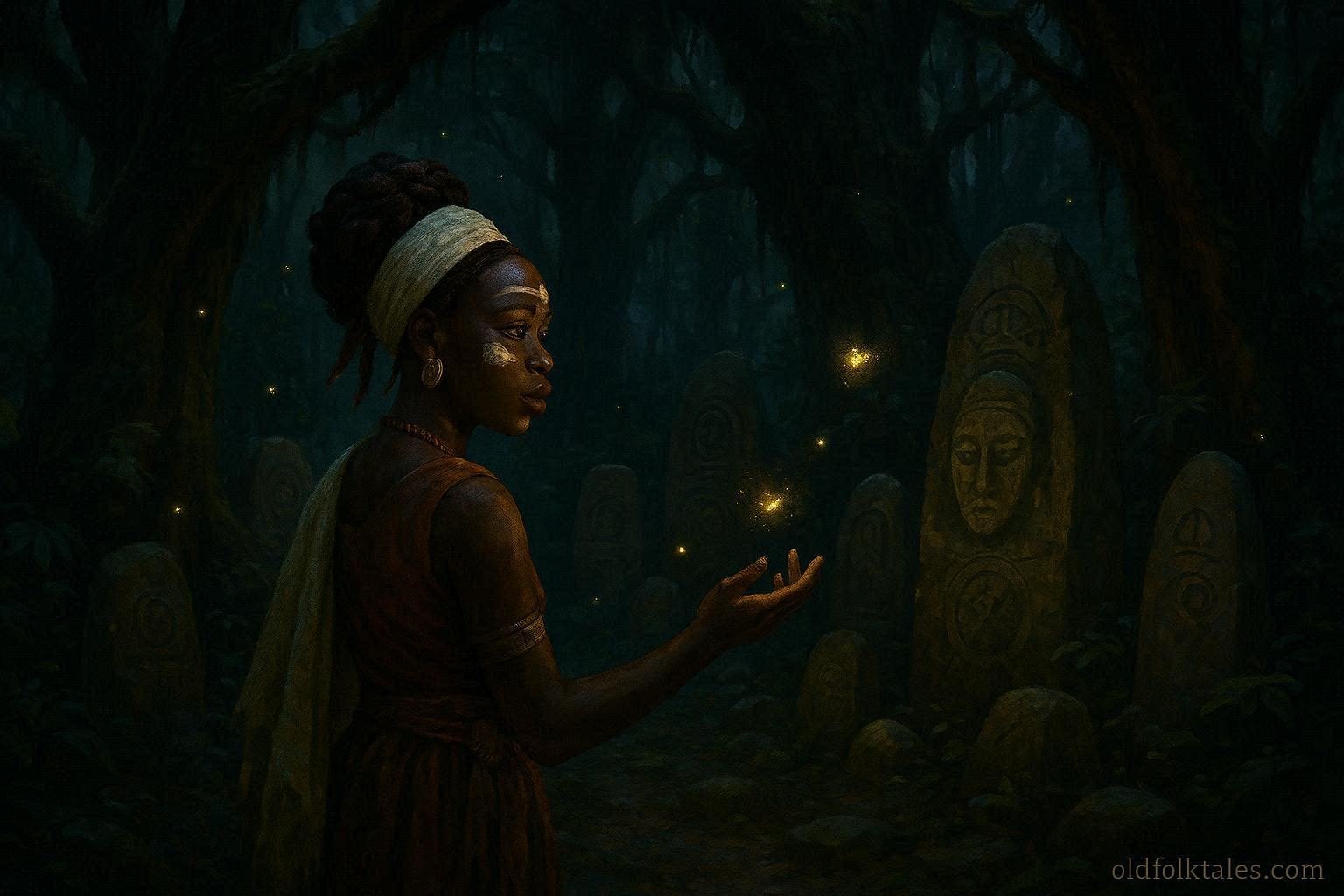
Behind the great tree, partially concealed by vegetation, she discovered a narrow opening leading into a hidden grove.
Inside stood several stone markers arranged in a circle.
Each contained carvings similar to those on the tree.
Nearby, protected beneath a rocky overhang, rested wooden objects, woven items, and carved artifacts unlike anything Sela had ever seen.
It appeared to be an ancient gathering place forgotten by time.
Excitement filled her heart.
She spent the day studying everything she could find.
The symbols seemed to tell stories.
They depicted migrations, ceremonies, important events, and ancestral teachings.
Many of the traditions represented in the carvings were unfamiliar even to her.
By evening, Sela understood that she had discovered something significant.
She returned to the village and shared her findings.
At first, some villagers doubted her account.
Yet Mabika believed her immediately.
The following day, he joined a small group accompanying Sela back to the hidden grove.
When they arrived, the elders were astonished.
Several recognized symbols associated with traditions that had nearly vanished from memory.
Others identified references to ancestral stories known only through fragmented oral accounts.
Over the following weeks, elders visited the site repeatedly.
They carefully documented the carvings and studied the artifacts.
Gradually, a clearer picture emerged.
Generations earlier, the grove had served as an important place where knowledge was preserved and shared. During periods of migration and change, however, its location had been forgotten.
As time passed, much of the wisdom connected to the site disappeared from community memory.
Now, thanks to Sela’s discovery, those teachings could be remembered once again.
The recovered knowledge proved valuable.
Some carvings described traditional farming methods adapted to changing seasons.
Others preserved medicinal knowledge about forest plants.
Many recorded stories explaining the origins of customs still practiced by the community.
The discovery strengthened the connection between younger and older generations.
People became eager to learn more about their heritage.
Storytelling gatherings grew larger.
Children asked more questions.
Elders shared knowledge that might otherwise have been lost.
Throughout the region, Sela became known as the woman who followed the fireflies.
Visitors often asked whether the insects had truly guided her to the hidden grove.
She always smiled before answering.
“Perhaps they did.”
Years later, after becoming an elder herself, Sela continued telling the story.
She explained that the fireflies represented more than glowing insects.
They symbolized curiosity.
They symbolized the courage required to seek understanding.
Most importantly, they symbolized the idea that knowledge often waits quietly for those willing to search for it.
Even today, among some storytellers of Gabon, it is said that unusual fireflies occasionally appear near forgotten places hidden within the forest.
Whether these accounts are true remains uncertain.
Yet the lesson endures.
Important knowledge can sometimes be lost.
But with curiosity, courage, and patience, it can also be found again.
And like the light of a firefly in the darkness, even a small discovery can illuminate the path for generations to come.
If you liked this story, see our Central African folktales collection
Moral Lesson
Curiosity, courage, and respect for knowledge can help preserve wisdom that might otherwise be forgotten.
Knowledge Check
- Where is the story set?
It is set among the Punu people in southern Gabon. - Who was Sela?
She was a curious young woman who loved learning about history and tradition. - Why did Sela follow the fireflies?
She was curious about their unusual behavior and wanted to discover where they were going. - What did the fireflies lead her to?
They guided her to a hidden grove containing ancient carvings, artifacts, and forgotten knowledge. - Why was the discovery important?
It helped recover ancestral teachings and cultural traditions that had been forgotten for generations. - What lesson does the story teach?
Curiosity and courage can lead to valuable knowledge and help preserve cultural heritage.
Source
Gabonese folklore. Adapted from Punu storytelling traditions preserved in Gabon oral storytelling archives and Central African folklore studies.