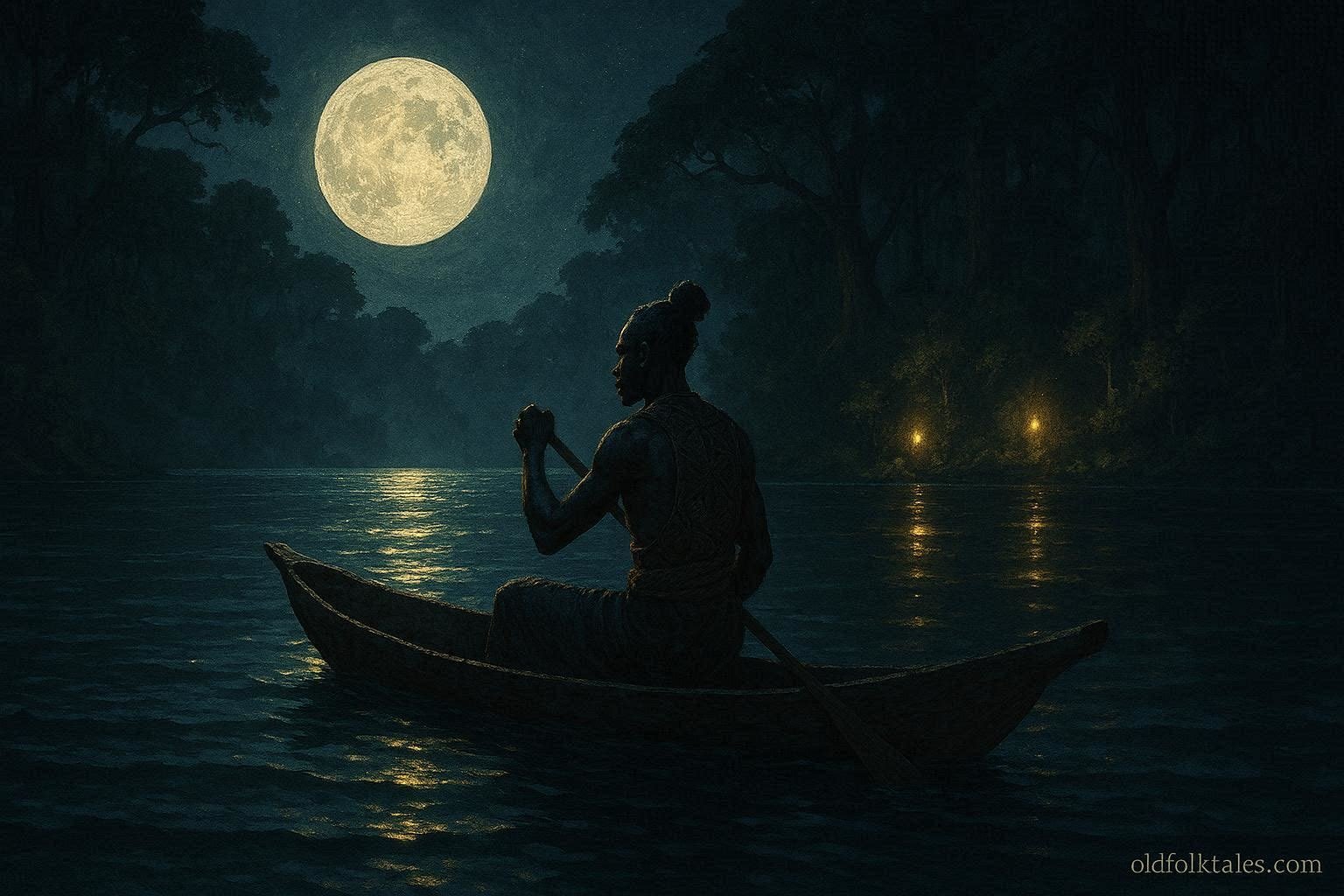
Among the vast forests and winding waterways of northeastern Gabon lies Lake Onangué, a beautiful body of water surrounded by dense vegetation and rich wildlife. For generations, communities living near the lake depended upon its waters for food, transportation, and survival. The lake was respected not only for its abundance but also for the many stories associated with it.
The Fang people who lived near the region believed that certain places carried the memory of those who came before. Ancient trees, rivers, and lakes were often regarded as more than physical features of the landscape. They were living reminders of ancestral presence and wisdom.
Among the many stories told about Lake Onangué, none was more enduring than the tale of the Moon Fisher.
The story began with a young fisherman named Ndzi.
Ndzi lived in a small settlement near the edge of the lake. His father and grandfather had both been skilled fishermen, and from childhood he learned how to read the water, repair nets, and navigate the lake’s hidden channels. He worked hard and respected the traditions of his people.
Keep reading: Discover more Central African folktales
Yet there was one thing that made him different from other fishermen.
He preferred fishing during the nights of the full moon.
Most fishermen worked whenever conditions allowed. They ventured onto the lake at dawn, during the afternoon, or whenever fish were plentiful. But Ndzi rarely entered the water except when the moon was full and bright.
Many villagers found this habit unusual.
Some laughed about it.
Others believed it was simply a personal preference.
Whenever people asked why he waited for the full moon, Ndzi struggled to explain his reason.
“I feel the lake speaks differently on those nights,” he would say.
Most listeners smiled politely without understanding.
As the years passed, his unusual practice continued.
Each month, when the moon reached its fullest brightness, Ndzi prepared his canoe and nets. He would paddle quietly onto the lake while silver moonlight reflected across the water’s surface. The stillness of those nights brought him peace, and he often returned with impressive catches.
One evening, after a successful fishing trip, Ndzi visited an elderly storyteller named Akoma.
Akoma was among the oldest residents of the community and possessed extensive knowledge of local traditions.
After listening to the young fisherman’s experiences, the elder nodded thoughtfully.
“My grandfather once spoke of people like you,” Akoma said.
Ndzi looked up with interest.
“What did he say?”
“He said some fishermen learn to listen to the water.”
Ndzi waited for further explanation.
“The lake remembers many things,” the elder continued. “Most people hear only waves and wind. A few hear something more.”
The words remained in Ndzi’s thoughts long after their conversation ended.
Months later, during another full moon, he paddled farther from shore than usual.
The night was exceptionally calm.
The moon reflected so clearly upon the water that it seemed a second sky existed beneath his canoe.
After casting his net, Ndzi sat quietly and listened.
At first, he heard only familiar sounds.
Water gently touched the canoe.
Insects sang along the shoreline.
A distant bird called somewhere in the darkness.
Then he noticed something unusual.
A faint rhythm echoed across the lake.
It sounded almost like distant voices.
Ndzi straightened.
The sound was difficult to identify.
It seemed to rise from the water itself before fading away.
Moments later, it returned.
Curious but cautious, he followed the direction from which the sound appeared to come.
His canoe drifted slowly across the moonlit lake.
The rhythm grew slightly clearer.
Although he could not distinguish specific words, the sound resembled singing.
It was soft, calm, and strangely familiar.
Eventually, the sound disappeared completely.
Ndzi searched the area but found nothing unusual.
By dawn, he returned home uncertain whether he had truly heard anything at all.
Yet the experience stayed with him.
The following month, during the next full moon, he returned to the same location.
Again, the mysterious sound appeared.
This time it lasted longer.
The rhythm seemed almost ceremonial, like songs sometimes performed during important community gatherings.
When he shared the experience with others, reactions were mixed.
Some believed he had simply imagined the sounds.
Others suggested that unusual echoes occasionally traveled across the water.
Only Akoma appeared unsurprised.
“There are stories,” the elder said, “about certain nights when the boundary between memory and the present becomes thin.”
“What does that mean?” Ndzi asked.
Akoma smiled.
“That is something you must discover yourself.”
Determined to understand, Ndzi continued his monthly journeys.
With each passing season, he became more attentive.
Instead of focusing solely on fishing, he spent time observing the lake itself.
He noticed subtle patterns.
Fish gathered differently beneath the full moon.
Bird movements changed.
Certain areas of the lake remained unusually calm regardless of weather conditions.
Gradually, he developed a deeper appreciation for the rhythms of the natural world.
One year, during a particularly bright full moon, something extraordinary happened.
As Ndzi paddled across the lake, he saw several lights shimmering upon the water in the distance.
At first, he assumed they were reflections.
But the lights moved independently.
They drifted slowly across the surface, forming a line that stretched toward a secluded section of shoreline rarely visited by fishermen.
Intrigued, he followed them.
The lights continued moving until they reached a small inlet surrounded by ancient trees.
There they disappeared.
Ndzi guided his canoe toward the shore and stepped onto land.
The area felt peaceful.
Large trees towered overhead, and the air seemed unusually still.
As he explored, he discovered several weathered carvings on stones partially hidden beneath roots and vegetation.
The symbols appeared ancient.
Although time had worn them down, some remained visible.
Recognizing their cultural significance, Ndzi returned to the village and informed the elders.
The discovery attracted considerable interest.
Several elders accompanied him back to the site.
After examining the carvings, they identified symbols associated with ancestral ceremonies practiced generations earlier.
Historical accounts preserved through oral tradition suggested that the location had once served as a gathering place where important teachings were shared and remembered.
Over time, however, the site had been forgotten.
The discovery sparked renewed interest in local history.
Elders began sharing stories that had rarely been told in recent years.
Young people listened carefully as traditions connected to the lake were discussed and preserved.
The hidden inlet became recognized as an important cultural site.
As for Ndzi, he gained a reputation not merely as a skilled fisherman but as someone who had helped reconnect the community with an important part of its heritage.
People began referring to him as the Moon Fisher.
Yet whenever anyone praised him, he remained humble.
“I only followed the lake,” he would say.
Years passed.
Ndzi continued fishing beneath the full moon and sharing what he learned with younger generations.
He taught them that successful fishing required more than nets and skill.
It required patience.
Observation.
Respect for nature.
And an understanding that wisdom often emerges when people take time to listen.
The story of the Moon Fisher spread throughout neighboring communities.
Some believed the mysterious sounds had been ancestral voices guiding him.
Others thought the experience reflected the deep connection between people and their environment.
Still others considered the tale a reminder that valuable knowledge can be hidden in familiar places, waiting for someone attentive enough to notice it.
Whatever the explanation, the lesson endured.
The lake had revealed its secrets not to the strongest fisherman or the wealthiest one, but to the person willing to approach it with patience and respect.
Even today, some storytellers in Gabon say that on certain full-moon nights, the waters of Lake Onangué become unusually calm.
Fishermen sometimes pause to listen.
Most hear only the sounds of nature.
But a few claim they hear faint rhythms carried across the water.
Whether those sounds come from memory, imagination, or ancestral wisdom remains uncertain.
Yet the story of the Moon Fisher continues to remind each new generation that knowledge often reveals itself to those willing to listen carefully.
Don’t miss out: Read more Southern African folktales
Moral Lesson
Wisdom comes to those who observe patiently, respect tradition, and remain open to learning from the world around them.
Knowledge Check
- Where is the story set?
It is set near Lake Onangué in Gabon. - Who was Ndzi?
He was a fisherman known for fishing only during the full moon. - What unusual thing did Ndzi hear on the lake?
He heard mysterious rhythmic sounds that resembled distant singing. - What did the lights on the water lead him to?
They guided him to a hidden inlet containing ancient ancestral carvings. - Why was the discovery important?
It helped the community reconnect with forgotten traditions and cultural history. - What lesson does the story teach?
Patience, observation, and respect for tradition can lead to wisdom and understanding.
Source
Gabonese folklore. Adapted from Fang oral traditions preserved in Ogooué-Ivindo oral tradition archives and regional Central African folklore studies.