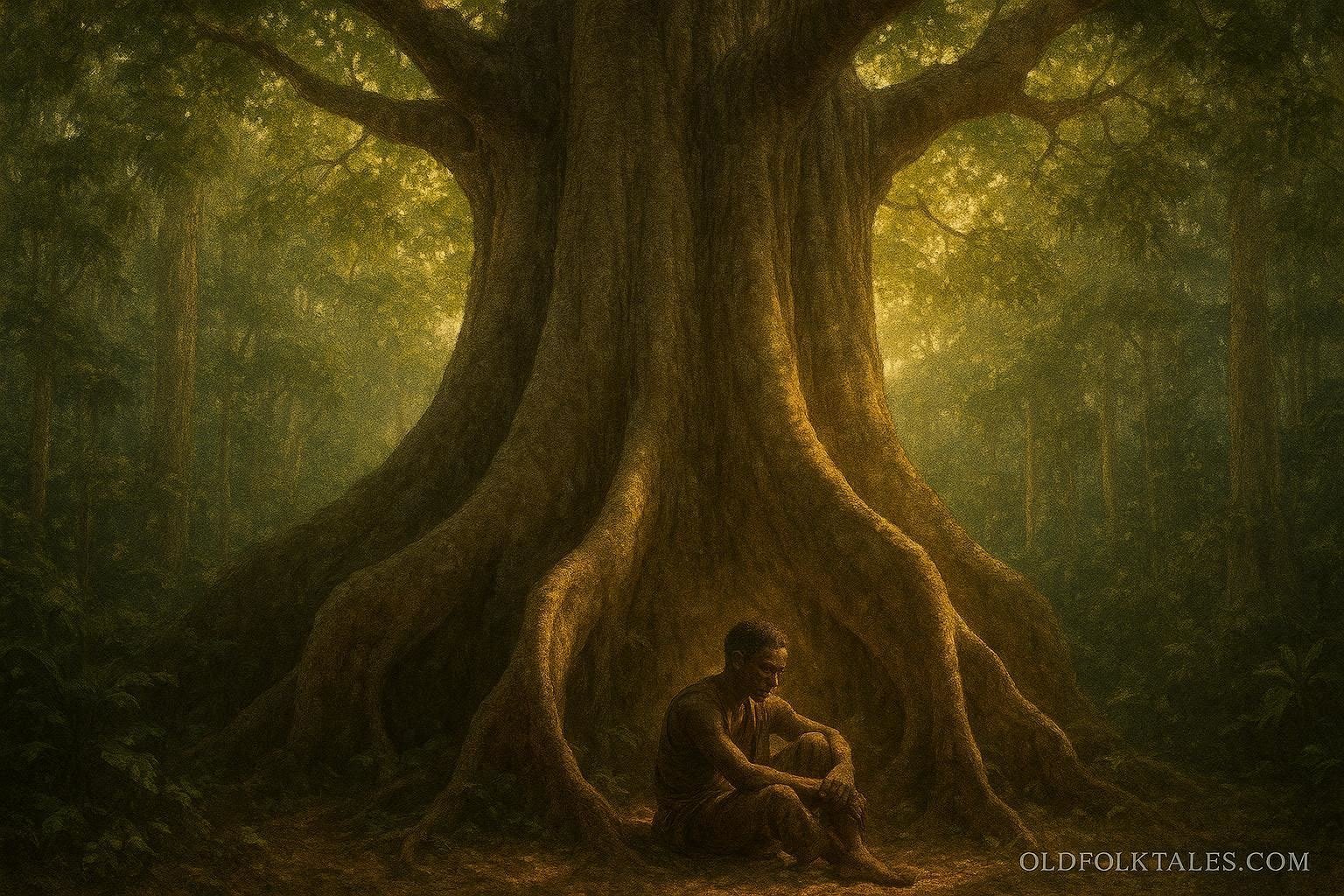
Deep within the forests of Río Muni stood a ceiba tree unlike any other. Its massive trunk rose high above the surrounding vegetation, while its branches stretched across the sky like the arms of a giant guardian. Travelers could spot the tree from great distances, and many used it as a landmark when moving through the forest.
For generations, Fang communities living near the region regarded the ceiba with great respect. Elders spoke of it in quiet voices and taught children never to damage its bark or disturb the ground around its roots. According to tradition, the tree was far older than any living person could remember. Some believed it had already stood in the forest when the ancestors of their ancestors first settled the land.
The ceiba was not feared, but it was treated with reverence. Stories claimed that it possessed a remarkable gift. During periods of uncertainty, when communities struggled with difficult decisions or faced challenges that threatened their future, the tree would reveal forgotten histories to those who approached it with sincerity and respect.
Don’t stop yet! See our complete East African folktales collection
Many listeners dismissed such stories as legends meant to encourage reflection. Others believed completely in the tree’s mysterious wisdom. Regardless of personal opinion, nearly everyone agreed that the ceiba occupied an important place in local tradition.
One season, a prolonged period of uncertainty settled over several neighboring communities.
The rains arrived late, harvests produced less food than expected, and hunters reported finding fewer animals in familiar areas. While these difficulties alone were concerning, another issue caused even greater anxiety.
The elders disagreed about how the communities should respond.
Some believed new farmland should be cleared deeper within the forest. Others argued that existing resources should be managed more carefully rather than expanding into unfamiliar territory. The discussions continued for many weeks without resolution.
As disagreements grew, uncertainty spread among the people.
Young farmers worried about future harvests. Families questioned whether enough food would be available in coming seasons. Rumors traveled from village to village, creating confusion and concern.
Among those troubled by the situation was a young man named Ndzi.
Ndzi was known for his curiosity and patience. Although still young, he spent much of his time listening to elders and learning the history of his people. He respected tradition but also believed that understanding the past could help solve present problems.
One evening, after listening to another inconclusive community meeting, Ndzi remembered the stories about the great ceiba tree.
The following morning, he decided to visit it.
Carrying only a small bag of provisions, he followed forest paths until he reached the clearing where the giant ceiba stood. Even though he had seen the tree before, its size amazed him. The roots spread across the ground like natural walls, while the trunk seemed almost impossibly wide.
Ndzi sat quietly beneath the branches.
At first, nothing happened.
The forest remained calm except for the sounds of birds and insects.
Hours passed.
As evening approached, he began reflecting on the challenges facing his community. He thought about the disagreements among the elders, the fears of the younger generation, and the uncertainty surrounding the future.
Then he remembered something his grandfather once taught him.
“When people forget where they came from,” his grandfather had said, “they often struggle to see where they should go.”
The words stayed in his mind.
As darkness settled over the forest, Ndzi felt as though the ceiba itself was encouraging him to remember.
Images from stories told by elders seemed to return vividly to his thoughts. He recalled accounts of previous generations who had survived droughts, migrations, and periods of scarcity. He remembered stories of communities that overcame hardship not through panic but through cooperation and patience.
The more he reflected, the clearer these memories became.
It felt almost as if forgotten voices were speaking through the history preserved within the tree.
By morning, Ndzi realized that the ceiba had not provided magical instructions. Instead, it had guided him toward knowledge that already existed within the collective memory of his people.
Excited by this realization, he returned to his village.
During the next community gathering, he respectfully shared what he had remembered.
He spoke about earlier generations who faced similar challenges. He described how they managed resources carefully, strengthened cooperation between settlements, and avoided decisions driven by fear.
At first, some elders were skeptical.
However, others recognized the historical accounts he described. They added their own recollections, expanding upon stories passed down through their families.
Gradually, the discussion changed.
Instead of arguing about immediate solutions, people began examining lessons from the past.
They discovered that many of the challenges they faced were not entirely new. Previous generations had confronted similar difficulties and left behind valuable examples of resilience and adaptation.
Inspired by these discussions, the communities agreed on a balanced approach.
They would improve management of existing farmland while cautiously exploring opportunities for expansion where necessary. They would also strengthen cooperation between villages to ensure resources could be shared during difficult periods.
The plan required patience, but it helped restore confidence.
As the months passed, conditions gradually improved. Harvests stabilized, relationships between neighboring communities strengthened, and fears about the future began to fade.
Word of Ndzi’s visit to the ceiba spread throughout the region.
Many people became convinced that the tree had spoken directly to him.
Ndzi disagreed.
Whenever asked about the experience, he explained that the ceiba had not given him secret knowledge.
Instead, it had reminded him to listen carefully to the wisdom already preserved within the stories of his ancestors.
His explanation only increased the tree’s reputation.
People came to see the ceiba not as a source of magical answers but as a symbol of memory and reflection. Visiting the tree encouraged individuals to think deeply about the lessons of previous generations.
Over time, more stories emerged.
A hunter facing uncertainty remembered an ancestral technique while resting beneath the tree.
A family struggling with conflict recalled forgotten advice from respected elders after visiting the site.
A young woman preparing to become a community leader gained confidence through reflecting on the achievements of earlier generations.
With each new story, the legend of the Talking Ceiba grew.
The tree became a powerful symbol of collective memory.
Elders used its story to teach children that wisdom often comes from understanding the experiences of those who came before. They explained that ancestry was more than genealogy, it was a living source of knowledge preserved through stories, customs, and traditions.
Generations later, the great ceiba continued standing above the forests of Río Muni.
Whether it truly spoke or merely inspired reflection remained a matter of personal belief.
Yet its lesson endured.
Whenever uncertainty arose, people remembered the story of the Talking Ceiba and the young man who discovered that the answers he sought could often be found within the wisdom of the past.
And so the tree remained a respected symbol of memory, ancestry, and guidance. A reminder that communities move forward most successfully when they carry the lessons of previous generations with them.
Click here to explore more Central African folktales
Moral Lesson
The wisdom of ancestors can help guide present decisions, especially during times of uncertainty and change.
Knowledge Check
1. What made the ceiba tree special?
It was believed to share forgotten histories and ancestral wisdom.
2. Why did Ndzi visit the tree?
He wanted guidance during a period of uncertainty affecting his community.
3. What did the tree teach him?
It encouraged him to remember the lessons preserved in ancestral stories.
4. How did the community benefit?
The people used historical knowledge to make wiser decisions about their future.
5. What did the ceiba symbolize?
Memory, ancestry, wisdom, and reflection.
6. What is the main lesson of the story?
Communities can find guidance by learning from the experiences of previous generations.
Source
Adapted from Fang sacred tree traditions and oral literature narratives preserved in Equatorial Guinea oral literature archives.