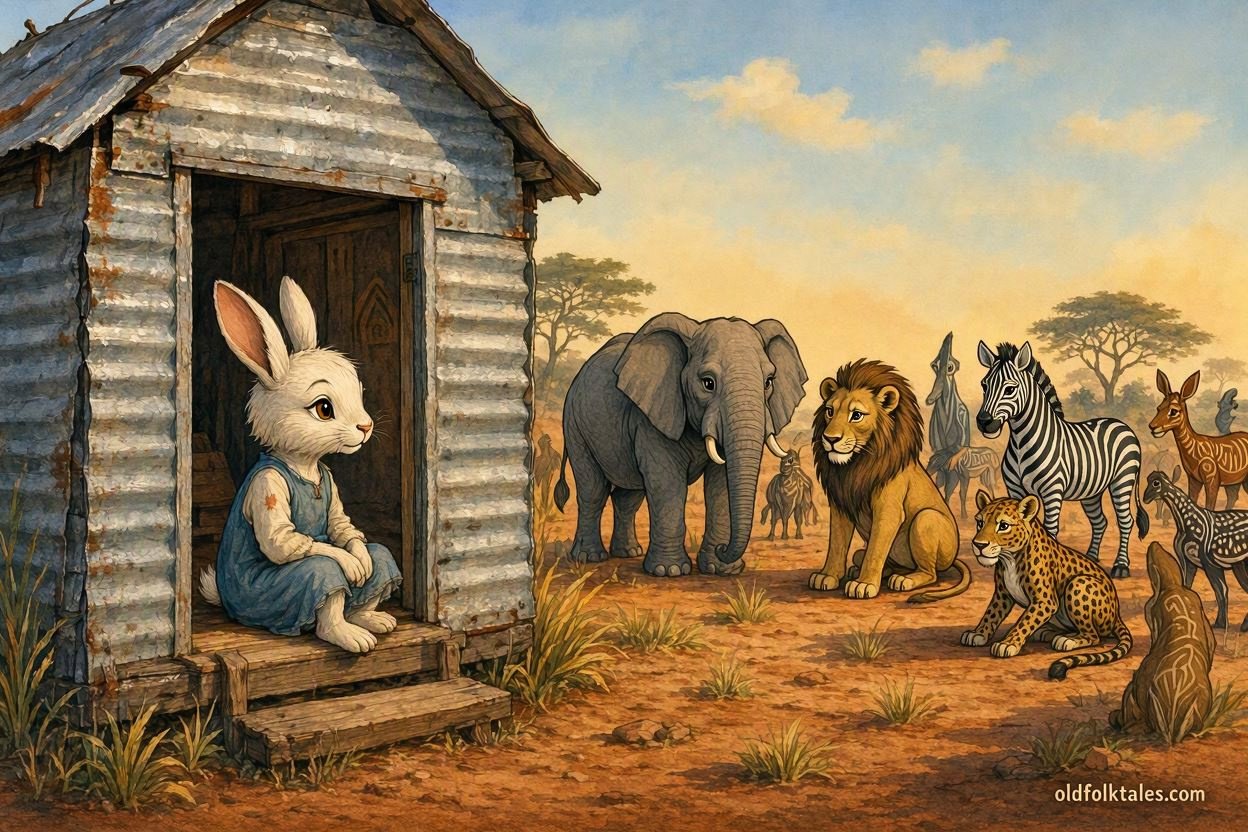
A little house made of iron stood quietly apart from the other homes. It was not large, but it was strong, neat, and unusual. Inside it lived a young rabbit girl whose beauty had attracted the attention of many creatures.
Master Rabbit had built the little iron house for her. When the house was finished and the young rabbit girl had moved inside, Master Rabbit decided to invite his friends to see her. The animals came together, ranging from the great lion to the smaller duiker.
Among them were powerful animals that believed they had much to offer a young bride. The elephant came first.
She walked towards the little iron house and knocked on the door.
The young rabbit girl called from inside.
“Who is knocking at my little iron house?”
The elephant proudly announced himself.
“I am the elephant.”
The young rabbit girl answered with a song. She told him that she knew who he was and that he might be as strong as a hundred. But she also told him to go away. She asked whether he had come because he wanted the rabbit, and when he declared his interest, she gave him the same answer.
She had already promised herself to someone else.
If you enjoyed this story, explore our full West African folktales collection
The elephant could not persuade her.
He left the little iron house disappointed.
As he walked away, Father Soft Paws, the lion, met him and asked what had happened.
The elephant explained that the young rabbit girl had refused him.
The lion then encouraged him to think differently.
“Send me,” he said. “Surely she will accept me. Look at my mane and my whiskers. I am handsome.”
The elephant agreed.
Father Soft Paws approached the little iron house. He knocked on the door.
Again the young rabbit girl asked who was there.
“I am Lord Roarer,” answered the lion.
The young rabbit girl gave him the same challenge she had given the elephant. She listened to his claim and then sent him away.
The lion returned without success.
The other animals began to encourage one another.
The gnu was told to try his luck because of his fine tail. He went to the little iron house and knocked.
Once again came the question from inside.
“Who is knocking at my little iron house?”
The gnu gave his name.
The answer did not change.
He too was sent away.
The eland tried next. He approached the house and knocked, hoping that his own qualities would make the young rabbit girl change her mind. But she refused him as she had refused the others.
Then came the zebra.
His coat was covered with fine stripes, and the other animals thought such striking markings might impress the young rabbit girl. They urged him to go.
The zebra went to the iron house.
He knocked.
The young rabbit girl asked who was there.
He answered that he was the zebra.
The same exchange followed.
She had already given her promise to another.
The zebra returned.
Still, the animals did not give up.
Then they looked towards the leopard.
The leopard was admired for his beautiful spots. The others told him that the young rabbit girl could not possibly refuse him.
“Go,” they urged. “With spots as fine as yours, surely she will accept you.”
The leopard approached the little iron house.
He knocked on the door.
The young rabbit girl asked the familiar question.
“Who is knocking at my little iron house?”
“I am the leopard,” he answered.
Again she listened.
Again she refused.
The leopard came back to the others.
They were surprised.
One of them asked whether he had really seen the young rabbit girl.
The leopard confirmed that he had.
“She refused me,” he told them.
The animals finally understood that none of their strength, beauty, size, or impressive appearance had persuaded her.
The young rabbit girl had already made her choice.
Then everyone looked towards Master Rabbit.
He had not boasted about his strength.
He had no enormous body like the elephant. He did not possess the lion’s mane or the leopard’s spots. He did not have the zebra’s stripes or the gnu’s impressive tail.
Yet he was the one she had chosen.
Master Rabbit finally made his way towards the little iron house.
He did not rush.
He came trotting along in his own manner. Then he moved quietly on his toes until he reached the door.
He gave the house a single knock.
From inside came the familiar question.
“Who is knocking at my little iron house?”
Master Rabbit answered simply.
“I am the rabbit.”
The young rabbit girl immediately responded differently.
She welcomed him.
She told him that he was the one she had accepted. She reminded him that she had already promised herself to him and invited him to come inside.
Master Rabbit did not hesitate.
He entered the little iron house.
The young rabbit girl welcomed him and asked him to sit with her.
Outside, the other animals waited.
After some time, they began wondering what had happened to Master Rabbit.
“Where has he gone?” they asked.
They decided that someone should go and greet him. They wanted to ask how he was getting on.
But none of them wanted to approach the house.
Instead, they encouraged one another.
“Father Soft Paws should go.”
“Go and bring Little Rabbit out.”
The lion and the others hesitated.
They had all gone to the house expecting the young rabbit girl to choose one of them. Each had believed that his own special quality would make him successful.
Now the smallest among them had entered the house while the others remained outside.
They joked that Little Rabbit was too small altogether for the young lady.
But they did not go in.
One by one, the animals began to leave.
The little iron house remained standing, and inside it were the two who had already chosen one another.
That was the end of the story.
The secret of the little iron house was not really hidden in the walls of iron. It was hidden in the choice of the young rabbit girl. The animals who came to court her believed that strength, beauty, size, and impressive appearance would make them desirable. Yet none of those qualities could change the promise she had already made.
Master Rabbit did not need to defeat the elephant, overpower the lion, outrun the zebra, or compete with the leopard’s beauty. He simply came to the door as himself, and the young rabbit girl welcomed him.
The story therefore turns the expected order upside down. The greatest animals gathered outside, while the smallest one entered the house. What appeared to be a contest of strength became a story about choice, loyalty, confidence, and the limits of outward appearance.
Love this story? Discover our full Southern African folktales collection
Moral Lesson
Strength, beauty, wealth, and social importance do not guarantee that someone will be chosen or valued. The young rabbit girl had already made her decision, and she remained faithful to it despite the impressive animals who came to win her attention. The story reminds us that personal choice and genuine affection cannot always be won through outward appearance or status.
Knowledge Check
1. Who built the little iron house?
Master Rabbit built the little iron house for the young rabbit girl.
2. Which animal came first to ask for the rabbit girl’s hand?
The elephant came first to the little iron house.
3. Why did the lion think the rabbit girl might accept him?
The lion believed his mane and whiskers made him handsome and attractive.
4. Which animals tried to win the rabbit girl after the elephant?
The lion, gnu, eland, zebra, and leopard all tried to win her.
5. Whom had the young rabbit girl already chosen?
She had already chosen Master Rabbit.
6. What does the story show about strength and appearance?
It shows that strength, beauty, size, and impressive appearance do not guarantee success in courtship or determine whom someone chooses.
Source
Adapted from J. Torrend, Specimens of Bantu Folk Lore from Northern Rhodesia: Texts and English Translations, Second Part, Tales in Rhodesian Tonga, “The Little Iron House,” pp. 174 to 177.