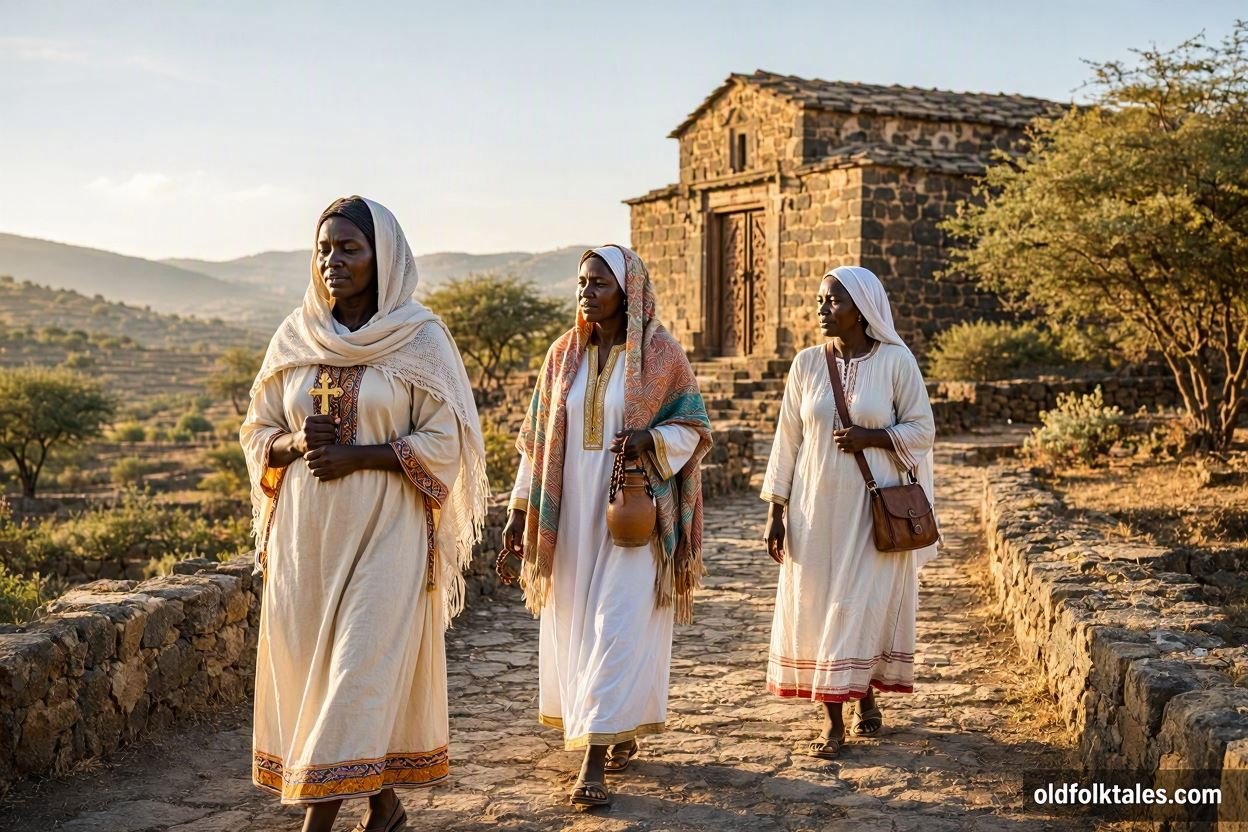
The old tradition of the Mänsa Bet Abrehe tells of three sacred women known as Mary of Sion, Mary of Berlri, and Mary of Dabre Sina. They were said to have come from Hagare Nagram and travelled into the country of the Mänsa Bet Abrehe. As the years passed, each Mary became connected with particular communities and sacred places, and their stories became part of the traditions preserved by the people who lived in the region.
Hagare Nagram was remembered as the place from which the three Marys came. From there, their journeys carried them into the country of the Mänsa Bet Abrehe. Their arrival became important because each Mary eventually became associated with a particular place of worship and with a religious tradition that continued through the generations.
Mary of Sion became connected with the Bet Arbay. She settled among them in their hill country and became their Mary. The people regarded her as part of their community and religious life. Her presence among the Bet Arbay continued until the Mänsa Bet Abrehe destroyed the Bet Arbay and took Mary of Sion.
After taking her, the Mänsa Bet Abrehe built a church for Mary at Haygat. The church became the place where she was honoured, and her name remained connected with the community. Yet the people did not remain at Haygat forever. When the village later moved, Mary of Sion was taken with them to Galab.
Explore the wisdom and wonder of North African folktales
At Galab, the people decided to build a house for Mary in the middle of the village. The place chosen for the building, however, was not without an owner. The field belonged to a man from Bet Abbaza. When he learned that the people intended to build the house of Mary on his land, he objected.
The man warned them against using his field. His concern was that once the house was built, tombs would eventually appear around it and the land would no longer be useful to him. The people did not accept his objection. They continued with their decision to build the sacred house on the field.
The owner of the field then pronounced a curse. According to the tradition, what he feared eventually happened. The land around the House of Mary became filled with tombs.
The House of Mary nevertheless remained standing. Whenever the building became old, it was renewed. The place continued to be remembered as the House of Mary, and the tradition surrounding it became part of the memory of Galab.
The story also preserves the names of priests who served Mary of Sion. The first was Priest Belenay, who had been a pupil of Priest Wad Beda, the priest of Bet Sahagan. After Belenay came Priest Haile Gargis, and later Priest Addemkel.
The tradition remembers Priest Addemkel as a man who could not read but had learned a small amount through hearing. During festivals and sacrifices for the dead, he recited what he had learned. These details show how the religious tradition was passed from one generation to another, even when formal learning was limited.
The priestly tradition eventually changed. The service of Mary stopped, and the tabot connected with the church was lost. Yet the memory of the priestly family did not disappear. The family continued to be known as the family of the priest and continued to receive its traditional tribute.
Mary of Sion herself remained part of the sacred memory of the place. The tradition says that she was the greatest of the three Marys. Some believed that she continued to exist invisibly at the site of her house. Others believed that she had eventually left. Her presence, however, remained associated with the House of Mary at Galab.
The other two Marys had their own traditions. Mary of Berlri and Mary of Dabre Sina were said to have settled on the plateau of the Mänsa Bet Abrehe at Agcaro, in a place called Asrah. Their priests had also come from Hagare Nagram.
The priests connected with the two Marys later became involved in a contest of promises. Each priest boasted about what he could accomplish. One claimed that he would plough a field and allow the others to eat the ears of corn the following day. Another claimed that he would cut a wooden pillar for the house of Mary and throw it from Massabbar to Amba. Others made further claims about throwing the pillar from one place to another until it reached Asrah.
While the priests were away, the Marys left. They travelled toward Dabre Sina, and when the priests returned, they discovered that the women had disappeared. The priests became concerned and followed their tracks.
Their search eventually brought them to the height of Qal Hasay. The Marys had placed their lamp above the cave where they were staying. When the priests saw the light, they were able to locate the cave and find the Marys.
For a time, the Marys and their priests remained together. The tradition says that Mary of Berlri and Mary of Dabre Sina were sisters. Eventually, however, their paths separated.
Mary of Berlri remained at her place with her priest. He offered incense to her every day, but the amount of incense gradually became smaller. The tradition says that Mary became angry with him because of this.
During one offering, when the priest entered her house to burn incense, Mary spoke to the mat that served as the curtain at the entrance. She commanded the mat to become stone and close the entrance. According to the tradition, the mat became stone, trapping the priest inside.
His voice was said to have been heard for forty days before he died. The outlines of the doorway remained visible, and this became part of the tradition explaining why Mary of Berlri’s house remained closed.
Mary of Dabre Sina followed another path. She settled in a large cave and was believed to have remained there. A convent later became associated with the place, and monks lived there. Her sacred site also became a place of pilgrimage, with both Mohammedans and Christians said to travel there during her festival.
The traditions of the Three Marys therefore became closely connected with the landscape of the Mänsa Bet Abrehe. Their story was remembered through churches, houses, caves, priests, sacred objects and places of pilgrimage. Each location carried part of the memory of the Mary associated with it.
For Mary of Sion, that memory became especially strong at Galab. The House of Mary stood on land that had once belonged to another man, and the dispute surrounding its construction became part of the story of the place. The tombs that were said to have filled the surrounding land became another part of the local tradition.
The story of the Three Marys shows how sacred traditions can become attached to particular places. A journey can become part of a community’s history, while a church, house or cave can preserve the memory of those believed to have been connected with it.
At Galab, the House of Mary remained a reminder of an older tradition. Even after the priestly service ended and the sacred object associated with the church was lost, the name and memory of the place continued. Through that memory, the story of Mary of Sion and the other two Marys remained part of the cultural traditions of the communities that preserved them.
Don’t stop yet! See our complete East African folktales collection
Moral Lesson
Sacred places can preserve the memory of a community’s past. The story of the Three Marys shows how journeys, religious traditions, disputes and important places can become woven together and remembered across generations.
Knowledge Check
1. Who were the Three Marys?
They were Mary of Sion, Mary of Berlri and Mary of Dabre Sina.
2. Where were the Three Marys said to have come from?
They were said to have come from Hagare Nagram.
3. Where was a church first built for Mary of Sion by the Mänsa Bet Abrehe?
A church was first built for her at Haygat.
4. Why was there a dispute over the land at Galab?
The land chosen for the House of Mary belonged to a man from Bet Abbaza, who objected to the building.
5. What did the tradition say happened after the landowner’s curse?
The land around the House of Mary became filled with tombs.
6. Where was Mary of Dabre Sina said to have settled?
She was said to have settled in a large cave where a convent later became associated with her.
Source
Adapted from Enno Littmann, Tales, Customs, Names and Dirges of the Tigre Tribes, Volume II, “The Legend of the Three Marys,” pp. 55 to 58, published by E. J. Brill in 1910.