In the sun-baked lands of Northern Nigeria, where wells and streams were treasured more than gold during the long dry season, the people often spoke of a place known as Ladi’s Spring. Its water was said to be pure, cool, and life-giving, flowing quietly even when nearby rivers had begun to dry beneath the relentless sun.
Among the villages that depended on this precious spring lived a young woman named Ladi. She was known not for wealth or beauty but for her gentle heart. Every morning before sunrise, she carried her clay water pot along the narrow footpath leading to the spring, returning with enough water for her household before helping her neighbours who were too old or too weak to make the journey themselves.
No one who asked Ladi for water was ever turned away.
Travellers crossing the dusty plains found relief because of her generosity, while widows and elderly villagers often discovered that their empty pots had quietly been filled before they awoke.
Many praised her kindness.
Others wondered why she worked so hard for people who could offer her nothing in return.
Ladi simply smiled.
“Water gives life,” she would say. “If it has been given freely to us, we should not withhold it from those in need.”
One particularly harsh dry season tested everyone’s patience.
Love this story? Discover our full Southern African folktales collection
The streams became shallow, crops withered beneath the scorching heat, and every journey to the spring grew longer as people searched desperately for enough water to survive.
Despite her own weariness, Ladi continued her daily routine.
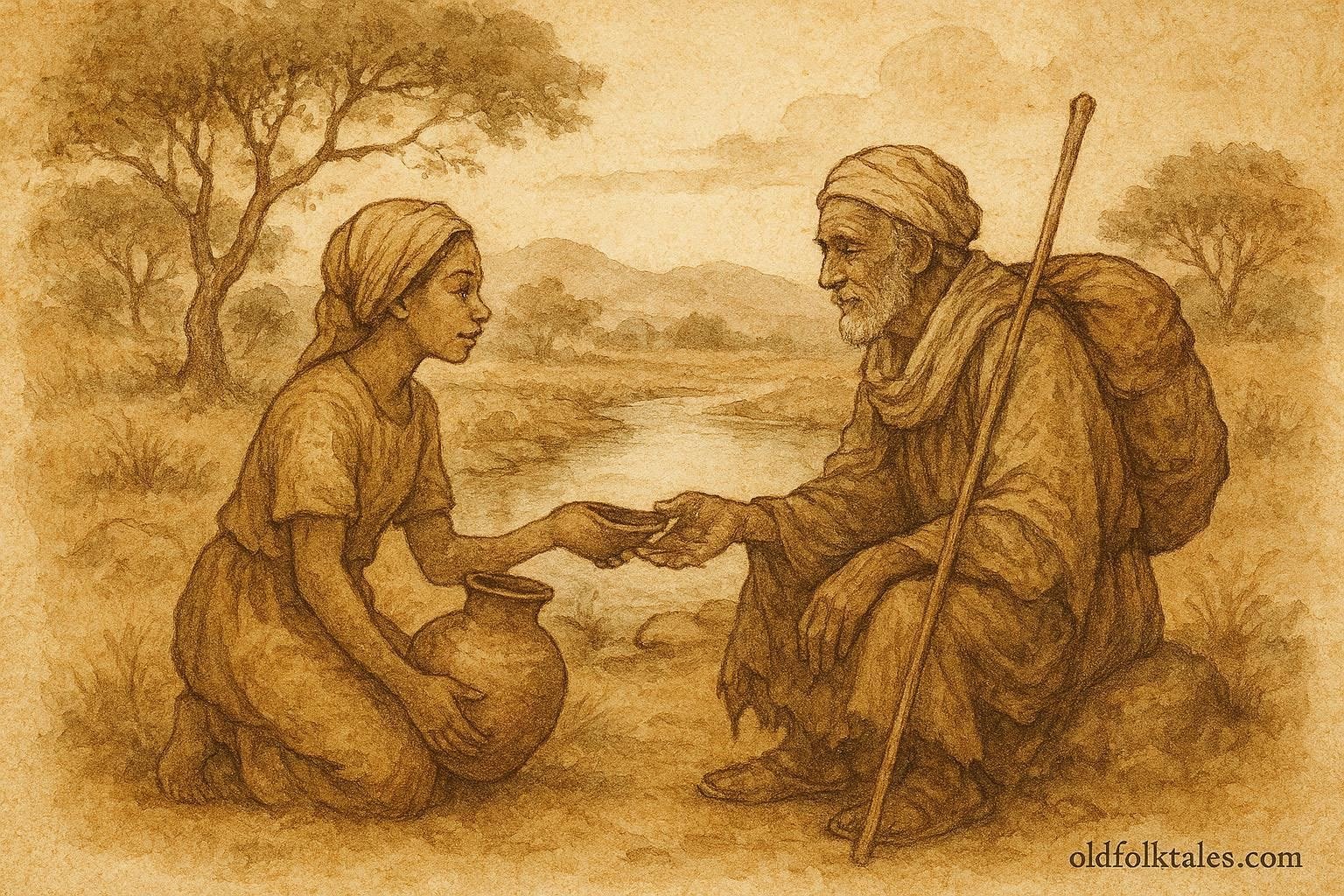
One morning, while making her way home with a full water pot balanced carefully upon her head, she noticed an old woman sitting alone beneath a thorn tree.
The stranger looked exhausted.
Her clothing was covered with dust, and her lips were dry from thirst.
In a faint voice, the woman called to Ladi.
“My daughter,” she pleaded, “I have travelled a great distance beneath this burning sun. Will you spare a little water for someone who has none?”
Ladi stopped immediately.
Without hesitation, she lowered her clay pot and offered the old woman the cool, clear water she had carried home with such effort.
The stranger drank slowly, thanking her with every sip.
“You have shown kindness without asking who I am,” the old woman said warmly. “May your generosity never be forgotten.”
Ladi smiled, lifted her now lighter water pot, and continued toward her village, thinking no more of the encounter.
She did not know that the traveller she had helped was no ordinary woman.
Nor did she realize that her simple act of compassion was about to change her life in ways she could never have imagined.
The following morning, Ladi rose before dawn as she always did and made her way to the spring with her empty clay pot. The air was cool, and the first rays of sunlight were beginning to brighten the horizon.
As she approached the spring, she noticed something unusual.
The water shimmered more brightly than she had ever seen before. Its gentle flow was clear and calm, and the entire place seemed filled with a peaceful stillness.
Curious, Ladi knelt to fill her pot.
Just then, she heard a familiar voice behind her.
“You have returned with the same kind heart you carried yesterday.”
Ladi turned and saw the old woman she had helped on the roadside.
But she no longer appeared tired or weak.
Her face was radiant, and her presence filled the spring with quiet dignity.
The old woman smiled.
“Many passed me without offering help,” she said. “Some feared sharing what little they possessed. Others looked away. Yet you gave freely, expecting nothing in return.”
Ladi bowed respectfully.
“I only did what anyone should do for a thirsty traveler,” she replied.
The woman nodded.
“Kindness offered without seeking a reward is the greatest gift of all.”
With those words, she touched the surface of the spring with her hand.
Gentle ripples spread across the water.
“From this day forward,” she declared, “this spring shall continue to refresh those who come with grateful hearts. May your kindness be remembered whenever its waters bring life to the weary.”
Before Ladi could speak again, the mysterious woman disappeared as quietly as she had appeared.
For a long moment, Ladi stood in silence, wondering whether she had witnessed a dream.
She filled her pot and returned to the village.
As the weeks passed, something remarkable became clear.
Although many nearby streams dried beneath the relentless heat, Ladi’s spring continued to flow with fresh, cool water.
People from neighboring villages soon heard of the spring that never failed during the dry season.
Travelers, farmers, herdsmen, and families journeyed there to draw water, always remembering the story of the generous young woman whose compassion had become forever linked with the life-giving spring.
Ladi never claimed credit for the blessing.
Whenever people praised her, she simply reminded them that no act of kindness is ever too small.
“If we wait until we have plenty before helping others,” she would often say, “many who need our help today may never receive it.”
The elders treasured her words.
Parents shared the story with their children, teaching them that generosity is measured not by how much a person gives but by the willingness to share even when resources are limited.
In time, the spring became known throughout the region as The Water of Ladi, a lasting reminder that compassion has the power to bring hope where hardship seems certain.
And so, the Hausa people continued telling the tale, believing that every cup drawn from the spring carried with it the memory of a young woman whose simple kindness became a blessing for countless generations.
Click here to discover more legendary tales from West Africa
Moral Lesson
This Hausa folktale teaches that genuine kindness expects no reward. Even the smallest act of compassion can bring blessings that reach far beyond the person who first offered help.
Knowledge Check
1. Who was Ladi?
Ladi was a kind-hearted young woman known for sharing water with anyone in need.
2. Why was water so valuable in the story?
The story takes place during a harsh dry season when water was scarce and essential for survival.
3. Who did Ladi help on her journey home?
She generously shared her water with an elderly traveler who was weak and thirsty.
4. How was Ladi rewarded for her kindness?
The mysterious woman blessed the spring, ensuring it continued to provide fresh water even during severe drought.
5. Why did people remember the spring?
It became known as The Water of Ladi, symbolizing generosity, hope, and compassion.
6. What is the main lesson of this Hausa folktale?
The story teaches that selfless kindness can become a lasting blessing for an entire community.
Source: Hausa folktale, Northern Nigeria. Adapted from Black Folk Tales: Retold from the Haussa of Northern Nigeria by Erick Berry (1928).