Across the fertile plains and wooded valleys of Central Africa, before the Lunda Kingdom became one of the region’s greatest powers, the land was home to many proud clans.
Each community had its own chief.
Each guarded its hunting grounds, rivers, and fertile fields with determination.
Although they shared common traditions, old rivalries often led to disputes that weakened them all.
Among these clans lived Princess Lueji, the daughter of a respected ruler whose wisdom was known far beyond his own people.
From childhood, Lueji preferred listening to elders rather than joining contests of strength.
She spent countless evenings learning the histories of neighboring clans, the customs of distant villages, and the stories of the ancestors.
Her father often smiled as he watched her.
“A leader who understands only her own people,” he would say, “can never unite many.”
As the years passed, Lueji became admired for her fairness.
Whenever disagreements arose between families, she patiently listened to every voice before offering a solution.
Don’t stop yet! See our complete East African folktales collection
Even those who did not always agree with her respected the kindness and honesty with which she spoke.
When her aging father fell ill, the chiefs gathered to discuss who would guide the people.
Some believed only a powerful warrior should lead.
Others wanted one clan to rule over all the rest.
The meeting soon dissolved into angry arguments.
Old rivalries resurfaced.
Ancient grievances were remembered.
The kingdom’s future seemed uncertain.
Lueji quietly rose to her feet.
Instead of choosing sides, she addressed every chief.
“If one clan wins while the others remain enemies,” she said, “none of us will truly prosper. A kingdom built through fear will one day fall through fear.”
The gathering became silent.
Her words carried the calm certainty of someone seeking peace rather than victory.
Although many chiefs admired her wisdom, they doubted that unity among so many rival families could ever become reality.
One elderly chief stepped forward.
“If you believe peace is possible,” he said, “show us how.”
Lueji accepted the challenge.
She proposed that instead of meeting only during times of conflict, the chiefs should gather each season to discuss trade, farming, hunting, and matters affecting every community.
She also suggested that young people from different clans visit one another’s villages to learn each other’s customs and traditions.
Some leaders welcomed the idea.
Others remained skeptical.
“Words alone cannot erase generations of mistrust,” one chief warned.
Lueji nodded.
“You are right,” she replied. “Trust is not created in a single day. It grows through many acts of honesty.”
The chiefs agreed to give her proposal a chance.
None of them realized that her quiet determination would soon lay the foundation for one of Central Africa’s greatest kingdoms.
The seasons passed, and Lueji remained faithful to her promise.
She traveled from village to village, meeting chiefs, elders, hunters, farmers, and craftspeople.
Instead of speaking first, she listened.
She learned which rivers caused disputes during the dry season.
She discovered which trade paths had become unsafe.
She heard the concerns of families whose relatives belonged to different clans.
Where others saw division, Lueji saw opportunities for cooperation.
She encouraged neighboring villages to share fishing grounds during difficult seasons.
She persuaded rival chiefs to exchange seeds and farming knowledge so that poor harvests in one region would not become famine for another.
She organized gatherings where storytellers, musicians, and blacksmiths shared their skills with people from distant communities.
Slowly, suspicion gave way to friendship.
One year, a severe drought struck the land.
Streams dried up, crops failed, and many feared that old rivalries would return as families competed for food and water.
Instead of retreating behind their own borders, the chiefs remembered Lueji’s counsel.
Communities that still had full granaries shared their harvests with those in need.
Hunters from different clans worked together instead of competing.
The people survived the difficult season because they chose unity over fear.
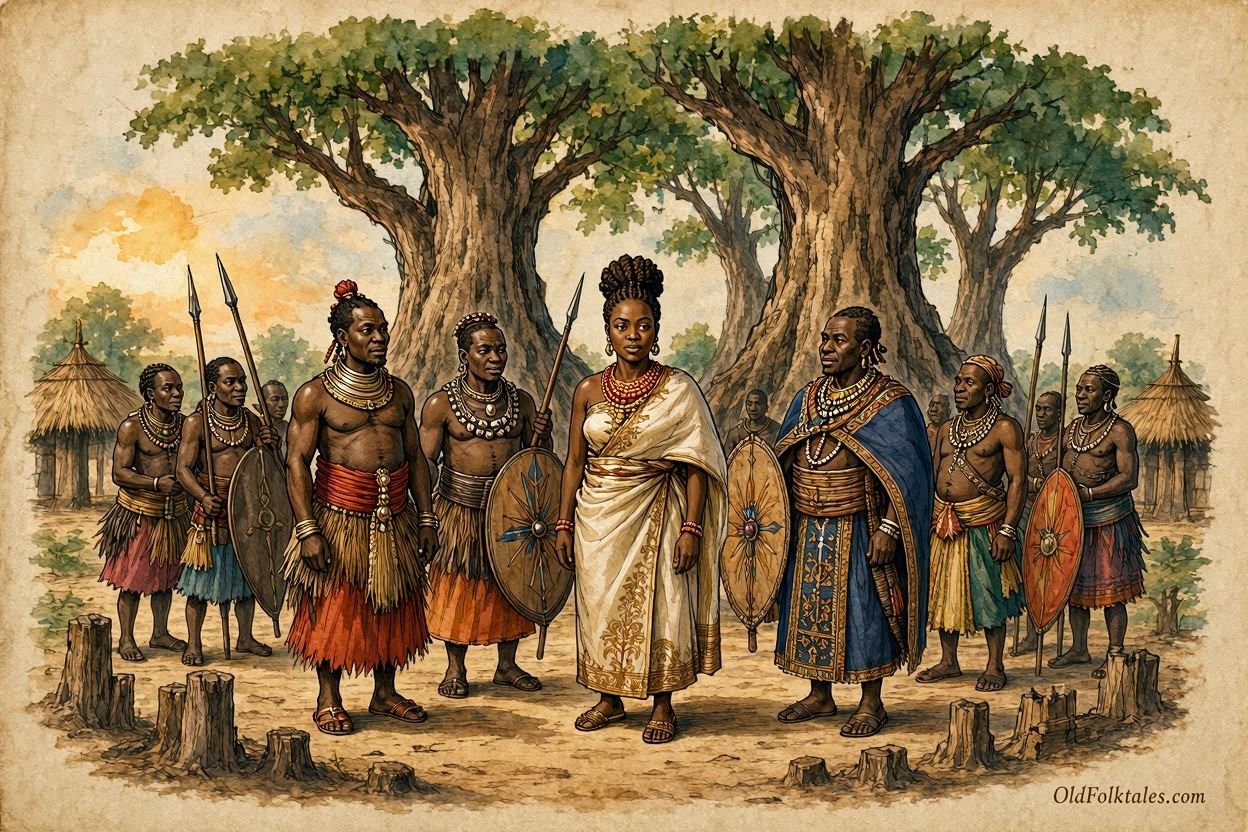
The elders gathered once more beneath the great trees.
This time, their meeting was peaceful.
The oldest chief rose to speak.
“When we followed only our own interests, we became weaker,” he said.
“When we followed the path of unity, we all became stronger.”
The chiefs turned toward Lueji.
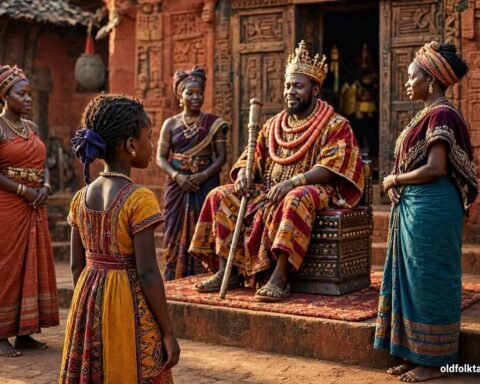
Together, they placed before her a beautifully carved royal stool, a symbol of leadership and responsibility.
“Lueji,” they said, “you have united what others believed could never be united. Guide us as one people.”
Lueji accepted the honor with humility.
“I do not accept this for myself alone,” she replied. “A kingdom is not built by one ruler. It is built by every family that chooses peace over conflict and justice over pride.”
Soon afterward, leaders from many clans pledged their friendship and cooperation.
The growing alliance became known as the Lunda Kingdom, a realm strengthened not by conquest but by trust, shared purpose, and mutual respect.
In later years, the wandering Luba prince Chibinda Ilunga arrived in Lueji’s kingdom.
Recognizing his wisdom and honorable character, Lueji welcomed him warmly.
Their marriage strengthened the bonds between the Lunda and Luba peoples, bringing new ideas, stronger alliances, and lasting prosperity.
Together, they encouraged fair leadership, expanded peaceful trade, and protected the customs of the many communities that now formed one kingdom.
As generations passed, the Lunda Kingdom became renowned across Central Africa.
Travelers admired its thriving markets, skilled craftsmen, and wise rulers.
Whenever young leaders asked how such a great kingdom had begun, the elders would point not to a battlefield but to the memory of a princess who believed that listening was stronger than shouting and cooperation was stronger than conquest.
And so, Lueji and the Birth of the Lunda Kingdom became one of the most treasured foundation legends of the Lunda people, reminding every generation that the strongest kingdoms are built through wisdom, diplomacy, and unity.
If you liked this story, see our Central African folktales collection
Moral Lesson
This Lunda folktale teaches that lasting greatness is built through unity, diplomacy, and servant leadership. A wise leader brings people together instead of allowing differences to divide them.
Knowledge Check
1. Why was Princess Lueji respected by the people?
She listened carefully, judged fairly, and sought peaceful solutions to conflicts.
2. What challenge faced the clans before the Lunda Kingdom was formed?
They were divided by long-standing rivalries and frequent disputes.
3. How did Lueji encourage unity among the clans?
She promoted regular councils, shared resources, cultural exchanges, and cooperation during difficult times.
4. What happened during the great drought?
The clans helped one another by sharing food, water, and resources, proving the strength of their unity.
5. How did Chibinda Ilunga contribute to the kingdom?
His marriage to Lueji strengthened the alliance between the Lunda and Luba peoples and helped expand peaceful leadership and prosperity.
6. What is the central lesson of this folktale?
The story teaches that true leadership is founded on wisdom, cooperation, diplomacy, and the willingness to unite people for the common good.
Source: Adapted from Lunda royal traditions discussed in Jan Vansina’s Kingdoms of the Savanna (1966) and supported by Thomas Q. Reefe’s The Rainbow and the Kings: A History of the Luba Empire (1981).