In the arid lands of southern Tunisia stretches Chott el Jerid, a vast salt lake that transforms with the seasons. During the hottest months, its surface becomes an endless expanse of white salt, shimmering beneath the desert sun like a sea of crystal. Travelers crossing its edges often spoke of strange mirages, distant shapes, and mysterious lights that appeared upon the horizon. For generations, the people living near the great salt flats respected the region, believing it held secrets older than memory itself.
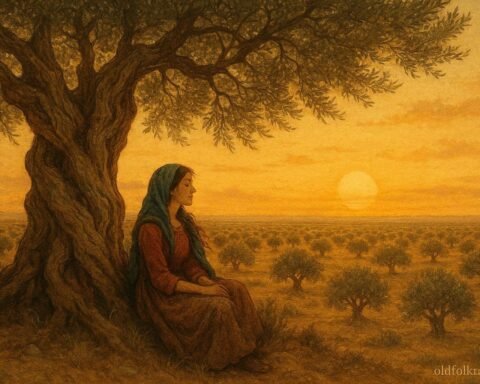
In one village near the edge of the chott lived a young woman named Amina. She was known for her kindness, intelligence, and deep concern for her community. Her father was a farmer, and like many families in the region, they depended on scarce water sources to survive. Life was never easy, but the people endured through cooperation and perseverance.
Then came the drought.
Season after season passed without meaningful rain. Wells that had supplied families for generations began to dry. Crops withered beneath the relentless sun. Herds grew weak, and food became increasingly scarce. The village elders met repeatedly, searching for solutions, but none could be found.
Looking for more? Explore the magic of East African folktales here
As conditions worsened, anxiety spread throughout the community. Some families considered leaving their ancestral homes in search of better conditions elsewhere. Others feared that abandoning the village would mean losing a part of themselves forever.
Amina watched her people suffer and felt powerless to help. Every day she carried water from a shrinking well, carefully measuring each drop. Children who once played in the village square now spent their days helping their families search for food and water.
One evening, after hearing another discussion among worried elders, Amina decided to walk alone toward the edge of Chott el Jerid. She hoped the solitude would help clear her thoughts.
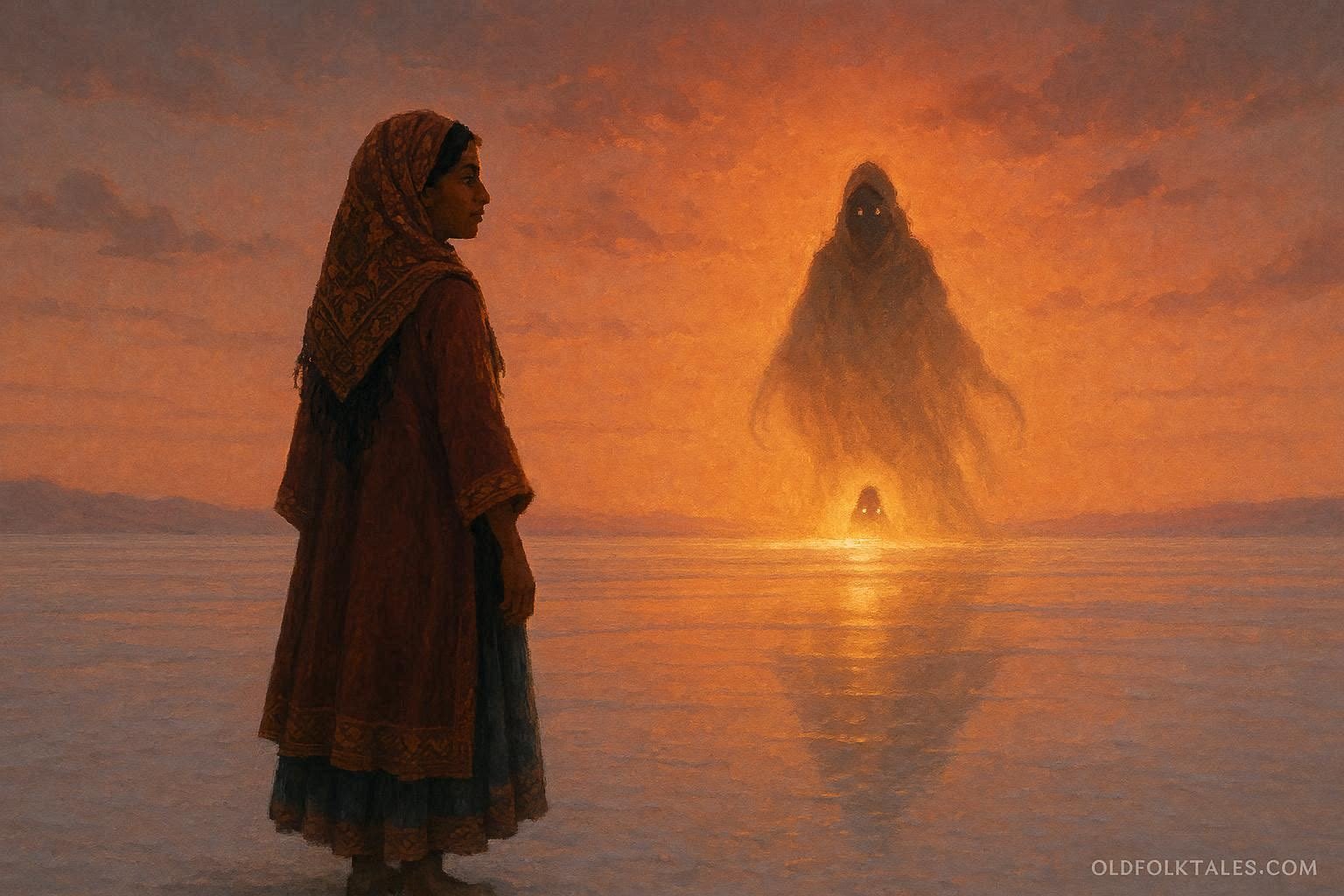
The setting sun cast golden light across the endless salt flats. The landscape seemed almost otherworldly. As she gazed across the horizon, she noticed something unusual.
Far in the distance stood a solitary figure.
At first, she assumed it was a traveler. Yet as the figure moved closer, she realized there were no footprints behind it despite the salt-covered ground.
A chill ran through her.
The figure appeared neither young nor old, neither man nor woman. Its flowing garments seemed woven from light and desert mist. Though Amina felt afraid, she remained where she stood.
The stranger stopped several steps away and regarded her silently.
“You carry the worries of your people,” the figure finally said.
Amina was startled.
“Who are you?” she asked.
The figure did not answer directly.
“Names matter little in places older than names.”
The response only deepened the mystery.
The stranger gestured toward the vast expanse of salt stretching beyond the horizon.
“Long before your village existed, water flowed freely through these lands,” the figure said. “The earth remembers what people have forgotten.”
Amina listened carefully.
“Can my people be saved?” she asked.
The figure studied her for a moment.
“Perhaps.”
Hope stirred within her.
“What must I do?”
The stranger pointed toward the heart of the salt flats.
“There is a hidden spring beneath the desert. It has slept for generations. It can restore life to your village.”
Amina’s heart raced.
“Then show me where it is.”
The figure’s expression remained calm.
“Every gift requires a choice.”
The words hung heavily in the air.
“What choice?” she asked.
“If the spring is awakened, it must never belong to one person, one family, or one group. It must serve everyone equally. Future generations must protect it and share it wisely. If greed takes root, the water will disappear once more.”
Amina considered the condition.
It seemed simple enough.
Yet she understood how difficult it could be for people facing hardship to resist selfishness.
“I accept,” she said.
The figure shook its head gently.
“The choice is not yours alone. The village must choose.”
Before Amina could ask another question, a powerful wind swept across the salt flats. When she shielded her eyes and looked again, the mysterious stranger had vanished.
The next morning, Amina gathered the village elders and shared everything she had seen.
Some believed her immediately.
Others were skeptical.
A few dismissed the encounter as a dream brought on by exhaustion.
Yet desperation persuaded them to listen.
Together, the villagers agreed to follow the directions Amina had received.
Led by elders, farmers, and laborers, the community traveled into the salt flats. For days they searched beneath the scorching sun. Many began losing hope.
Then, just as some proposed turning back, workers uncovered damp soil beneath the salt crust.
Excitement spread.
They dug carefully.
Soon water emerged from the earth.
At first it was only a trickle.
Then it became a steady flow.
The hidden spring was real.
Cheers echoed across the desert.
Families wept with relief.
The spring transformed life in the village. Water once again nourished crops. Livestock recovered. Hope returned to the community.
Remembering Amina’s story, the villagers established a council responsible for protecting the spring. Rules were created to ensure fair access for everyone. No family could claim ownership. No individual could control its use.
For many years, the system worked well.
The village prospered.
Children grew up hearing the story of the mysterious figure and the promise connected to the spring.
But as generations passed, memories faded.
Some began arguing that certain families deserved larger shares of the water because of their influence or wealth. Others sought greater control over its distribution.
Gradually, old lessons were forgotten.
One year, as disputes intensified, the flow of water began decreasing.
At first, few noticed.
Then the decline became impossible to ignore.
Fear spread throughout the community.
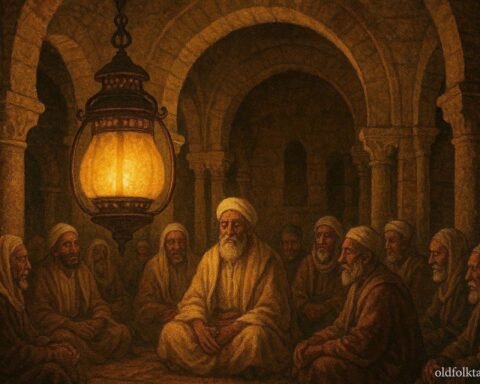
The elders gathered and revisited the ancient story. They remembered the warning attached to the spring.
The water had never been a reward.
It had been a responsibility.
Recognizing their mistake, the villagers renewed their commitment to sharing the resource fairly. Disputes were settled. Cooperation returned.
In time, the spring’s flow recovered.
The lesson was never forgotten again.
Amina lived to old age and became one of the village’s most respected elders. Although many asked whether the mysterious figure had truly been a spirit of the desert, she always gave the same answer.
“What matters is not who appeared,” she would say. “What matters is the choice we made afterward.”
Generations later, travelers crossing Chott el Jerid still hear stories about the Bride of the Salt Flats. Some say the mysterious figure continues to wander the desert, appearing during moments of great need.
Others believe the tale is a reminder that survival depends not only on resources but also on how people choose to share them.
Whatever the truth may be, the story endures across southern Tunisia.
For the people of the desert understand that nature’s gifts are precious, and that communities flourish when they place cooperation above selfishness.
Fascinated by this tale? Discover more North African folktales
Moral Lesson
Shared resources must be protected with fairness, responsibility, and cooperation if communities are to thrive.
Knowledge Check
1. Where is the story set?
The story is set near Chott el Jerid in southern Tunisia.
2. Who was Amina?
Amina was a young woman who sought a way to save her drought-stricken village.
3. What did the mysterious figure reveal?
The figure revealed the location of a hidden spring beneath the salt flats.
4. What condition was attached to the spring?
The water had to be shared fairly and never controlled by a single person or family.
5. What happened when villagers became selfish?
The spring’s flow began to decrease until the community restored fairness and cooperation.
6. What is the main lesson of the story?
Communities must protect shared resources through unity, responsibility, and fairness.
Source
Adapted from southern Tunisian desert folklore traditions preserved in Saharan folklore archives and North African oral heritage studies.