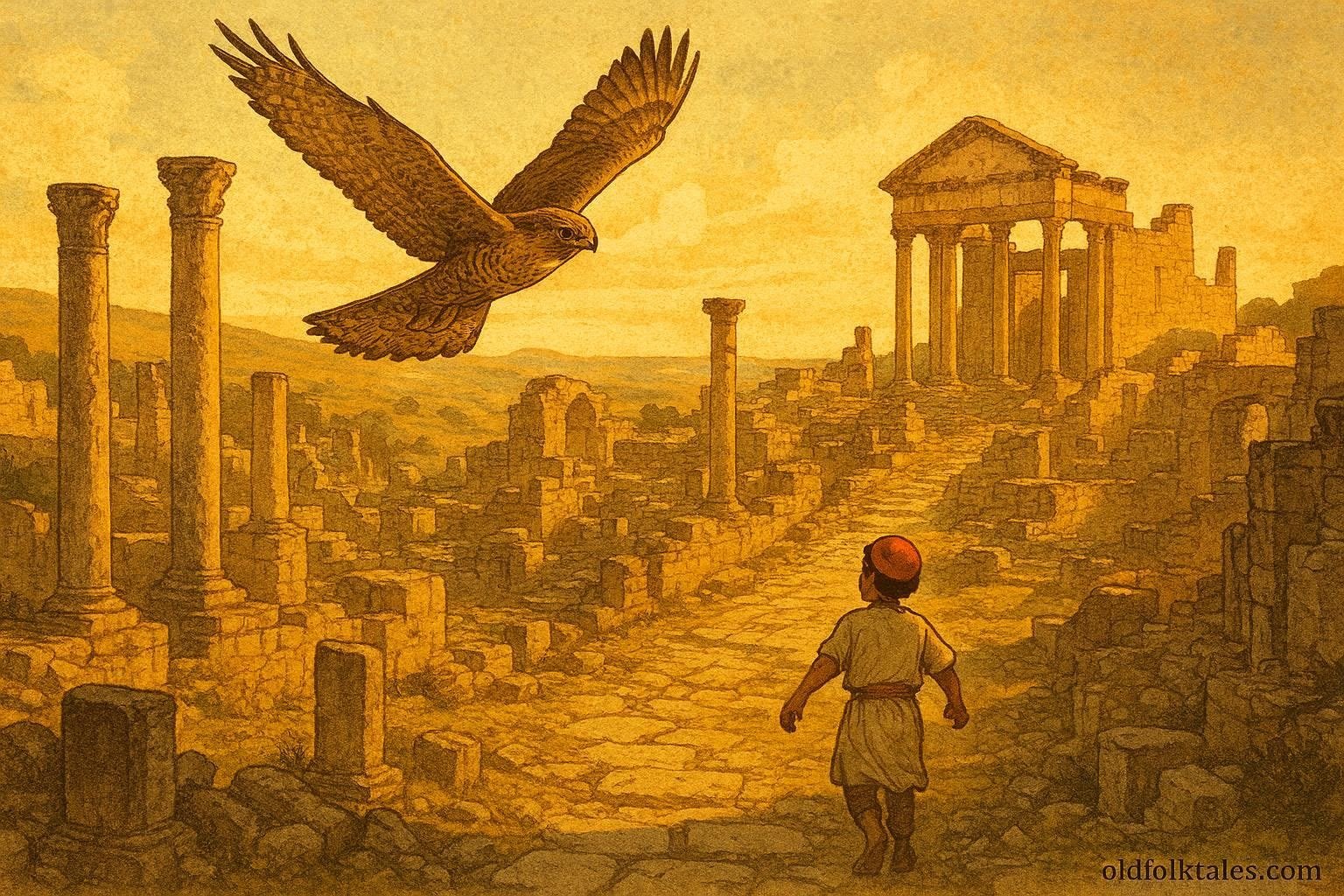
In the rolling hills of northern Tunisia stood the ancient ruins of Dougga, one of the most remarkable archaeological sites in the region. Long before the villages that now surrounded it existed, Dougga had been a thriving city filled with merchants, farmers, craftsmen, and scholars. Though centuries had passed and many of its buildings had fallen into silence, the stone columns, temples, and pathways remained as reminders of a distant age.
The villagers who lived nearby respected the ruins. Some visited them occasionally, while others preferred to keep their distance, believing the ancient city belonged to the ancestors and should not be disturbed unnecessarily. Children grew up hearing stories about hidden chambers, forgotten treasures, and secrets buried beneath the old stones.
Among these tales, one legend stood out above all others.
It spoke of a sacred falcon that watched over Dougga.
According to local tradition, the falcon appeared whenever an important piece of the past was in danger of being forgotten. Elders claimed that the bird served as a messenger between generations, guiding worthy individuals toward knowledge that needed to be remembered.
Most people regarded the story as a beautiful folktale.
Yet every so often, reports of an unusual falcon would emerge, keeping the legend alive.
If you enjoyed this story, explore our full West African folktales collection
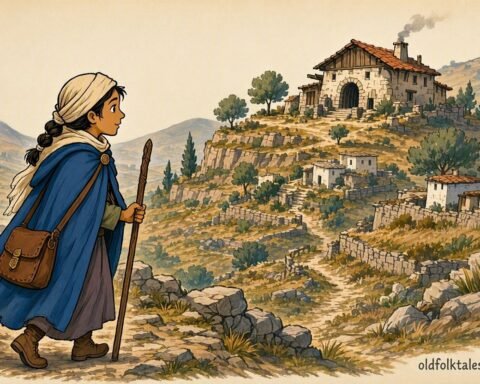
In a village near the ruins lived a young man named Nabil. He was curious, adventurous, and deeply fascinated by history. While many of his friends spent their free time elsewhere, Nabil often wandered among the ancient stones, imagining what life must have been like centuries earlier.
His grandfather encouraged this interest.
“The past is not dead,” the old man often told him. “It speaks through the things people leave behind.”
One spring morning, while exploring a section of the ruins rarely visited by tourists or villagers, Nabil noticed a large falcon perched atop a weathered stone column.
Its feathers shimmered in the sunlight.
Its eyes seemed unusually alert.
The bird stared directly at him.
For several moments, neither moved.
Then the falcon spread its wings and flew away.
Nabil thought little of the encounter until the following day, when he saw the same bird again.
This time it appeared near an ancient archway.
As soon as Nabil approached, the falcon flew to another part of the ruins and settled there.
The pattern continued for several days.
Whenever Nabil visited Dougga, the falcon appeared.
Each time, it seemed to guide him from one location to another.
At first, he assumed coincidence explained the encounters.
But eventually, curiosity overcame him.
One afternoon, he decided to follow the bird wherever it led.
The falcon flew across crumbling pathways and over fallen walls. It paused frequently, waiting until Nabil caught up before continuing onward.
The journey eventually brought him to a secluded area hidden behind dense vegetation.
Unlike the more familiar parts of the ruins, this section appeared largely untouched.
Ancient stones lay scattered across the ground.
Fragments of carvings emerged from beneath layers of earth.
Nabil had never explored this area before.
The falcon landed atop a large stone slab partially buried beneath soil and roots.
It remained there silently.
As Nabil approached, he noticed faint markings on the stone.
Carefully clearing away dirt, he revealed an inscription worn by centuries of weather.
Though he could not fully understand the text, he recognized symbols that suggested the slab marked something important.
Excited by the discovery, he returned to the village and shared what he had found.
Some villagers were interested.
Others dismissed the story.
“A bird led you to a stone?” one man laughed.
“Perhaps it wanted a better audience.”
Despite the teasing, Nabil’s grandfather listened carefully.
The next morning, he accompanied his grandson back to the site.
After examining the inscription, the old man agreed that the discovery seemed significant.
Together, they informed local historians and researchers familiar with Dougga’s history.
Within days, a small team arrived to investigate.
As work began, additional structures were uncovered beneath the earth.
The area proved to contain remnants of a forgotten section of the ancient city.
Among the discoveries were inscriptions, tools, and artifacts that revealed details about communities that had once lived there.
The findings generated excitement throughout the region.
Historians learned new information about the city’s past.
Villagers took pride in the role their community had played in preserving local heritage.
Yet the most remarkable discovery was still to come.
Hidden within a stone chamber beneath the site, researchers uncovered a collection of tablets and records.
Though fragile, the documents contained stories, agreements, and accounts written by ordinary citizens centuries earlier.
Unlike royal records or official histories, these writings described everyday life.
They spoke of farmers, craftsmen, teachers, and families.
For the first time, people gained a clearer understanding of the lives of those who had built and sustained the ancient city.
The discovery transformed how many villagers viewed their heritage.
History was no longer simply about rulers and monuments.
It was also about ordinary people whose experiences had shaped the community across generations.
Meanwhile, the mysterious falcon continued appearing from time to time.
Witnesses reported seeing it soaring above the ruins or resting atop ancient columns.
Whenever Nabil visited Dougga, he often looked for the bird.
Sometimes he found it.
Sometimes he did not.
One evening, as the sun began setting over the hills, he spotted the falcon once more.
It stood upon a high stone overlooking the excavation site.
For a long moment, bird and young man regarded one another.
Nabil felt a sense of gratitude.
Whether the falcon had truly guided him or whether chance had played a role no longer seemed important.
The result was the same.
A forgotten chapter of history had been rediscovered.
As years passed, Nabil became a respected advocate for preserving cultural heritage. He worked alongside historians and educators to ensure that future generations appreciated the value of the past.
Whenever young people asked him about the falcon, he smiled.
“Perhaps it was a sacred guardian,” he would say.
“Or perhaps it simply reminded me to pay attention.”
The legend of the Falcon of Dougga endured.
Some believed the bird still watched over the ancient city, waiting for moments when important stories risked being lost.
Others viewed it as a symbol of curiosity and discovery.
Yet all agreed on one thing.
The past contains treasures far greater than gold.
Knowledge, memory, and heritage are among the most valuable inheritances any community can receive.
And those who seek them with courage and respect often find more than they expected.
Explore the wisdom and wonder of North African folktales
Moral Lesson
Understanding and preserving history helps communities appreciate their identity and pass valuable knowledge to future generations.
Knowledge Check
1. Where is the story set?
The story is set among the ancient ruins of Dougga in Tunisia.
2. Who was Nabil?
Nabil was a curious young villager fascinated by history and ancient ruins.
3. What made the falcon unusual?
The falcon repeatedly appeared and seemed to guide Nabil to forgotten areas of the ruins.
4. What was discovered beneath the hidden site?
Researchers uncovered ancient structures, artifacts, and records describing everyday life in the old city.
5. Why was the discovery important?
It revealed forgotten parts of the community’s heritage and history.
6. What is the main lesson of the story?
History and cultural heritage should be preserved because they help people understand their identity.
Source
Adapted from Tunisian Arab folklore traditions inspired by archaeological legends preserved in Tunisian archaeological folklore archives and North African heritage studies.