In the Ubari Lakes region of the Libyan Sahara, where dunes rise like golden walls around hidden bodies of water, the Tuareg and Amazigh peoples have long spoken of places that are not only rare, but sacred.
Among these is Lake Gaberoun, a quiet stretch of water surrounded by silence, heat, and shifting sand.
Don’t stop yet! See our complete East African folktales collection
To outsiders, it appears like a refuge.
To those who know its stories, it is something more.
A place watched.
A place remembered.
A place that does not tolerate disrespect.
This is the story of travelers, a sacred lake, and a djinn that reveals itself not in form, but in light.
The Hidden Lake in the Desert
Far beyond the familiar trade routes, Lake Gaberoun rests among dunes that seem to guard it from careless discovery.
The water is calm.
Almost unnaturally still.
Palm trees stand quietly at its edges, offering shade to those who arrive weary from the desert.
To many travelers, it feels like a miracle.
But among the Tuareg, it is known that such places are not to be approached without respect.
Because what sustains life in the desert is never ordinary.
The Arrival of the Travelers
A group of travelers once came upon the lake after days of difficult journey.
Their water was nearly gone.
Their strength fading.
When they saw the lake, they rushed toward it with relief.
Some drank immediately.
Others entered the water without pause.
They laughed.
They celebrated their survival.
But in their urgency, they forgot something important.
They had not acknowledged the place.
They had not asked permission.
The First Sign of Change
As evening approached, something subtle began to shift.
The air grew heavier.
The light changed.
The surface of the lake, once still, reflected the sky in unusual ways.
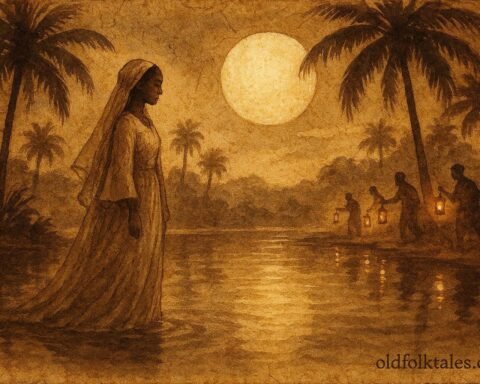
And in the distance, faint glimmers appeared among the dunes.
At first, the travelers dismissed it.
The desert plays tricks, they said.
But the lights did not disappear.
They moved.
Slowly.
Deliberately.
The Djinn Reveals Itself
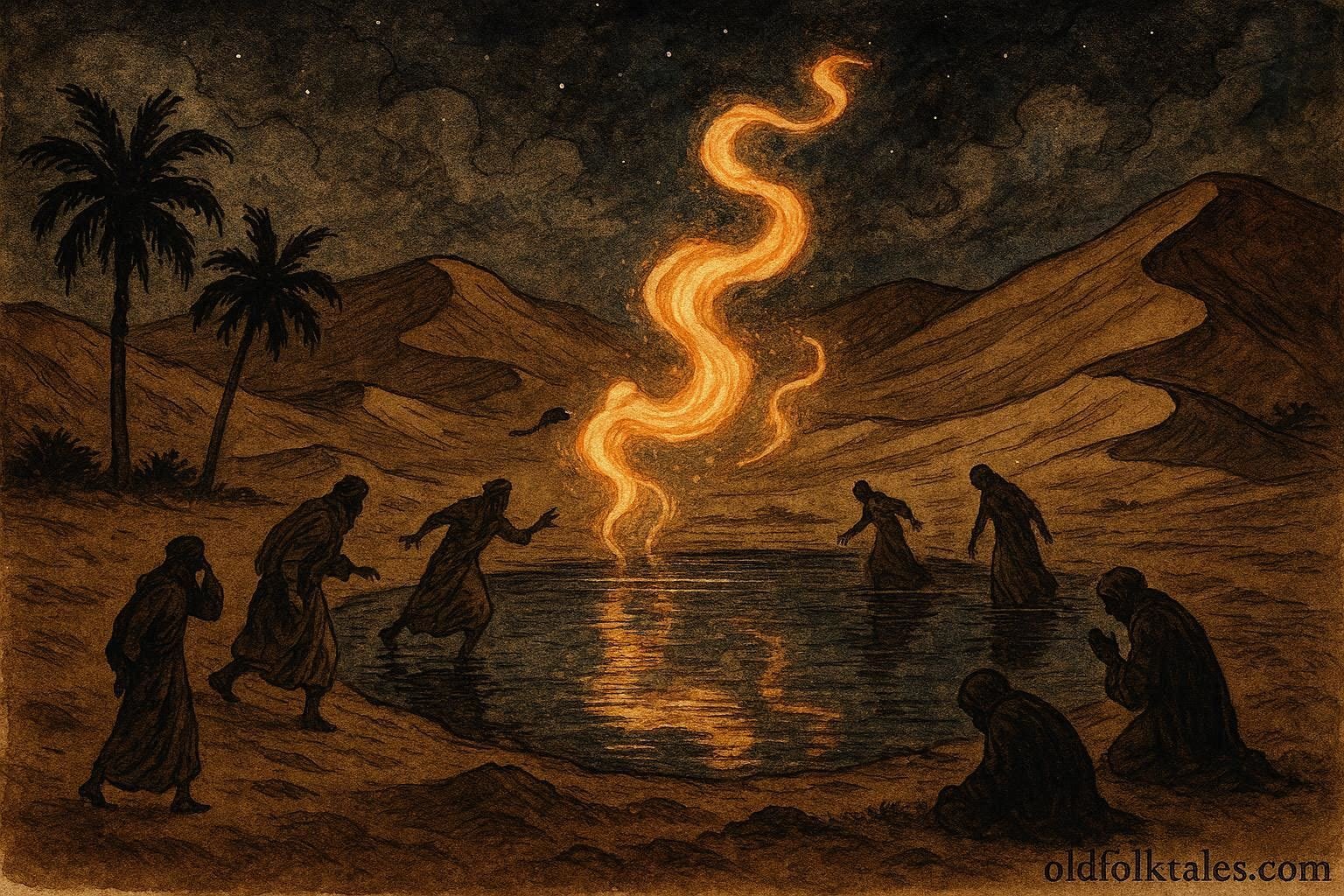
As night deepened, the lights became clearer.
They did not form a shape.
They did not speak.
But they moved with intention.
Circling.
Approaching.
Receding.
The travelers began to feel uneasy.
Some tried to follow the lights.
Others tried to ignore them.
But no matter where they turned, the lights remained present.
Watching.
Guiding, or misleading.
The Illusion of the Desert
Soon, confusion spread.
Paths that had been clear during the day became unfamiliar.
The dunes seemed to shift.
Landmarks disappeared.
Some travelers believed they were walking in the right direction, only to find themselves returning to the same place.
Others became separated from the group entirely.
The desert had become an illusion.
And within that illusion, the djinn moved unseen.
The Nature of the Test
Among the group, reactions differed.
Some became angry.
They blamed the desert.
They shouted in frustration.
Others grew fearful and silent.
But a few began to reflect.
They remembered the traditions they had once heard.
That sacred places in the desert are not empty.
That water is not simply taken.
It is respected.
And they began to understand what might have gone wrong.
The Act of Humility
Those who recognized their mistake did something simple.
They stopped moving.
They lowered their voices.
And they spoke, not to each other, but to the unseen presence around them.
They expressed respect.
They acknowledged their intrusion.
And they asked for forgiveness.
Not as a demand.
But as an offering of humility.
The Changing of the Light
As they spoke, the lights began to change.
Their movement slowed.
Their intensity softened.
And gradually, the confusion around them began to clear.
The dunes no longer shifted unpredictably.
The air felt lighter.
And a path, faint but steady, appeared before them.
The djinn had not disappeared.
It had responded.
Those Who Could Not Leave
Not all travelers chose this path.
Some refused to believe.
They continued to wander, trying to force direction through determination alone.
But the illusion remained strong around them.
And the more they resisted, the deeper they became lost within it.
Because the desert does not respond to force.
Only to understanding.
The Safe Return
Those who had shown humility followed the faint path away from the lake.
Step by step, the landscape returned to clarity.
The lights faded into the distance.
And by morning, they found themselves beyond the shifting dunes, back on a stable route.
They did not celebrate loudly this time.
They carried something different with them.
Awareness.
Respect.
And the memory of what they had encountered.
The Story That Remains
From that time on, the story of Lake Gaberoun was told with greater care.
Travelers were warned not to approach sacred waters carelessly.
Not to take without acknowledgment.
Not to assume that silence means emptiness.
Because in the Sahara, presence is often unseen.
And what appears as illusion may be a test.
Explore the wisdom and wonder of North African folktales
Moral Lesson
Sacred places demand respect, not entitlement. Humility and awareness allow safe passage, while arrogance and disregard lead to confusion and loss.
Knowledge Check
- What is “The Djinn of Lake Gaberoun” about?
It is a Saharan folktale about travelers who encounter a djinn after disrespecting a sacred desert lake. - Where does the story originate?
From the Ubari Lakes region in the Libyan Sahara, within Tuareg and Amazigh oral traditions. - How does the djinn appear?
As shifting lights moving through the dunes and around the travelers. - Why did the travelers become lost?
They disturbed the sacred lake without showing respect or humility. - How did some travelers escape?
By acknowledging their mistake and showing humility toward the unseen spirit. - What lesson does this African folktale teach?
It teaches that respect for sacred places and humility before nature are essential for survival.
Source: African folktale, Libya.
Adapted from Tuareg and Amazigh oral traditions of the Ubari Lakes region, documented in late 20th-century Saharan folklore compilations and ethnographic surveys (1980s–1990s).
Cultural Origin: Libyan Sahara (Ubari Lakes region, Tuareg and Amazigh traditions)