Among the quiet villages of Mauritius lived a gentle man known to everyone as Bonhomme Francœur. He owned little, wore simple clothes, and worked hard each day to earn enough for his family. Although he was not wealthy, people admired him because he treated every person with respect, whether rich or poor.
Children greeted him with smiles whenever they saw him walking through the village paths. Elderly neighbours knew they could depend on him whenever they needed help carrying firewood, repairing a fence, or gathering food from the fields. Bonhomme Francœur never expected payment for his kindness. Helping others simply brought him joy.
Many people wondered why someone with so little always found reasons to share.
His answer never changed.
“A generous heart never becomes poor.”
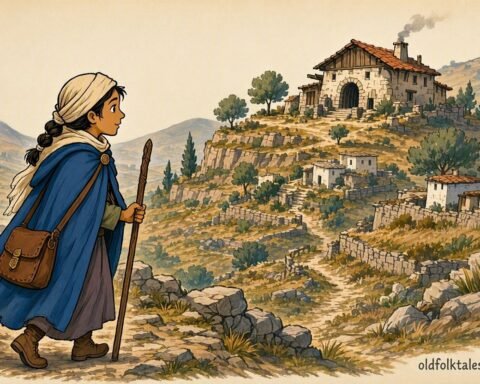
One morning, Bonhomme Francœur set out before sunrise to visit a neighbouring village where he hoped to sell a few goods. The journey required him to pass through thick woodland where travellers rarely met another soul.
If you liked this story, see our Central African folktales collection
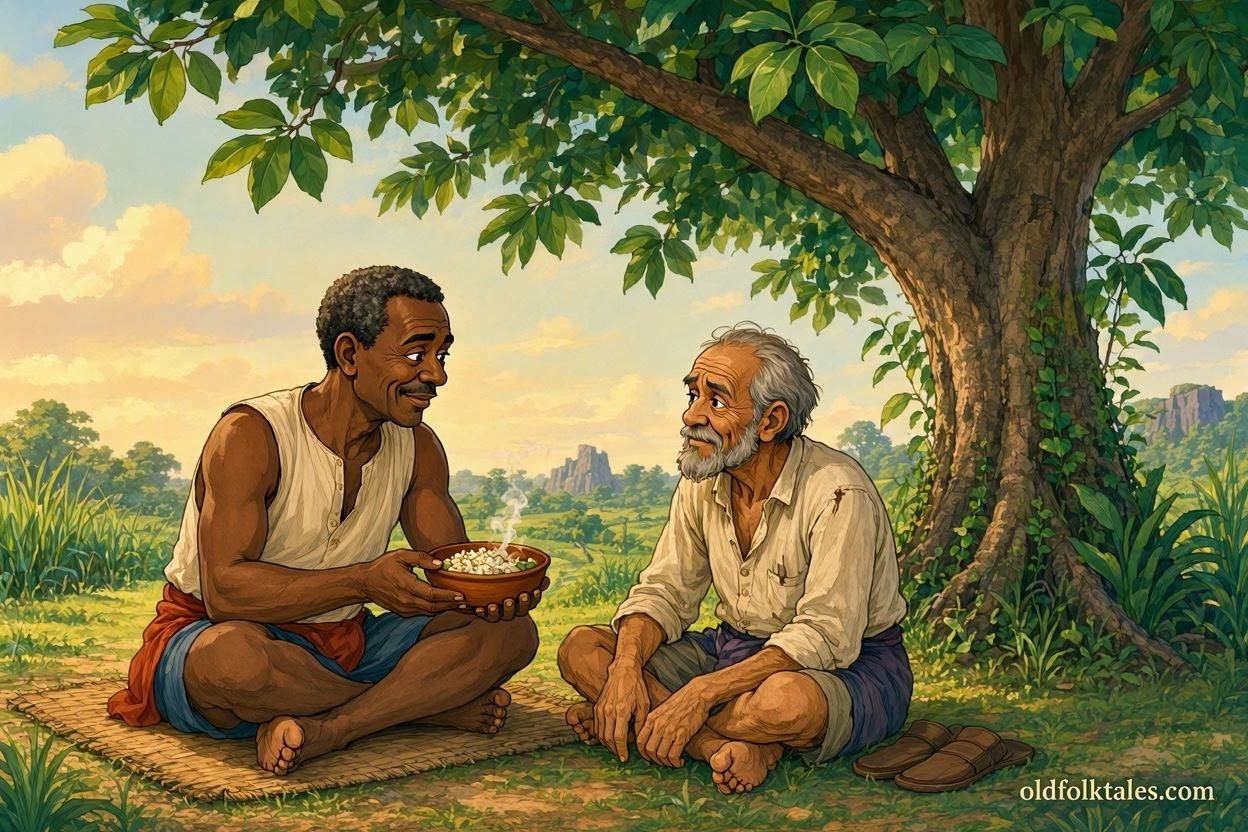
As he walked, he noticed an old stranger sitting beneath a large tree. The man’s clothes were worn, and he appeared exhausted from hunger and thirst.
Without hesitation, Bonhomme Francœur opened the small bundle he carried.
Inside was the modest meal his wife had prepared for the long journey.
He divided the food into two equal portions and offered one to the stranger.
The old man looked at him with surprise.
“You hardly have enough for yourself,” he said.
Bonhomme Francœur smiled.
“Food tastes better when it is shared.”
The stranger accepted the meal with gratitude.
After they finished eating, Bonhomme Francœur also shared his drinking water before preparing to continue his journey.
The old man thanked him warmly and disappeared along another forest path.
Bonhomme Francœur thought little of the meeting.
He simply continued toward the marketplace, believing he had done nothing extraordinary.
When he finally arrived, however, he discovered that misfortune had already reached the village.
The market had closed unexpectedly.
Merchants had packed away their goods.
There was no opportunity to sell anything.
Disappointed but unwilling to complain, Bonhomme Francœur began the long walk home.
As evening approached, dark clouds gathered above the forest.
Heavy rain soon flooded the narrow paths.
Finding shelter became impossible.
Just as he wondered where he might spend the night, he noticed a small cottage standing alone among the trees.
He knocked politely.
An elderly woman opened the door.
Although she possessed little herself, she welcomed the weary traveller inside.
Bonhomme Francœur thanked her sincerely and accepted only the smallest meal she could spare.
Throughout the evening, he helped gather firewood, repaired a broken chair, and cleaned the cottage before resting for the night.
The old woman watched quietly.
She had rarely met someone who worked so willingly without expecting a reward.
The following morning, as Bonhomme Francœur prepared to leave, the woman handed him a small bundle.
“I have little to give,” she said, “but please accept this gift.”
He thanked her but hesitated.
“I cannot take what you may need.”
The woman smiled.
“It was meant for someone with a generous heart.”
Bonhomme Francœur accepted the bundle with gratitude and continued his journey.
When he finally reached home, his family eagerly gathered around him.
Inside the bundle they discovered valuable treasures far beyond anything Bonhomme Francœur had ever imagined owning.
His wife looked at him with astonishment.
“How did this happen?”
He quietly told them about the hungry stranger and the lonely old woman.
He insisted that the treasure had not come because he sought wealth.
It had come because kindness often returns when least expected.
News of his good fortune soon spread throughout the village.
Some neighbours celebrated with him.
Others became jealous.
One greedy man decided he would imitate Bonhomme Francœur, hoping to receive an even greater reward.
He searched for travellers to help, but every act of generosity was performed only because he expected riches in return.
Whenever he offered food, he complained about the cost.
Whenever he helped someone, he demanded gratitude.
Eventually he encountered strangers who saw through his selfish intentions.
Instead of receiving treasure, he returned home empty handed, frustrated that his plan had failed.
The villagers soon understood the difference between the two men.
Bonhomme Francœur had given because kindness came naturally to him.
The greedy neighbour had given only because he desired reward.
One acted from love.
The other acted from selfishness.
Years passed, and Bonhomme Francœur continued living as humbly as before.
His new wealth never changed his character.
He repaired homes for widows.
He helped children attend school.
He shared food with hungry families during difficult seasons.
Whenever people praised him for his generosity, he gently reminded them that true riches are measured not by what a person owns but by the kindness they leave behind.
His story became one of the best loved legends in Mauritius, reminding every generation that honest hearts often receive blessings beyond anything money alone can buy.
Looking for more? Explore the magic of East African folktales here
Moral Lesson
True kindness expects nothing in return. Bonhomme Francœur’s generosity, honesty, and humility brought him unexpected blessings because he helped others out of compassion rather than personal gain. The story reminds us that good deeds performed with a sincere heart are often rewarded in ways we never imagine.
Knowledge Check
1. Why was Bonhomme Francœur respected in his village?
Answer: He was respected because he was kind, honest, humble, and always willing to help others.
2. What did Bonhomme Francœur share with the hungry stranger?
Answer: He shared his food and drinking water.
3. Why did the elderly woman give Bonhomme Francœur a bundle?
Answer: She rewarded his kindness, hard work, and generous spirit.
4. Why did the greedy neighbour fail to receive the same reward?
Answer: He helped others only because he expected to become rich, not because he genuinely cared.
5. How did Bonhomme Francœur use his newfound wealth?
Answer: He continued helping others by supporting poor families, widows, and children while remaining humble.
6. What is the main lesson of this Mauritian folktale?
Answer: Genuine kindness, honesty, and generosity are rewarded, while selfishness and greed lead to disappointment.
Source
Adapted from: Histoire de Bonhomme Francœur, in Le Folk-lore de l’Île Maurice by Charles Baissac (1888).