The road to trade was long and often uncertain, stretching across lands where trust could not always be guaranteed.
A merchant once traveled these roads, known among his people for his business dealings and steady manner. He bought and sold goods, moving from place to place, building his livelihood through exchange.
Those who knew him believed him to be reliable, but no one had yet seen what he would do when honesty was truly tested.
One season, the merchant set out on a journey that would take him far from home.
He carried with him goods of value, carefully packed and guarded. His intention was simple: to trade well and return with profit.
Don’t miss out: Read more Southern African folktales
The journey required patience, and he moved steadily, stopping only when necessary.
Along the way, he came upon a place where travelers often rested.
It was neither a village nor an empty land, but a point where paths crossed and strangers met. There, he decided to pause and gather his strength before continuing.
As he settled, he noticed something lying not far from where he stood.
It was a bundle, wrapped carefully and left unattended. No one nearby claimed it, and no voice called out for its return.
The merchant approached it slowly.
He looked around, expecting someone to step forward and say it belonged to them. But no one did.
The place remained quiet, as though the bundle had been forgotten.
Curiosity led him to examine it more closely.
Without opening it, he could tell that it was not empty. Its weight suggested that it held something of value.
He paused.
This was a moment that required a decision.
He could leave it where it was, untouched and unknown.
He could take it, believing that no one would notice its absence.
Or he could wait, hoping that its owner would return.
The merchant stood in silence, considering each choice.
There was no one watching him. No one to question his actions. Whatever he chose to do would be known only to him.
After some thought, he decided to take the bundle with him.
He reasoned that if its owner returned, he would have no way of finding it again. But if he carried it, there might still be a chance to return it later.
With that decision, he continued his journey.
The bundle remained with him, its presence a quiet reminder of the choice he had made.
As he traveled, he thought often about what it might contain.
At times, he felt tempted to open it and see for himself. The weight of it suggested value, and the thought of what might be inside grew stronger with each passing day.
But he did not open it.
He told himself that what did not belong to him should not be claimed by him.
Eventually, he reached another resting place, where travelers gathered and shared news.
It was there that he heard something that caught his attention.
A man was speaking with urgency.
He described a bundle he had lost, explaining where he believed he had left it and what it contained.
The merchant listened carefully.
The description matched exactly what he carried.
For a moment, he said nothing.
The choice before him returned, now clearer than before.
He could remain silent and keep the bundle.
No one knew he had it. No one could prove otherwise.
Or he could step forward and return it, giving up whatever value it held.
The decision weighed heavily on him.
He thought of the journey he had made, the effort he had given, and the opportunity now in his hands.
Then he thought of something else.
He thought of the kind of person he wished to be.
Without delay, he stepped forward.
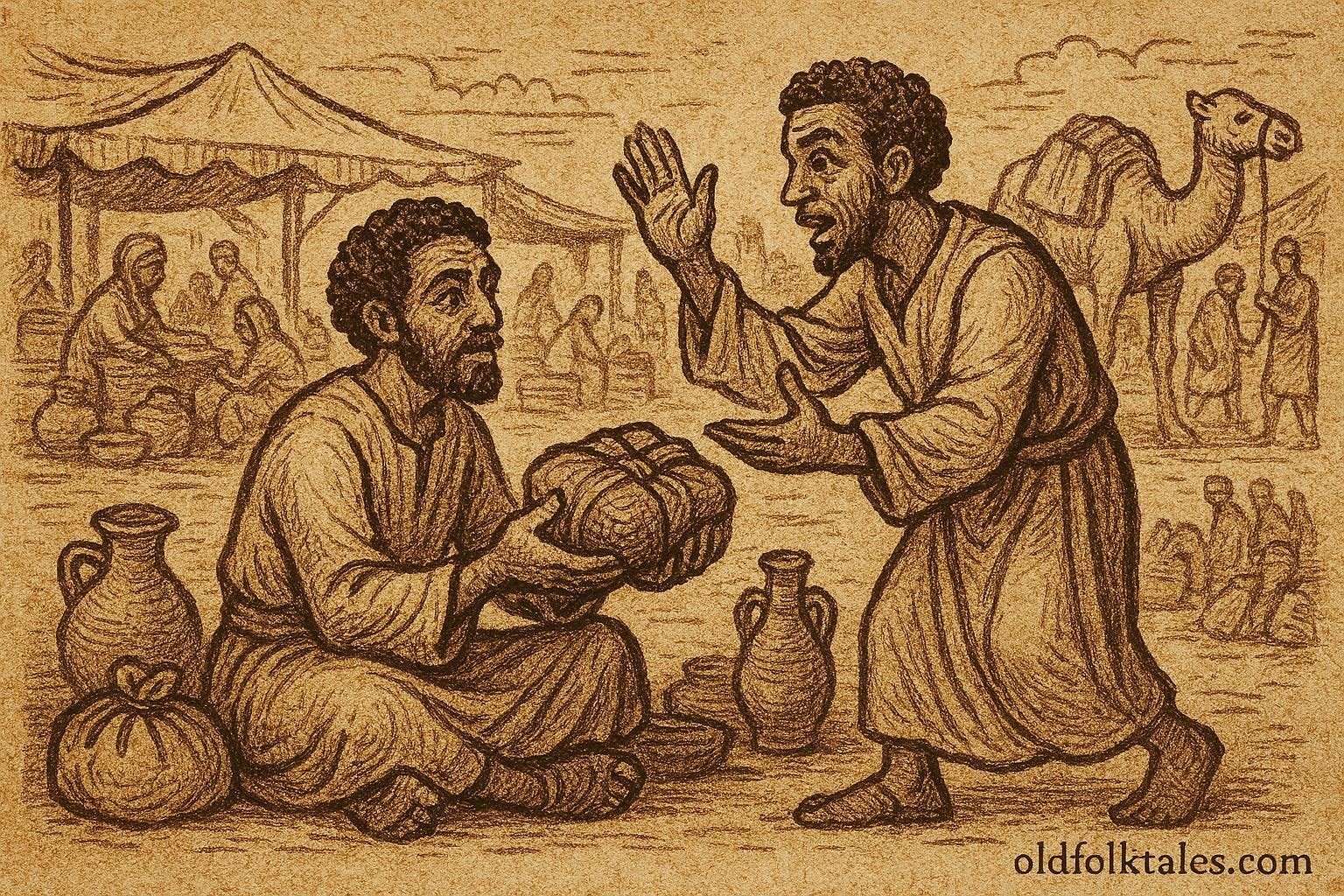
He spoke calmly, explaining that he had found the bundle and had carried it in the hope of returning it to its owner.
The man who had lost it listened with relief.
He examined the bundle and confirmed that it was indeed his.
Gratitude filled his voice as he thanked the merchant.
The loss he had feared was now undone.
Those who witnessed the moment spoke among themselves.
They recognized what had taken place, understanding that the merchant had faced a choice and had chosen honesty.
The owner of the bundle offered a reward.
But the merchant did not accept it.
He explained that returning what was not his was not something that required payment. It was simply what was right.
His words carried weight.
They revealed not only his action, but the principle behind it.
The story of the merchant spread among the people.
It was told not because of the bundle itself, but because of the decision that had been made.
People spoke of the moment when no one was watching, when the choice could have gone either way.
They spoke of the restraint he had shown, and the integrity that guided him.
When the merchant returned home, he was received with respect.
Not because of the goods he carried, but because of the character he had demonstrated.
His journey had brought him more than profit.
It had revealed who he truly was.
Continue your journey: Read more East African folktales
Moral Lesson
True honesty is shown when no one is watching, and integrity is measured by the choices we make in silence.
Knowledge Check
- What did the merchant find during his journey?
A bundle that appeared to contain something valuable. - What choices did he face?
To keep the bundle, ignore it, or return it to its owner. - Why did he keep the bundle at first?
He hoped to return it if he found the owner. - What happened when he found the owner?
He returned the bundle honestly. - Did he accept a reward?
No, he refused it because he believed honesty should not be rewarded. - What is the main lesson of the story?
Integrity is shown through honest actions, even when no one is watching.
Source
Eritrean folktale. Collected by Enno Littmann in Publications of the Princeton Expedition to Abyssinia (1910).