The fertile plains of Njaiyen were known throughout Wolof country for their rich soil and abundant harvests. Every rainy season, farmers worked side by side, preparing their fields before the first heavy clouds gathered above the horizon. They believed the land rewarded not only hard work but also wisdom, patience, and cooperation.
Among them lived a farmer named Bocar.
No one questioned his strength. He could clear a field faster than most men and work from sunrise until the stars filled the sky. Yet Bocar possessed one weakness greater than any drought.
He refused advice.
Whenever elders offered guidance, he smiled politely but ignored every word.
Whenever neighbors suggested better methods, he insisted his own way was always best.
“I have my father’s hands,” he often declared.
“They have never failed me.”
The village elder would quietly reply,
“Strong hands accomplish little without an open mind.”
But Bocar never listened.
One year, the first rains arrived earlier than expected.
Experienced farmers hurried to prepare drainage channels so excess water could flow safely through their fields.
Old Mama Kumba, whose family had farmed the land for generations, approached Bocar.
“The rain will be heavier this year,” she warned.
“You should dig deeper channels.”
Bocar laughed.
“My field has stood here longer than I have lived.”
“It knows how to care for itself.”
Mama Kumba sighed and walked away.
Days later, another elder noticed that Bocar had planted all his millet in one low area where water naturally collected.
“You should spread your crops across higher ground as well,” the elder advised.
“If flooding comes, you will still have something to harvest.”
Don’t stop yet! See our complete East African folktales collection
Bocar shook his head.
“Why should I divide my strength?”
“My way is faster.”
Again, the advice was ignored.
As the weeks passed, dark clouds gathered more often than anyone remembered.
Rain fell day after day.
Streams overflowed.
The carefully prepared fields of most farmers carried the extra water safely away.
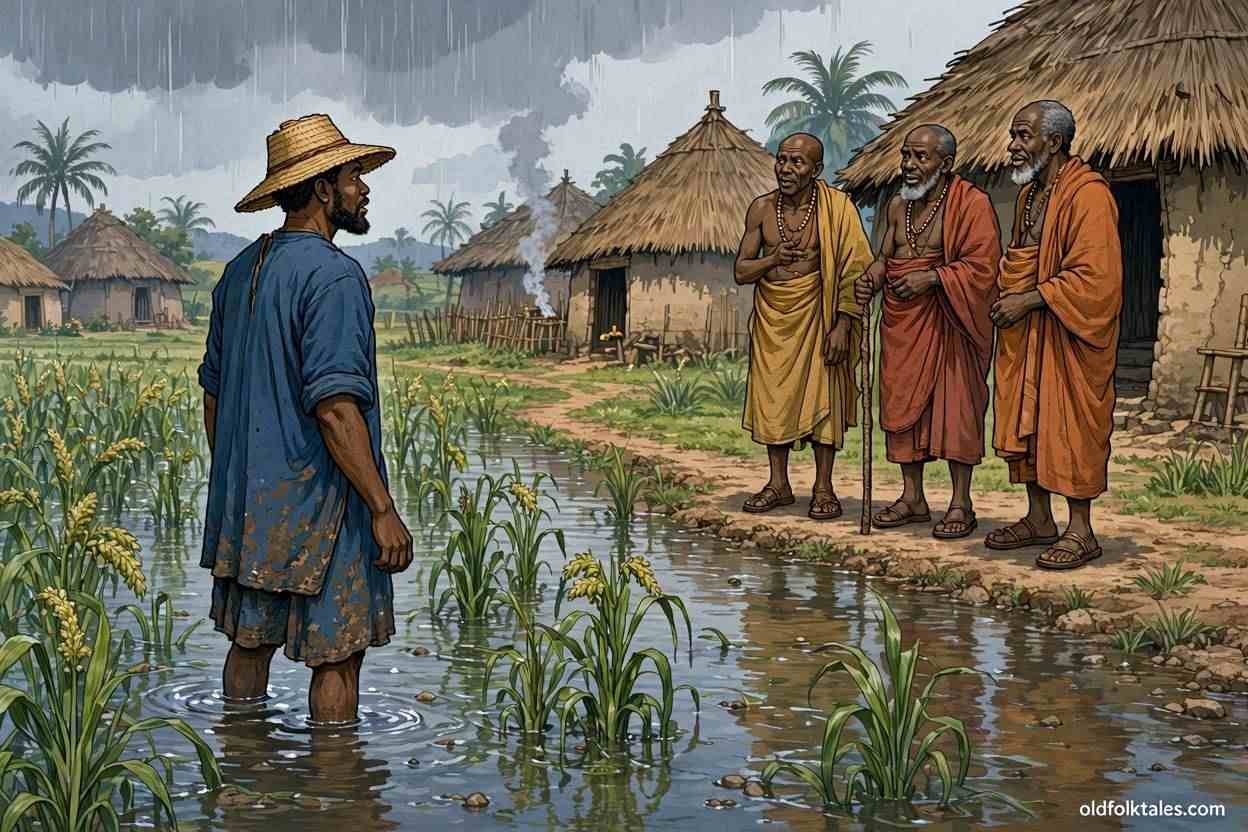
But Bocar’s field became a shallow lake.
His young millet disappeared beneath muddy water.
When the rains finally stopped, nearly every stalk had died.
For the first time in many years, Bocar stood silently in his ruined field.
His wife, Aissatou, placed a gentle hand on his shoulder.
“We still have time.”
“For what?”
“To ask for help.”
Pride answered before wisdom could.
“I will manage alone.”
The following weeks became even harder.
Bocar tried replanting by himself.
The work that usually took a few days stretched into many exhausting weeks.
His remaining seeds were too few.
His strength alone could not overcome the lost time.
One afternoon he collapsed beneath the hot sun.
As he rested beneath a small acacia tree, he noticed something he had never paid attention to before.
A line of tiny ants carried grains many times larger than themselves.
None worked alone.
Each ant helped another whenever the load became too heavy.
Together they accomplished what no single ant could have done.
Bocar watched them for a long time.
That evening he visited the village elder.
Without speaking, he lowered his head.
The elder smiled kindly.
“It is difficult to carry pride and wisdom at the same time.”
Bocar nodded.
“I have carried the wrong one.”
The next morning, something unusual happened.
Bocar walked from house to house asking forgiveness from those whose advice he had ignored.
He visited Mama Kumba first.
“I should have listened.”
The elderly woman smiled warmly.
“The land teaches every farmer.”
“Some simply need a longer lesson.”
Word spread quickly through Njaiyen.
Before sunrise the following day, dozens of villagers gathered in Bocar’s field.
Some brought hoes.
Others carried seeds.
Children fetched water.
Women prepared food for everyone working together.
No one spoke of Bocar’s earlier pride.
Instead, they worked as one family.
The damaged field was repaired.
New drainage channels were dug.
Seeds were planted across both high and low ground.
Trees were added to reduce erosion.
The work that would have taken Bocar many weeks alone was finished before sunset.
Months later, another season of heavy rain arrived.
This time the channels carried the water safely away.
The higher fields remained healthy.
When harvest came, Bocar’s granary was not the largest in the village.
But it was full enough to feed his family.
During the harvest celebration, the chief invited Bocar to speak.
The farmer looked across the crowd.
“I once believed asking for help was a sign of weakness.”
He paused.
“I now know refusing wisdom is the greater weakness.”
The villagers applauded.
Mama Kumba laughed softly.
“And who taught you that?”
Bocar smiled.
“The rain.”
“And the ants.”
From that day onward, young farmers often sought Bocar’s advice.
Whenever they did, he never answered immediately.
Instead, he asked,
“What have the elders already told you?”
If they admitted ignoring good counsel, he would simply smile.
“Go back.”
“Listen first.”
“Then return if you still have questions.”
Years later, long after Bocar had become one of the respected elders himself, children still heard the story of the stubborn farmer who nearly lost everything because he trusted only himself.
Parents reminded their sons and daughters that strength, determination, and hard work were precious gifts.
But they also taught that wisdom grows best in hearts willing to listen.
For in Njaiyen, people never forgot the harvest that transformed one proud farmer into one of the village’s wisest men.
Click here to discover more legendary tales from West Africa
Moral Lesson
Hard work alone does not guarantee success. True wisdom comes from humility, listening to good counsel, and working together for the common good.
Knowledge Check
1. Why did Bocar’s harvest fail?
Because he ignored wise advice and relied only on his own judgment.
2. What lesson did the ants teach Bocar?
That cooperation makes difficult tasks possible and strengthens everyone involved.
3. What values does this Wolof folktale promote?
Humility, perseverance, cooperation, wisdom, and respect for elders.
4. Why did the villagers help Bocar after his mistake?
Because their community valued forgiveness, unity, and helping one another grow.
5. Is The Obstinate Farmer of Njaiyen based on a traditional Gambian folktale?
Yes. It is an original adaptation inspired by a documented Wolof folktale preserved in a published Gambian folklore collection.
6. What is the central message of the story?
Success belongs not only to those who work hard but also to those who remain humble enough to learn from others.
Source
Adapted from: Folk Tales and Fables from The Gambia, Volume 1 by Dembo Fanta Bojang and Sukai Mbye Bojang. This is an original retelling inspired by the documented traditional Wolof folktale.