In a small village tucked within the windswept lands of Tripolitania, where the desert pressed close against mud-brick homes and the nights could turn bitter without warning, people lived by a quiet understanding: survival depended not only on strength, but on one another.
In that village lived an old woman.
Looking for more? Explore the magic of East African folktales here
She had no wealth to her name, no herds, no storehouses, no fine fabrics folded away in carved chests. Her home was simple, her meals modest, and her days long. Yet she carried herself with a quiet dignity that neither hardship nor age had taken from her.
Those who paid attention knew this: though she was poor in possessions, she was rich in patience.
The Night the Cold Came
One evening, as the sun sank beneath the horizon and the desert exhaled its cold breath, the temperature dropped sharply. Winds slipped through cracks in walls and under doorways, carrying with them a chill that bit deep into bone.
Inside her small home, the old woman reached for her fire.
But there was none.
Her coals had died.
She searched carefully, stirring the ashes, hoping to find even the smallest glow hidden beneath. Nothing answered her effort. The darkness deepened, and with it, the cold.
Fire was not a luxury, it was life. Without it, the night would stretch long and merciless.
So she wrapped her shawl tightly around her shoulders and stepped outside.
The village was quiet, but not asleep. Faint flickers of firelight danced behind some doors, a reminder that others had warmth she did not.
She knew where she must go.
The Wealthy Neighbor
At the edge of the village stood a larger house, stronger walls, a higher doorway, and a courtyard that spoke of abundance. This was the home of a wealthy neighbor, a man known as much for his possessions as for his reluctance to share them.
Still, need has a way of humbling even the proudest spirit.
The old woman approached and knocked gently.
After a moment, the door opened.
The man stood there, his expression guarded.
“What do you want?” he asked.
“I have come to borrow fire,” the old woman said simply. “My coals have gone out, and the night is cold.”
The man studied her for a long moment. He had fire, more than enough. Inside his home, flames burned steadily, casting a golden glow.
But generosity did not come easily to him.
“I will give you fire,” he said slowly, “but only if you agree to return it.”
The old woman nodded.
“I will return it,” she said.
His eyes narrowed slightly.
“Not just return it,” he added. “You must return it exactly as you received it.”
It was an impossible demand.
Fire, once given, cannot be reclaimed in the same form. It changes, it spreads, it consumes. No one could return the same flame.
The old woman understood this. She saw the trap hidden within his words.
But she did not argue.
“I accept,” she said calmly.
The man smirked, satisfied with his cleverness. He took a burning piece of wood from his hearth and handed it to her.
“Do not forget,” he said. “Exactly as you received it.”
“I will not forget,” she replied.
The Long Night
The old woman returned to her home, shielding the flame from the wind. Inside, she placed the burning wood carefully among her cold coals.
Slowly, patiently, she breathed life back into her fire.
Warmth returned. Light filled the small room. The night, though still cold beyond her walls, no longer held power over her.
She sat beside the fire, her hands extended toward its warmth, her mind quiet.
She did not rush. She did not worry.
Instead, she waited.
The Morning After
At dawn, the village stirred to life. The cold of the night began to loosen its grip as the sun climbed into the sky.
The old woman rose, steady and composed.
She prepared herself, then stepped outside once more, not toward the well, nor toward the market, but toward the home of the wealthy neighbor.
But this time, she did not go alone.
As she walked, she spoke to those she passed.
“Come,” she said. “There is something that must be witnessed.”
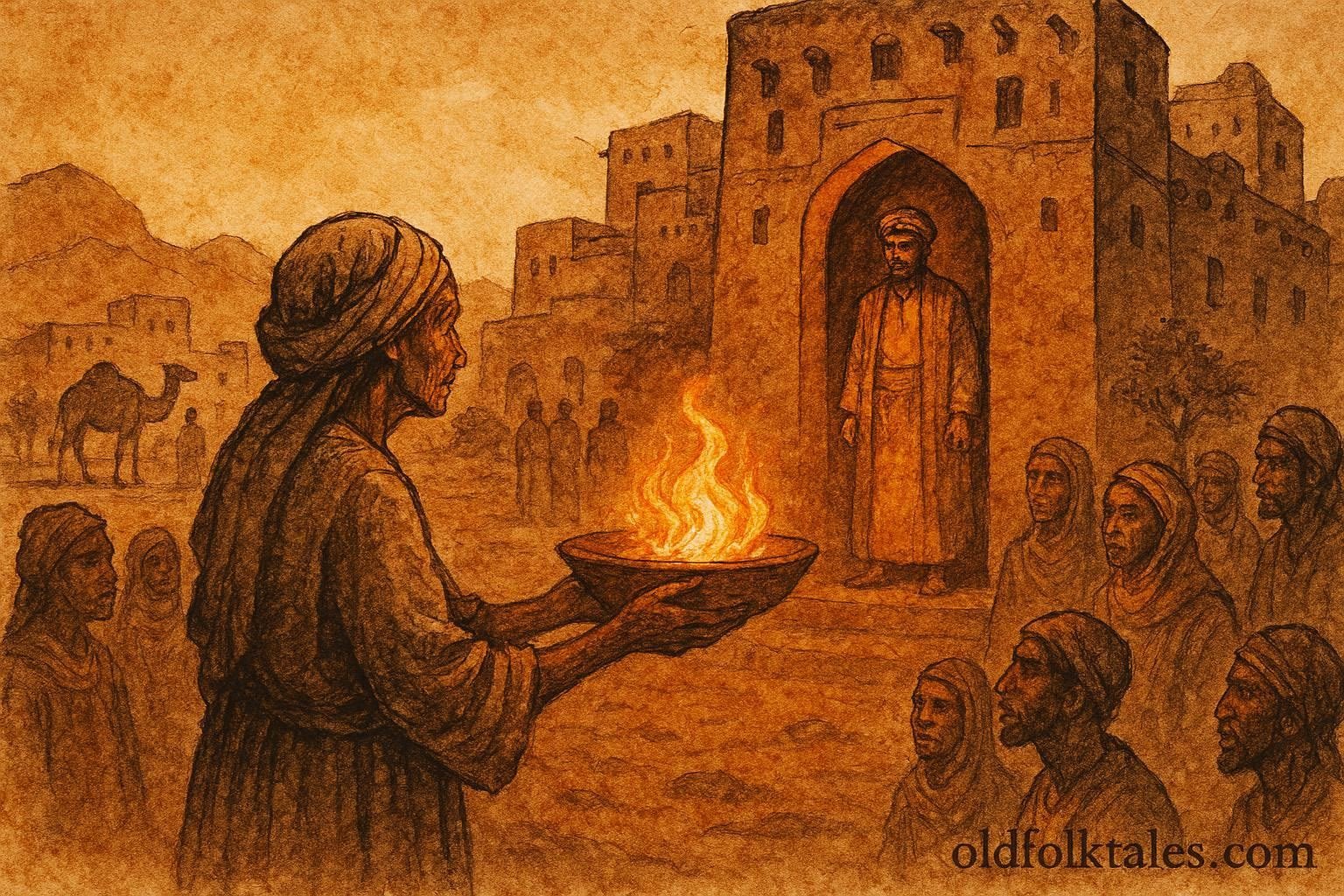
Curiosity travels quickly in a village. One by one, people followed, neighbors, traders, children, elders. By the time she reached the man’s home, a small crowd had gathered behind her.
She knocked.
The door opened.
The man looked surprised to see her, and even more surprised to see the villagers gathered.
“I have come to return what I borrowed,” the old woman said.
The man straightened, a hint of triumph in his posture.
“Good,” he said. “Then return it exactly as you received it.”
“I will,” she replied.
The Return of the Fire
The old woman turned to the crowd.
“You have all heard his condition,” she said clearly. “That I must return the fire exactly as I received it.”
Murmurs spread through the villagers.
She then faced the man again.
“When I came to you last night,” she continued, “I received a burning piece of wood from your fire.”
She paused, letting her words settle.
“Fire does not remain as it is,” she said. “It changes. It warms. It becomes something new. So, to return it exactly as I received it, I must return it in the same state.”
The man frowned, uncertainty flickering across his face.
“What are you saying?” he asked.
Without raising her voice, the old woman answered:
“I must return it as a burning piece of wood.”
A ripple moved through the crowd.
Before the man could respond, she gestured calmly toward his home.
“Bring your hearth,” she said. “Let us take from it a burning piece, and I will place it back as it was given to me.”
The meaning of her words settled heavily in the air.
To return the fire “exactly,” she would need to take again from his hearth, to remove another burning piece of wood.
The same act. The same loss.
The same giving.
The man’s expression shifted. What he had intended as a trap now stood revealed as something else entirely.
If he insisted on his condition, he would lose again.
If he refused, his greed would be plain for all to see.
The villagers watched closely.
Some began to whisper.
“She speaks truth.”
“He asked for the impossible.”
“This is not fairness.”
The man felt their eyes on him, the weight of their judgment pressing down.
The Exposure of Greed
For a long moment, he said nothing.
Then, slowly, his shoulders lowered.
“There is no need,” he muttered.
But the old woman did not move.
“You asked for it to be returned exactly,” she reminded him.
The crowd murmured again, louder this time.
He looked from one face to another, seeing not admiration, but disapproval.
The truth had become visible, not through force, not through anger, but through simple, patient reasoning.
At last, he raised his hand.
“Keep it,” he said, his voice tight. “There is no debt.”
The old woman inclined her head slightly.
“I thank you,” she said.
But she did not leave immediately.
Instead, she turned once more to the villagers.
“Fire warms all,” she said. “It does not choose between rich and poor. And neither should we.”
Her words settled into the hearts of those who heard them.
Aftermath in the Village
From that day forward, something shifted.
The wealthy neighbor, though still rich, was no longer admired in the same way. His actions had been seen, weighed, and understood.
And the old woman, though still poor, was regarded with new respect.
Not because she had wealth.
But because she had wisdom.
She had taken an impossible demand and answered it not with anger, but with clarity.
Not with defiance, but with truth.
Moral Lesson
True justice does not always come through power, it often comes through patience, wisdom, and the courage to reveal truth. Generosity strengthens a community, while greed isolates those who cling to it.
Knowledge Check
- What is the main lesson of “The Old Woman and the Borrowed Fire”?
The story teaches that wisdom and patience can expose greed and restore fairness within a community. - Why was the wealthy neighbor’s condition impossible?
He demanded the fire be returned exactly as given, but fire constantly changes and cannot be returned in the same form. - How did the old woman outsmart the wealthy neighbor?
She used logic and public accountability to show that returning the fire “exactly” required taking another burning piece from his hearth. - What does the fire symbolize in the folktale?
Fire represents life, shared resources, and the responsibility of generosity within a community. - What role does the village play in the story?
The village acts as a moral witness, reinforcing communal values and holding individuals accountable. - What cultural values are reflected in this Libyan folktale?
The story emphasizes fairness, communal responsibility, respect for the vulnerable, and the use of wisdom to achieve justice.
Source: African folktale, Libya. Collected in North African folktale anthologies and oral narrative archives (1970s–1980s folklore documentation).
Cultural Origin: Tripolitania region, northwestern Libya (Arab village oral traditions)